

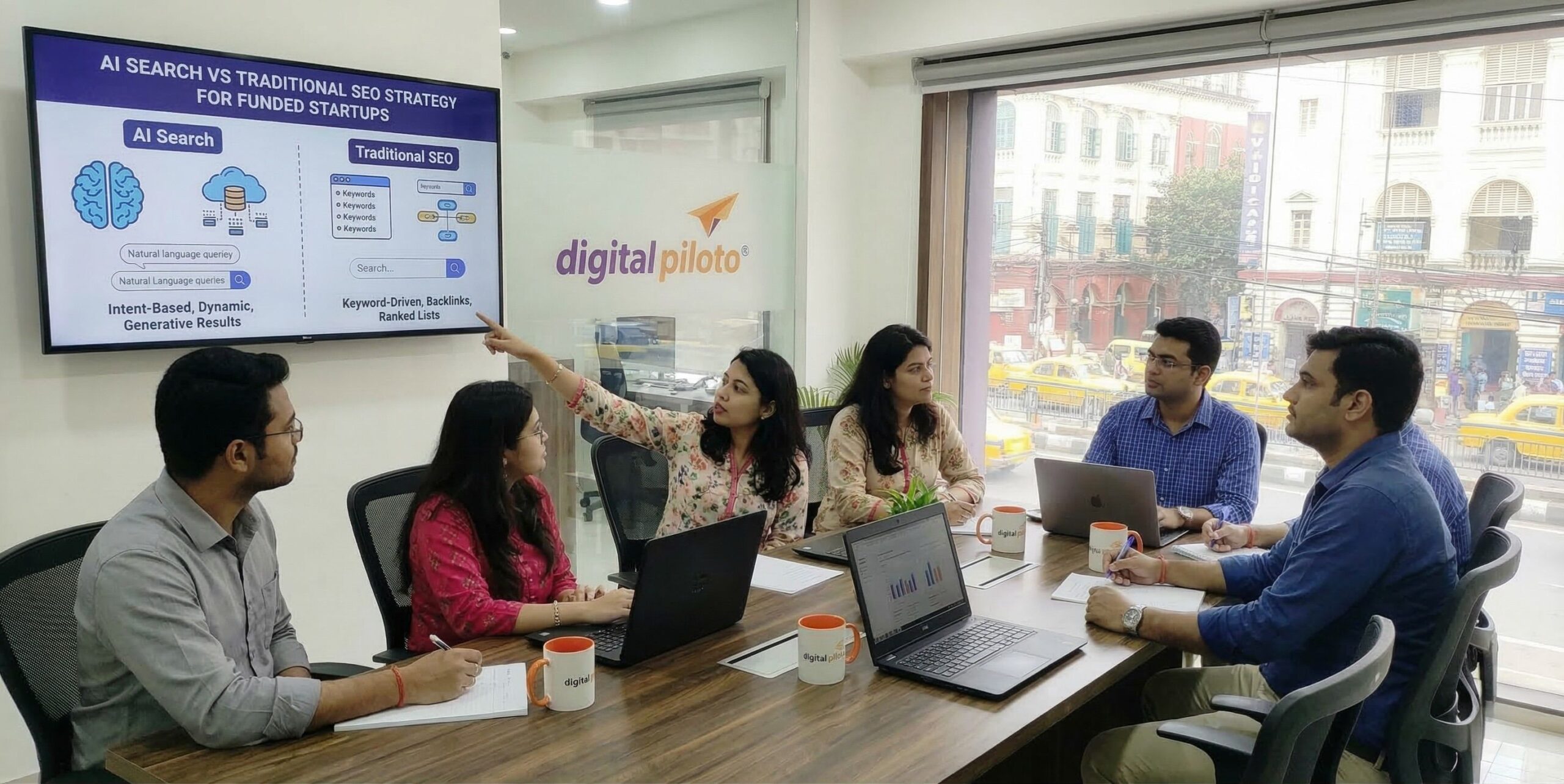
Funded startups move fast. They experiment, scale, pivot—and often rethink their marketing channels every quarter. But here’s a question many founders are quietly asking in 2026: should we still invest heavily in SEO, or shift toward AI-driven discovery? The debate around AI search vs SEO is real, and the answer isn’t simply choosing one over the other.
Many growth-stage companies now partner with a trusted digital marketing service provider in Kolkata to build hybrid strategies that work across both traditional search engines and emerging AI discovery systems. The goal is simple—ensure startups appear wherever modern users search for answers.
Why AI Search Is Changing Startup Marketing
Search behavior is shifting. Instead of typing short queries into search engines, users increasingly ask full questions through AI assistants and generative search tools. These systems often provide summarized answers directly—without requiring users to click a link.
This trend is known as the zero-click experience. According to research highlighted by Pew Research Center, a growing percentage of online queries are resolved without users visiting a traditional webpage.
For startups, this means visibility depends not only on ranking in Google but also on whether AI platforms can interpret and reference your content.
Traditional SEO Still Matters
Despite the hype around AI search, traditional SEO continues to play a crucial role. Search engines still drive significant traffic, particularly for product discovery and commercial queries.
The key difference is how SEO is implemented today. Instead of focusing purely on keywords, modern optimization prioritizes context, topical authority, and structured information.
Startups that combine SEO fundamentals with AI-ready content tend to achieve stronger digital visibility across multiple discovery platforms.
A Practical Hybrid Strategy for Startups
Rather than choosing between AI search and traditional SEO, funded startups should build strategies that support both systems simultaneously.
1. Create AI-Friendly Content Architecture
AI models rely on structured information to understand content. Startups should therefore design pages that are easy for both humans and machines to interpret.
- Use clear headings and logical page structures.
- Include FAQ sections that mirror conversational queries.
- Provide concise summaries at the beginning of articles.
This approach increases the chances that AI tools will reference your content when generating answers.
2. Build Topic Clusters Instead of Single Posts
Startups often publish isolated blog posts targeting individual keywords. While this worked years ago, AI-driven systems prefer content ecosystems that demonstrate expertise.
- Create pillar pages explaining core concepts.
- Support them with detailed subtopics.
- Connect articles using strong internal linking.
When executed correctly, this structure strengthens both search rankings and AI visibility.
3. Use Paid Insights to Inform Content Strategy
Interestingly, paid marketing campaigns often reveal what users actually want to know. Data from ads, landing pages, and keyword research can guide organic strategies.
A skilled digital marketing specialist can analyze campaign performance to identify real customer questions, which then become valuable content opportunities.
Essential Tools for AI-Ready SEO
Startups love tools—and fortunately, several platforms help bridge the gap between AI search and SEO.
- Semantic keyword tools: Platforms that identify related topics and search intent.
- Content optimization software: Tools that improve readability and contextual relevance.
- AI analytics dashboards: Systems that track how AI engines reference your content.
Many companies also collaborate with an experienced AI SEO agency in Kolkata to refine their optimization frameworks and adapt quickly as search technology evolves.
A Simple Startup Content Template
To make implementation easier, here’s a practical content template startups can use when publishing AI-friendly articles.
- Introduction: Answer the core user question quickly.
- Explainer section: Provide context and definitions.
- Actionable steps: Offer practical advice or tutorials.
- FAQ section: Address conversational queries.
- Summary: Reinforce the main takeaway.
This structure improves readability while increasing the likelihood that AI systems extract useful insights from the page.
Common Mistakes Startups Should Avoid
Even well-funded startups sometimes struggle with search visibility. Here are a few mistakes worth avoiding:
- Ignoring AI search trends: Assuming traditional SEO alone is sufficient.
- Publishing shallow content: Articles that lack depth rarely earn authority.
- Over-optimizing for keywords: Excessive keyword repetition can reduce readability.
A balanced approach—combining structured content, topical authority, and AI optimization—is far more sustainable.
Frequently Asked Questions
What is the difference between AI search and traditional SEO?
AI search uses generative models to summarize answers directly, while traditional SEO focuses on ranking webpages in search engine results.
What does zero-click search mean?
Zero-click search refers to situations where users receive answers directly on the search results page or AI interface without clicking a website link.
Should startups stop investing in SEO?
No. SEO remains important for traffic and brand visibility. Startups should instead combine SEO with AI-ready content strategies.
How can startups optimize for AI search?
Startups can optimize for AI search by structuring content clearly, answering common questions, and building topical authority around key subjects.
Final Thoughts
The debate around AI search vs SEO isn’t about replacing one strategy with another. For funded startups, the smartest path forward is integration. Brands that combine strong SEO foundations with AI-friendly content structures will likely dominate the next era of digital discovery.
Blog Development Credits:
This article draws inspiration from concepts shared by Amlan Maiti. Research and drafting involved AI tools such as ChatGPT, Google Gemini, and Copilot, with final optimization completed by Digital Piloto Private Limited.