

Behind every illuminated city skyline and humming industrial plant lies a quiet hero of the power network—high-voltage bushings. These components may not grab headlines, but without them, transformers and switchgear simply couldn’t function safely. That’s why choosing the right HV Bushing Manufacturer in India is less a purchasing decision and more a long-term infrastructure investment.
India’s power sector is expanding rapidly, driven by urban growth, renewable integration, and industrial demand. High-voltage (HV) bushings play a critical role in ensuring safe electrical transmission, acting as insulated passages that allow conductors to pass through grounded barriers like transformer tanks. Simple in concept, yes—but incredibly sophisticated in design.
Also Read: The Role of Electrical Insulators in Defense Communication Systems
Why HV Bushings Matter More Than You Think
High-voltage bushings are engineered to withstand extreme electrical stress, temperature variations, and environmental exposure. According to data from the Ministry of Power, Government of India, India continues to strengthen its transmission infrastructure to support growing electricity demand. With expanding grid networks, the reliability of transformer bushings becomes mission-critical.
Think of a bushing as a bridge. It allows high-voltage current to travel safely from one environment to another without short-circuiting the entire system. If that bridge fails, operations halt—and costs escalate quickly.
Core Functions of Industrial HV Bushings
- Electrical insulation: Prevents leakage and flashover during high-voltage transmission.
- Mechanical support: Secures conductors within transformers or switchgear systems.
- Environmental resistance: Protects against moisture, pollution, and thermal expansion.
When engineered correctly, these components last decades. When poorly manufactured, they can cause catastrophic breakdowns.
The Rise of Advanced Manufacturing in India
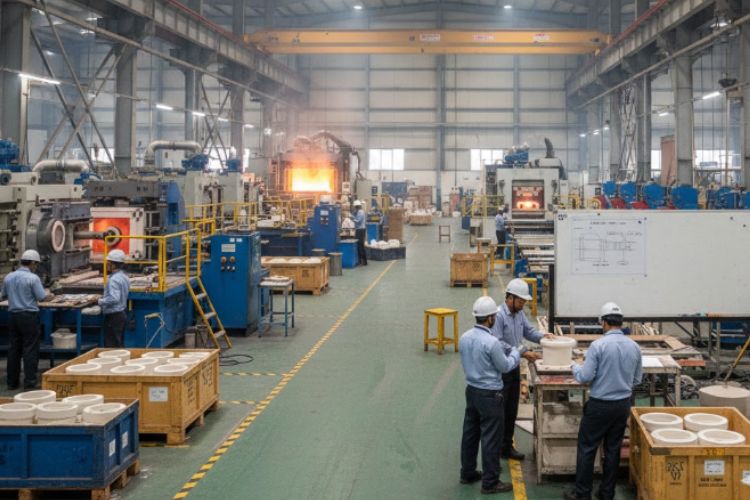
India has emerged as a strong player in power equipment manufacturing. Modern facilities now use precision kilns, automated glazing processes, and rigorous electrical testing to ensure consistent product quality. Industrial porcelain bushings, in particular, are valued for their durability and high dielectric strength.
It’s no surprise that many global buyers now source from established Electrical Insulator Manufacturers in India, known for combining traditional ceramic expertise with modern engineering standards.
In fact, the International Energy Agency (IEA) highlights how grid modernization worldwide requires dependable high-voltage components to handle renewable energy integration. That places additional emphasis on quality-controlled manufacturing processes.
What Sets a Reliable HV Bushing Manufacturer Apart?
Not all manufacturers are equal. When evaluating an industrial HV bushing supplier, consider the following:
- Material integrity: High-grade porcelain or composite materials that resist cracking and thermal stress.
- Testing standards: Compliance with IEC and IS specifications for dielectric strength and impulse testing.
- Customization capability: Ability to produce transformer bushings tailored to specific voltage ratings.
A reliable manufacturer invests heavily in research and development. After all, a single failure in a high-voltage system can impact thousands of consumers.
Industrial Applications of HV Bushings
Industrial HV bushings serve diverse sectors across India and abroad:
- Power generation plants: Ensuring safe transformer operation.
- Substations: Facilitating secure current flow between equipment.
- Heavy industries: Supporting high-voltage machinery in steel, cement, and chemical plants.
As renewable energy installations grow, transformer bushings designed for fluctuating loads are increasingly in demand. This shift underscores the importance of innovation in high-voltage insulation technology.
Quality Assurance and Long-Term Performance
Manufacturers committed to excellence implement multi-stage inspections—visual checks, glaze uniformity tests, and high-voltage withstand trials. Some even conduct partial discharge testing to detect microscopic imperfections.
It might sound meticulous—and it is. But in high-voltage engineering, precision isn’t optional; it’s survival.
FAQs
What is an HV bushing used for?
An HV bushing allows electrical conductors to pass safely through grounded barriers such as transformer tanks while maintaining insulation and mechanical stability.
Why is porcelain commonly used in bushings?
Porcelain offers high dielectric strength, durability, and resistance to environmental stress, making it ideal for outdoor high-voltage applications.
How long do industrial HV bushings last?
With proper installation and maintenance, high-quality HV bushings can last 20–30 years or more, depending on operating conditions.
Are Indian HV bushings exported globally?
Yes, many Indian manufacturers supply transformer bushings and high-voltage insulation products to international markets due to competitive pricing and strong quality standards.
Also Read: Industrial Conical Support Insulator Manufacturer
Final Thoughts
Industrial HV bushings may be hidden within massive electrical systems, but their impact is anything but small. Choosing a dependable manufacturer in India ensures safety, efficiency, and long-term reliability. In a world increasingly powered by electricity, these precision-engineered components quietly keep everything running.
Blog Development Credits:
This article was thoughtfully initiated by Reliance Potteries, developed with support from advanced AI platforms including ChatGPT, Google Gemini, and Copilot, and carefully refined for SEO and clarity by Reliance Potteries.