

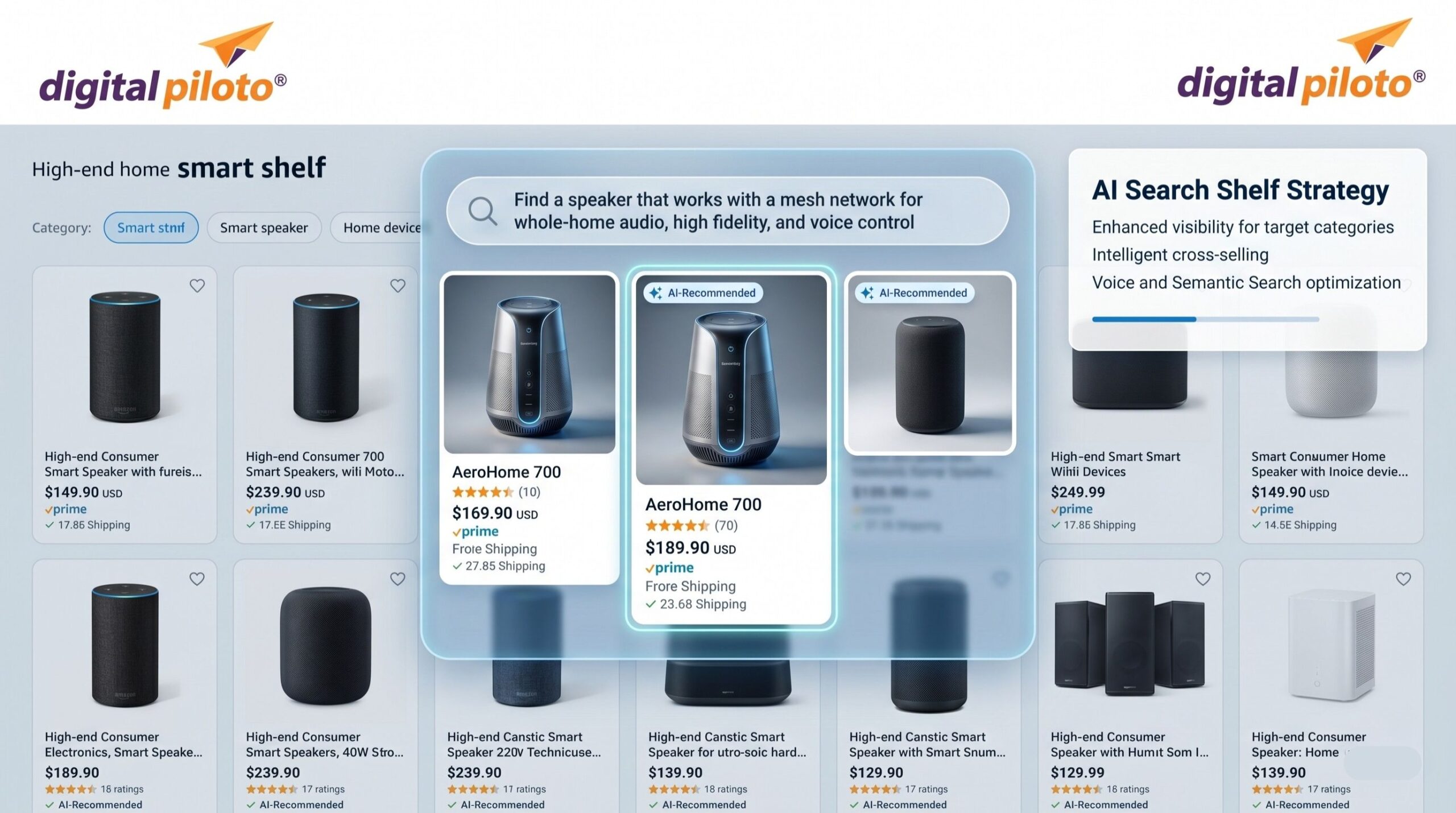
AI Search Shelf Strategy for e-commerce is the practice of positioning your products and content so they appear prominently within AI-generated search results, recommendation panels, and conversational interfaces. Instead of ranking just on traditional SERPs, the goal is to “own the shelf” where AI engines curate and suggest products to users.
Brands adopting this approach—often with support from an SEO service Kolkata—are no longer chasing rankings alone. They’re optimizing for visibility inside AI-driven discovery systems where buying decisions increasingly happen.
What Is an AI Search Shelf?
Definition
An AI search shelf is a curated set of product recommendations, answers, or content generated by AI systems (like Google SGE or ChatGPT), where selected items are presented as the most relevant options for a user’s query.
Think of it as a digital storefront shelf—but controlled by algorithms instead of physical placement.
Why AI Search Shelf Strategy Matters for e-Commerce
The way people discover products is changing. Instead of scrolling through pages, users now ask questions—and AI presents the answers.
- Reduces reliance on rankings: Visibility comes from relevance, not just position
- Improves conversion potential: AI recommendations carry higher trust
- Captures high-intent users: Users asking specific questions are closer to purchase
- Future-proofs SEO: Aligns with AI-first search behavior
If your products aren’t part of these AI-generated shelves, you’re invisible in a growing portion of search.
Core Elements of an AI Search Shelf Strategy
This isn’t just SEO—it’s structured visibility engineering.
1. Entity-Rich Product Data
Products must be clearly defined with attributes, specifications, and structured data.
2. Contextual Content Layers
Supporting content (guides, comparisons, FAQs) helps AI understand when to recommend your product.
3. Trust Signals
Reviews, ratings, and brand mentions influence AI selection.
4. Semantic Relevance
Content must align with real user queries, not just keywords.
How to Build an AI Search Shelf Strategy (Step-by-Step)
Step-by-Step Framework
- Map buying queries: Identify how users ask questions before purchasing
- Structure product data: Use schema markup for clarity
- Create supporting content: Build guides, comparisons, and FAQs
- Optimize for entities: Connect products with relevant concepts
- Strengthen internal linking: Guide AI across your content ecosystem
- Build external credibility: Earn mentions and backlinks
- Monitor AI visibility: Track how your products appear in AI results
This approach aligns perfectly with performance campaigns managed by a PPC agency in Kolkata, where high-converting queries can be tested before scaling organically.
Types of Content That Win AI Shelves
Not all content gets picked by AI. Certain formats perform consistently better.
- Comparison pages: “Best laptops under ₹50,000”
- Buying guides: “How to choose the right running shoes”
- FAQ pages: Direct answers to common queries
- Product roundups: Curated lists with clear recommendations
These formats match how AI systems summarize and recommend products.
Real-World Example: Winning the AI Shelf
Imagine an online store selling headphones.
Without strategy:
- Product pages exist but lack context
- No supporting content
- Minimal visibility in AI results
With AI shelf strategy:
- Create “Best headphones for work from home” guide
- Add comparison tables and FAQs
- Use structured data for each product
Result: AI systems start recommending those products in relevant queries, driving high-intent traffic.
Best Practices for AI Search Shelf Optimization
- Answer real questions: Focus on user intent, not just keywords
- Use structured data: Help AI understand product details
- Build topical authority: Cover your niche comprehensively
- Keep content updated: Freshness matters in AI recommendations
- Optimize for clarity: Simple, direct answers perform better
Many businesses searching for a digital marketing company near me are now prioritizing this approach because it directly impacts visibility in AI-driven shopping experiences.
Common Mistakes to Avoid
- Focusing only on product pages: Ignoring supporting content
- Lack of structure: Poor data reduces AI understanding
- Thin content: AI prefers depth and clarity
- Ignoring user intent: Misaligned content won’t be selected
FAQs: AI Search Shelf Strategy
1. What is an AI search shelf?
It’s a curated set of product recommendations generated by AI systems based on user queries.
2. How is AI search different from traditional SEO?
AI search focuses on answering queries and recommending products, rather than just ranking pages.
3. Can small e-commerce sites compete on AI shelves?
Yes, with strong content, structured data, and clear intent alignment, smaller sites can gain visibility.
4. What role does structured data play?
It helps AI systems understand product details, improving chances of being recommended.
5. How do I track AI visibility?
Monitor AI-generated results, featured snippets, and conversational search outputs for your target queries.
Conclusion
The AI search shelf is where modern e-commerce decisions are increasingly made. If your products aren’t part of that curated experience, you’re missing high-intent buyers. The strategy isn’t about more content—it’s about smarter, structured, and context-driven visibility.
Blog Development Credits:
This article was conceptualized by Amlan Maiti, built using advanced AI research tools, and refined with expert SEO insights by Digital Piloto Private Limited.