

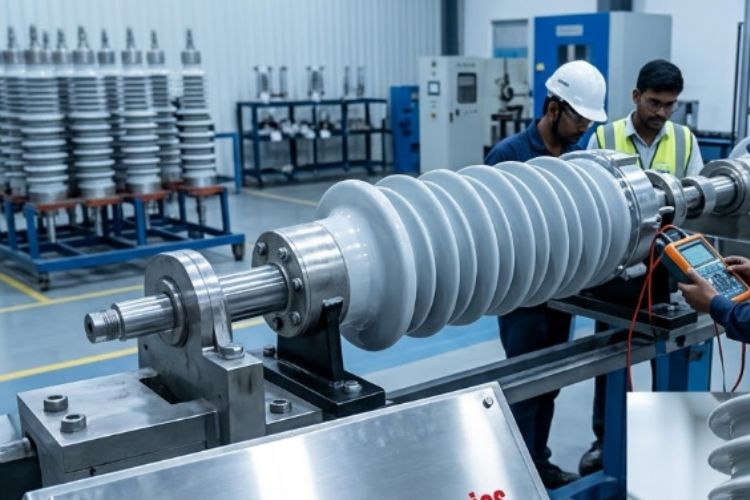
When you think about power transmission, towering lines and substations usually come to mind. But tucked inside this ecosystem is a quiet hero—the HV bushing. Ever wondered how these precision-engineered components are made? In this guide, we’ll walk through the HV bushing manufacturing process in a way that feels less like a textbook and more like a behind-the-scenes tour.
In India’s rapidly growing power sector, partnering with a reliable HV Bushing Manufacturer in India has become crucial. These components ensure safe insulation and efficient current flow across transformers and switchgear—essentially acting as controlled gateways for electricity.
Also Read: Industrial Heat Loss: How Advanced Insulators Solve It
What Exactly Is an HV Bushing?
At its core, a high voltage bushing is an insulating structure that allows electrical conductors to pass safely through grounded barriers like transformer tanks. Think of it as a carefully designed “tunnel” that prevents electrical leakage while handling extreme voltage stress.
Why Manufacturing Precision Matters
A minor defect in a bushing can lead to major system failures. According to data from the IEEE, insulation failures account for a significant percentage of transformer breakdowns globally. That’s why every stage of manufacturing is closely monitored and controlled.
Step-by-Step HV Bushing Manufacturing Process
1. Raw Material Selection
Everything starts with the right materials. High-quality porcelain, conductive metals, and insulating oil or resin form the backbone of HV bushings.
- Porcelain: Offers excellent mechanical strength and weather resistance.
- Copper/Aluminum Conductors: Ensure efficient current flow.
- Insulating Medium: Oil or resin enhances dielectric strength.
Manufacturers often test raw materials rigorously before even beginning production—it’s a bit like a chef tasting ingredients before cooking a complex dish.
2. Porcelain Forming and Shaping
The outer shell, typically made from porcelain, is formed using advanced molding techniques. The shaping process must ensure uniform thickness and structural integrity.
- Slip casting or extrusion methods are commonly used
- Designs include sheds (ribs) to improve insulation in wet conditions
- Dimensional accuracy is critical to prevent stress points
3. Drying and Firing
Once shaped, the porcelain components are dried and fired in kilns at extremely high temperatures—often exceeding 1200°C. This step transforms the material into a dense, durable structure capable of withstanding harsh environments.
Interestingly, slight variations in firing temperature can affect the final strength, which is why experienced manufacturers treat this step almost like an art form.
4. Assembly of Internal Components
Now comes the integration phase. Conductors are inserted into the porcelain housing, and insulation layers are carefully added.
At this stage, leading Electrical Insulator Manufacturers in India focus on maintaining alignment and eliminating air gaps, which could otherwise lead to partial discharge issues.
- Capacitor grading layers may be added for voltage control
- Sealing systems are installed to prevent moisture ingress
- Oil filling or resin impregnation enhances insulation
5. Vacuum Drying and Impregnation
This is where things get technical. The assembled unit undergoes vacuum drying to remove moisture completely. Afterward, it’s impregnated with insulating oil or resin under controlled conditions.
This step significantly improves dielectric performance—essential for handling high voltage applications like transformers and circuit breakers.
6. Testing and Quality Assurance
Before reaching the market, each HV bushing undergoes a battery of tests:
- Dielectric Testing: Ensures insulation can withstand high voltage.
- Thermal Testing: Evaluates performance under heat stress.
- Mechanical Testing: Checks structural durability.
According to the CIGRÉ organization, advanced testing protocols have significantly reduced failure rates in modern bushings—highlighting the importance of this final stage.
Key Trends in HV Bushing Manufacturing
The industry isn’t standing still. Here are a few trends shaping the future:
- Eco-friendly Materials: Reduced reliance on oil-based insulation
- Smart Monitoring: Integration of sensors for real-time diagnostics
- Compact Designs: Space-saving solutions for urban substations
These innovations are particularly relevant as global electricity demand continues to rise, especially in developing economies.
FAQs on HV Bushing Manufacturing
1. What materials are used in HV bushings?
HV bushings typically use porcelain, copper or aluminum conductors, and insulating oil or resin to ensure durability and electrical performance.
2. Why is vacuum impregnation important?
Vacuum impregnation removes moisture and air, improving dielectric strength and preventing internal discharge issues.
3. How long do HV bushings last?
With proper maintenance, HV bushings can last 20–30 years, depending on operating conditions and quality.
4. What causes HV bushing failure?
Common causes include insulation degradation, moisture ingress, and manufacturing defects.
Also Read: Industrial HV Bushing Manufacturer India
Final Thoughts
HV bushings might not grab headlines, but their role in power systems is indispensable. From raw material selection to precision testing, every step in the manufacturing process reflects a blend of engineering discipline and craftsmanship. As power infrastructure evolves, so too will the sophistication of these critical components.
Blog Development Credits:
This article was thoughtfully developed by Reliance Potteries, combining deep research and AI-assisted drafting tools, then refined and optimized for clarity and SEO by the same expert team.