

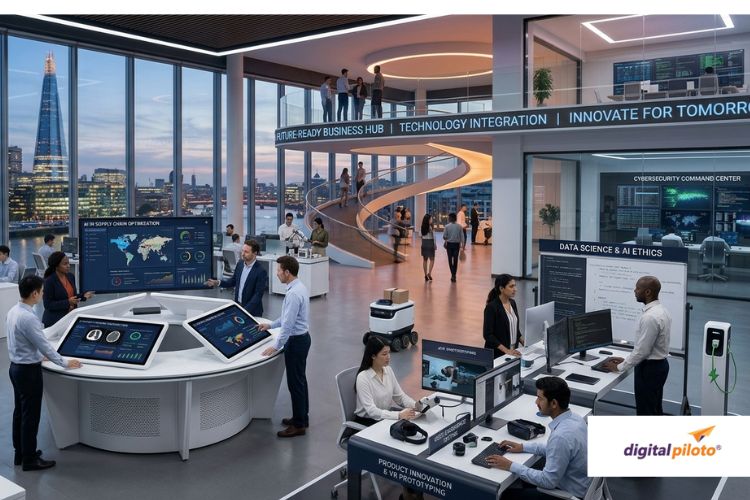
Creating a future-ready business through technology means building an organization that can adapt quickly, make smarter decisions, and respond confidently to changing customer expectations and market conditions. Technology is no longer a support function operating behind the scenes; it has become one of the strongest drivers of resilience, growth, and competitive advantage.
The businesses thriving today are not necessarily the largest or oldest. More often, they are the organizations willing to rethink processes, embrace digital tools, and invest in innovation before disruption forces them to react. Even industry-specific companies working with a modern Property Marketing Agency are discovering that technology strategy increasingly determines long-term market position.
What Is a Future-Ready Business?
A future-ready business is an organization designed to evolve alongside changes in technology, customer behavior, and industry trends without requiring major reinvention every few years.
Definition Format
Traditional Business Model: Focuses on stability, fixed processes, and predictable market conditions.
Future-Ready Business Model: Prioritizes adaptability, data-driven decisions, and continuous improvement through technology.
The distinction may seem subtle, but it changes how companies invest, hire, operate, and compete.
Why Technology Has Become a Business Strategy
For years, technology was viewed primarily as an operational expense. Today, it influences customer acquisition, employee productivity, service delivery, and profitability.
When leaders discuss business growth, technology is no longer part of the conversation—it often is the conversation.
- Automation reduces manual workload.
- Cloud infrastructure improves flexibility.
- Data analytics supports faster decisions.
- Artificial intelligence uncovers opportunities.
- Digital experiences strengthen customer loyalty.
The organizations that recognize this shift early usually gain an advantage that compounds over time.
How Automation Creates Agility
One of the most practical ways businesses become future-ready is through intelligent automation.
Automating repetitive tasks frees teams to focus on activities that require creativity, strategy, and relationship building.
This is especially valuable in industries facing talent shortages or increasing operational complexity.
Automation is often misunderstood as a replacement for people. In reality, the strongest implementations make employees more effective rather than less necessary.
The Role of Data in Long-Term Growth
Data has become one of the most valuable business assets, but collecting information alone creates little value.
Future-ready companies build systems that transform raw information into actionable insights.
Businesses use data to:
- Predict customer demand.
- Identify emerging trends.
- Improve operational efficiency.
- Reduce unnecessary costs.
- Personalize customer experiences.
Many executives discover that the challenge is not finding more data but learning which information actually matters.
Why Customer Experience Is Becoming a Technology Function
Customers rarely separate their experience with a company from the technology that delivers it.
A slow website, poor mobile experience, or delayed response time shapes perception just as strongly as product quality.
This is why digital transformation increasingly overlaps with customer experience strategy.
Businesses investing in customer-centric technology often improve retention before they improve acquisition.
Industry Examples of Future-Ready Transformation
Real Estate
Virtual property tours, predictive pricing models, and AI-powered customer journeys are changing how buyers make decisions.
Hospitality
Hotels are using personalization engines, automated check-ins, and smart guest experiences to improve satisfaction.
As a result, organizations investing in modern Hotel Marketing Services are increasingly combining marketing expertise with technology infrastructure.
Retail
Retailers use demand forecasting, customer analytics, and recommendation systems to create more efficient operations and stronger customer relationships.
Manufacturing
Predictive maintenance and connected supply chains help reduce downtime and improve planning accuracy.
Step-by-Step: Building a Future-Ready Business
Step 1: Evaluate Existing Processes
Identify workflows that slow decision-making or depend heavily on manual effort.
Step 2: Prioritize Business Outcomes
Technology investments should solve business problems rather than simply introduce new tools.
Step 3: Strengthen Data Infrastructure
Reliable reporting and analytics create the foundation for intelligent decisions.
Step 4: Introduce Scalable Technologies
Choose platforms and systems that can grow alongside the business.
Step 5: Build a Culture of Adaptation
The technology may change rapidly, but organizational mindset often determines success.
The Human Side of Digital Transformation
Technology projects succeed or fail largely because of people rather than software.
Employees need training, leadership support, and clear communication about why change is happening.
One lesson repeated across industries is that resistance usually decreases when teams understand how technology improves their work rather than threatens it.
Common Mistakes Businesses Make
- Adopting technology without a clear objective.
- Ignoring employee adoption challenges.
- Choosing short-term fixes instead of scalable systems.
- Underestimating cybersecurity requirements.
- Measuring technology success using only cost savings.
Future readiness is not created by purchasing software. It comes from aligning technology decisions with business strategy.
Frequently Asked Questions
What is a future-ready business?
A future-ready business is designed to adapt quickly to technological, economic, and customer changes while maintaining long-term competitiveness.
Why is technology important for business growth?
Technology improves efficiency, customer experience, scalability, and decision-making, making sustainable growth easier to achieve.
How does automation help businesses?
Automation reduces repetitive work, improves consistency, and allows employees to focus on higher-value activities.
Can small businesses become future-ready?
Yes. Many cloud-based technologies and automation tools make digital transformation accessible to smaller organizations.
What is the biggest challenge in becoming future-ready?
Change management and employee adoption are often more difficult than implementing the technology itself.
Conclusion
Future-ready businesses are not built by predicting the future perfectly. They are built by creating systems, cultures, and technologies capable of adapting when the future changes unexpectedly. In an environment where disruption has become normal, adaptability may be the most valuable competitive advantage of all.
Blog development credits
This article was inspired by strategic ideas developed by Amlan Maiti, supported by research using advanced AI platforms including ChatGPT, Gemini, and Copilot, and finalized with optimization and SEO enhancements from Digital Piloto.