

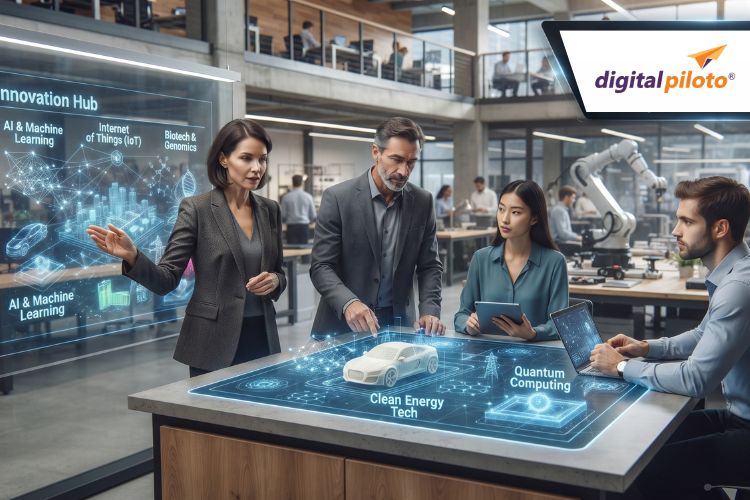
Emerging technologies are reshaping industries by changing how businesses operate, make decisions, serve customers, and create value. Artificial intelligence, automation, connected devices, and advanced analytics are no longer future concepts. They are practical tools already transforming manufacturing, healthcare, hospitality, logistics, retail, and financial services.
The organizations gaining the biggest advantage are not necessarily those spending the most on innovation. More often, they are the businesses willing to experiment early and adapt quickly. Companies investing in digital transformation initiatives such as Manufacturing Lead Generation are increasingly combining technology with operational expertise to create measurable business growth.
What Are Emerging Technologies?
Emerging technologies are innovations that are rapidly evolving and beginning to create significant commercial, social, or operational impact across industries.
Unlike established technologies, emerging solutions often redefine existing business models rather than simply improving them.
History shows that industries rarely change gradually. They tend to shift when new technologies make old processes inefficient or unnecessary.
Why Are Industries Experiencing Faster Transformation?
Several technological advances are converging at the same time.
- Computing power has become cheaper.
- Cloud infrastructure has improved accessibility.
- Data collection capabilities have expanded dramatically.
- AI models have become more practical for business use.
- Customers expect faster and more personalized experiences.
These forces reinforce one another, accelerating innovation cycles across nearly every sector.
Artificial Intelligence Is Becoming Business Infrastructure
Artificial intelligence has moved beyond experimentation and into day-to-day operations.
Definition:
Artificial intelligence refers to systems capable of performing tasks that typically require human intelligence, including learning, prediction, decision-making, and language understanding.
Businesses are using AI to automate customer support, forecast demand, optimize inventory, and personalize recommendations.
The most successful implementations often focus on improving employee capabilities rather than replacing employees entirely.
Automation Is Expanding Beyond Factories
Automation was once associated primarily with manufacturing production lines.
Today, automation touches finance departments, customer service teams, HR operations, and marketing workflows.
Examples of modern automation include:
- Invoice processing and financial reconciliation.
- Automated customer onboarding.
- Marketing campaign optimization.
- Inventory management systems.
- Predictive maintenance alerts.
The goal is increasingly about removing repetitive work so people can focus on higher-value decisions.
The Internet of Things Is Creating Connected Businesses
Connected devices are producing enormous amounts of operational intelligence.
Machines, vehicles, sensors, and equipment can now communicate in real time.
Definition:
The Internet of Things (IoT) refers to physical devices connected to networks that collect and exchange data automatically.
Manufacturers use IoT to monitor equipment health, while logistics companies track shipments with unprecedented precision.
Data visibility often becomes a competitive advantage long before automation begins.
Digital Twins Are Changing Decision-Making
One of the lesser-known innovations gaining momentum is the digital twin.
A digital twin is a virtual model of a physical product, machine, facility, or process.
Businesses can test scenarios in the virtual environment before making costly real-world decisions.
Digital twins help organizations:
- Reduce operational risks.
- Improve maintenance planning.
- Optimize production processes.
- Increase resource efficiency.
- Improve forecasting accuracy.
Simulation is rapidly becoming a strategic advantage rather than a technical luxury.
Technology Is Redefining Customer Experience
Consumers increasingly expect seamless experiences regardless of industry.
Hospitality businesses, for example, are integrating AI recommendations, smart booking systems, and personalized communications to improve guest experiences.
Many organizations working with a Hotel Digital Marketing Agency are finding that customer expectations are evolving as quickly as the technology itself.
Convenience has become one of the strongest drivers of customer loyalty.
Cybersecurity Is Becoming a Growth Strategy
As industries become more connected, cybersecurity becomes more important.
Businesses often view security as a defensive investment, but customers increasingly view it as a trust signal.
Organizations that protect customer information effectively may gain an advantage in reputation and retention.
Digital trust is becoming a business asset.
How Businesses Should Evaluate Emerging Technologies
Not every trend deserves immediate adoption.
Technology decisions should begin with business outcomes rather than headlines.
Step-by-step evaluation framework:
- Identify operational challenges or customer pain points.
- Assess technologies that address those problems directly.
- Estimate potential return on investment.
- Launch a controlled pilot project.
- Measure results before expanding deployment.
This disciplined approach prevents organizations from pursuing innovation simply because competitors are doing so.
The Human Factor Remains Essential
Technology often receives credit for transformation, but people usually determine whether transformation succeeds.
Training, leadership alignment, and organizational culture remain critical factors.
Human capabilities that remain difficult to automate include:
- Strategic thinking.
- Creativity and innovation.
- Relationship management.
- Complex decision-making.
- Ethical judgment.
Technology changes tools. People change businesses.
What Comes Next?
The next decade will likely see industries become increasingly intelligent, connected, and predictive.
Businesses that wait for certainty may discover that competitors have already captured the advantages of early adoption.
Experimentation, agility, and continuous learning may become just as important as technology investments themselves.
Frequently Asked Questions
What are emerging technologies?
Emerging technologies are rapidly developing innovations that have the potential to significantly transform industries and business operations.
Which industries are being affected the most?
Manufacturing, healthcare, logistics, retail, finance, and hospitality are experiencing some of the fastest technology-driven changes.
Why is artificial intelligence important for businesses?
AI improves efficiency, supports decision-making, automates repetitive tasks, and enables personalized customer experiences.
What is a digital twin?
A digital twin is a virtual representation of a physical object or process used for simulation and optimization.
How should businesses approach new technologies?
Businesses should focus on solving specific problems, run pilot projects, and measure outcomes before scaling adoption.
Conclusion
Emerging technologies are not simply creating new tools; they are redefining how industries compete and grow. Businesses that combine curiosity with disciplined implementation are more likely to turn innovation into long-term advantage rather than short-term excitement.
Blog development credits
This article draws inspiration from technology and marketing perspectives explored by Amlan Maiti, supported by research using advanced AI systems and refined through optimization expertise from Digital Piloto Private Limited.