

Imagine asking an AI assistant for a company’s contact details and receiving a phone number the business stopped using two years ago. Another assistant suggests an office that has closed. A third describes services the company no longer provides. None of these answers helps the customer, and each raises an uncomfortable question: which version of the business is correct?
This problem is becoming increasingly relevant as customers use AI-powered tools to research companies before making decisions. For businesses working with a digital marketing agency in India, maintaining accurate brand information is now an important consideration alongside website visibility, content quality, and online reputation.
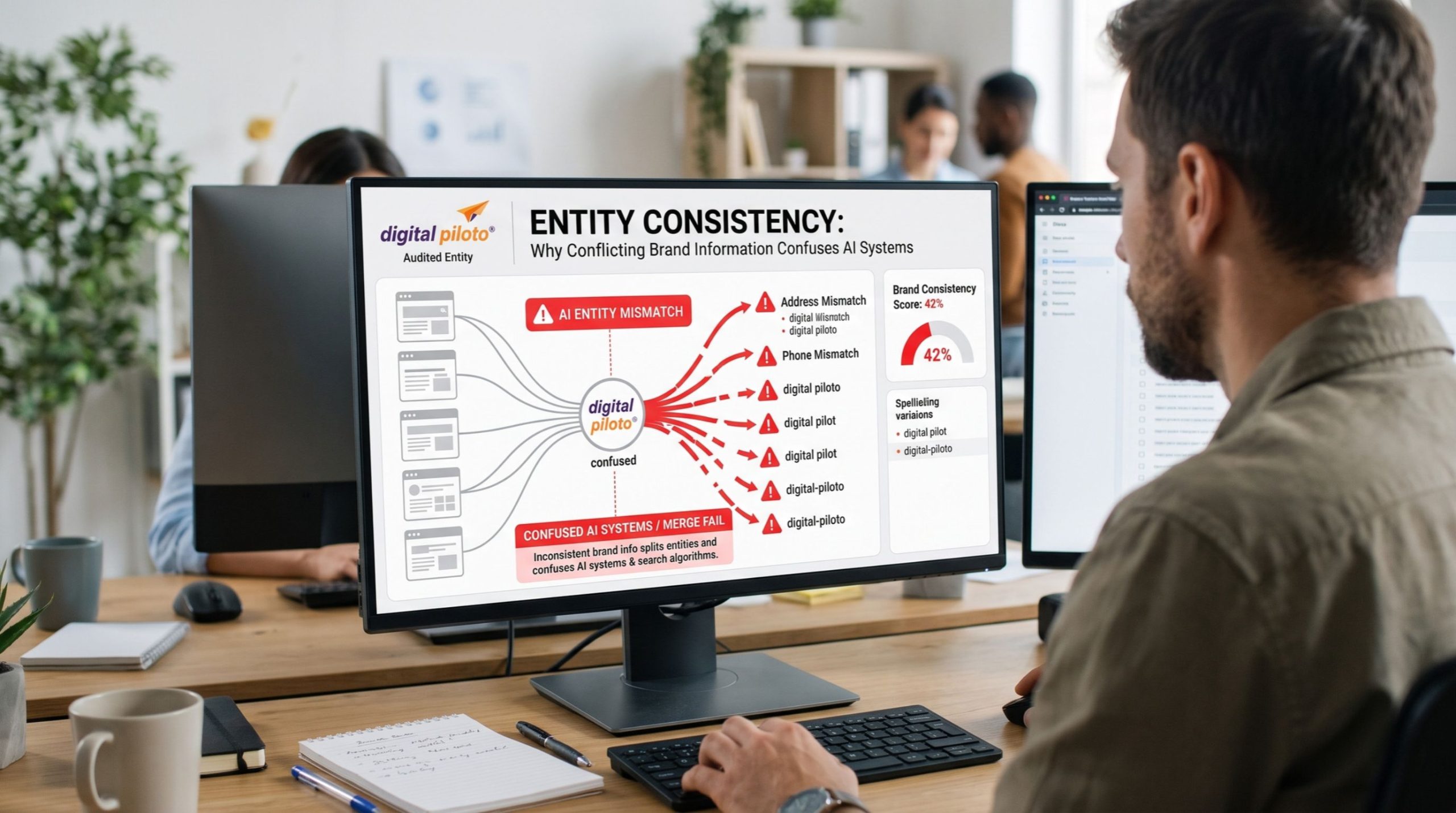
The underlying challenge has a name: entity consistency. It sounds technical, but the idea is straightforward. If a business presents conflicting facts across different websites and platforms, both people and automated systems may struggle to determine which information deserves attention.
That doesn’t mean AI always becomes confused in the same way. Different platforms retrieve, interpret, and generate information differently. Still, businesses have good reasons to make their public identity as accurate and understandable as possible.
What Is Entity Consistency in AI Search?
Entity consistency is the practice of maintaining accurate, coherent, and identifiable information about a business, person, product, or organization across relevant digital sources. For a brand, this includes its official name, website, business locations, contact details, services, leadership, and relationships with other organizations.
Think of it as maintaining one dependable business identity across the digital world.
Suppose a company operates under the name Evergreen Interiors. Its website identifies it as Evergreen Interiors Pvt. Ltd., its Google Business Profile displays Evergreen Home Design, and an old industry directory lists Evergreen Furniture Studio.
These names might represent legitimate historical or trading identities. Alternatively, they could refer to different businesses entirely.
Without sufficient context, an information-retrieval system has to interpret the relationship between them. If the surrounding details also disagree, the task becomes harder.
Entity Consistency Is More Than Matching Business Names
Marketers often associate consistency with NAP: name, address, and phone number. Those details remain useful, especially for businesses serving local customers.
But brand identity extends much further.
A software company may have one legal name and several product brands. A healthcare organization may operate different clinics under a parent company. An international business may maintain separate regional websites, service offerings, and telephone numbers.
In these situations, demanding identical information everywhere would be impractical and sometimes misleading.
The objective is not artificial uniformity. It is factual consistency with clearly explained differences.
An alternate brand name is not inherently an error. An outdated address presented as the current headquarters is.
How Do AI Systems Interpret a Brand’s Identity?
AI-powered search systems can use different combinations of web content, search indexes, structured information, retrieved documents, and model-generated responses.
Some systems retrieve information from external sources when answering a question. Others may produce responses partly from information learned during model development. Their exact processes vary, and commercial platforms do not disclose every source-selection or information-reconciliation mechanism.
It would therefore be inaccurate to describe one universal method by which all AI assistants identify businesses.
However, several understandable information problems can arise whenever an application needs to identify an organization from multiple records.
Entity Recognition and Disambiguation
Entity recognition involves identifying a named thing within information. Disambiguation involves determining which specific thing that name refers to.
Consider a customer asking about a company called Summit Solutions. If several organizations share that name, the system may need additional details such as location, industry, website, or legal identity to determine the intended business.
A recognizable name alone may not provide enough context.
This is why accurate descriptions, official website addresses, relevant identifiers, and clearly documented business relationships can be useful.
Information Retrieval and Conflicting Sources
Now imagine that the correct company has been identified, but its address differs across several websites.
Its official contact page shows one location. A business directory lists another. An older press release mentions a third address without explaining that the company relocated.
A retrieval-based AI application may encounter one or more of these sources when preparing an answer. The result depends on which information is available, retrieved, interpreted, and selected.
It may provide the correct address, repeat an outdated one, or express uncertainty.
The important point is that conflicting public records create opportunities for factual mistakes. They do not prove that an AI system automatically penalizes the business.
Why Conflicting Brand Information Matters
Most businesses have experienced some version of the following problem: a customer calls an outdated number, visits the wrong address, or asks about a service that was discontinued months earlier.
These are ordinary information-management failures, but they can have commercial consequences.
When AI assistants become another way customers discover businesses, inaccurate information can potentially travel through an additional channel.
1. Customers May Receive the Wrong Information
A prospective customer asks an AI assistant whether a supplier provides installation services. An old directory says yes, while the supplier’s current website says the service has been discontinued.
If the answer repeats the outdated claim, the customer may contact the company with an expectation it cannot fulfill.
The business loses time clarifying the misunderstanding. The customer loses confidence.
2. Different Organizations May Be Mixed Up
Similar business names are common, particularly across regions and industries.
If a brand’s official website, social profiles, and directory entries provide limited identifying information, it can become harder to distinguish that organization from another company with a similar name.
Clear brand descriptions and relationships help reduce ambiguity.
3. Brand Reputation May Be Misrepresented
An outdated leadership profile, expired certification, incorrect business category, or unrelated review can create a misleading impression.
This is especially concerning when customers are researching professional services, expensive products, or organizations handling sensitive information.
Accuracy is therefore a reputation issue, not merely an SEO housekeeping task.
4. Internal Teams May Repeat the Same Errors
Conflicting information doesn’t always originate outside a business.
A sales presentation may use an old service list. The website may display a different company description. An automated support assistant could rely on an outdated internal knowledge base.
Correcting external listings while leaving internal data inconsistent solves only part of the problem.
What Google’s Documentation Actually Says
Google provides some of the clearest official guidance on describing organizational information through structured data.
Its Organization structured data documentation explains that including relevant organizational properties can help Google understand an organization’s administrative details and distinguish it from other entities.
Supported properties include business names, alternate names, website addresses, logos, contact information, and appropriate organizational identifiers.
Google also documents ways to establish business details using official website information and structured data.
These are documented capabilities, but they should not be misrepresented as guarantees of higher rankings or AI citations.
Does Google Require Identical Information Everywhere?
No official universal requirement says every brand description must use exactly the same words on every website.
A company’s LinkedIn description can reasonably emphasize its services, while an industry directory may describe its specialist capabilities.
Both descriptions can be accurate.
The important distinction is between different wording and contradictory facts.
Likewise, Google’s official guidance for AI features emphasizes foundational search practices, helpful content, technical accessibility, and accurate business information rather than a special entity-consistency formula.
Businesses should aim for dependable facts, not mechanically duplicated sentences.
Where Brand Information Conflicts Usually Begin
Conflicting records often accumulate gradually. A company relocates, launches a new service, changes ownership, or updates its branding. The main website gets revised, but older references remain online.
Several years later, the business may have dozens of public records describing slightly different versions of its identity.
The following sources deserve particular attention during a brand information audit:
- Official website: Homepage, About page, contact information, service pages, footer details, and structured data.
- Search and business profiles: Google Business Profile and other applicable search or mapping services.
- Social and professional profiles: LinkedIn, social media accounts, executive profiles, and verified corporate pages.
- Business directories: Industry-specific platforms, regional directories, trade associations, and relevant business databases.
- Third-party references: News coverage, interviews, partner websites, archived announcements, and published company profiles.
- Internal information systems: CRM records, product catalogs, customer support documentation, and connected AI applications.
Not all these sources carry equal importance for every business.
A local restaurant may need to prioritize operating hours, menu information, and address accuracy. An international software provider may need to focus on product naming, company ownership, integrations, and support channels.
The audit should reflect how real customers research the organization.
Brand Entity Consistency Across ChatGPT and Other AI Platforms
Businesses understandably want to know whether correcting brand information will improve their visibility in ChatGPT, Google AI Overviews, Gemini, Perplexity, and Microsoft Copilot.
The reasonable answer is that accurate information supports a more trustworthy digital presence, but the exact influence on AI responses must be evaluated separately.
There is no publicly established universal ranking algorithm covering all these platforms.
ChatGPT Search and Brand Discoverability
OpenAI documents OAI-SearchBot as a crawler used to help surface websites in ChatGPT search experiences. Its crawler documentation distinguishes that role from other OpenAI systems used for different purposes.
Allowing appropriate search crawler access may support discoverability, but it does not guarantee that ChatGPT will recommend a business or repeat every fact from its website.
For businesses exploring ChatGPT business listing services, a sensible starting point is to review whether the organization can be identified accurately through its official website and relevant public sources.
That includes checking its current name, actual service availability, official website, contact methods, and verified business relationships.
It is equally important not to confuse search visibility with a guaranteed ability to submit or control every answer generated by ChatGPT.
Google AI Overviews and AI Mode
Google’s AI search experiences are connected to its established Search infrastructure, although AI Overviews and AI Mode can present information differently.
Google’s official AI optimization guide recommends maintaining useful, accessible content and keeping applicable business information up to date.
For organizations, this reinforces the value of reliable website information, accurate business profiles, and appropriate structured data.
It does not establish that adding more schema properties or brand mentions will automatically produce citations.
Perplexity, Bing, and Copilot
Other AI search platforms should also be evaluated independently.
Perplexity documents its own crawler roles, while Microsoft’s Bing ecosystem provides separate webmaster tools and AI visibility reporting capabilities.
These distinctions matter because a business may be represented accurately on one platform while another displays outdated or incomplete information.
Testing only one assistant cannot establish universal brand accuracy.
How to Conduct an Entity Consistency Audit
An effective audit should begin with evidence, not assumptions about what an AI model supposedly prefers.
Before correcting public information, the business needs an approved record of what is currently true.
Step 1: Establish a Canonical Business Record
Create a master document containing the organization’s verified identity.
This becomes the internal reference against which website information, business listings, and third-party profiles can be reviewed.
Useful fields include:
- Official trading name, registered legal name, approved alternate names, and former names where relevant.
- Canonical website domain and verified social or professional profile URLs.
- Current business locations, legitimate service areas, and customer-facing contact methods.
- Accurate products, services, categories, and operating regions.
- Verified leadership information, parent-company relationships, subsidiaries, and relevant business identifiers.
- Last verification date, information owner, and supporting evidence for significant changes.
Importantly, this record should distinguish public information from private administrative details.
Not every internal identifier, employee contact, or office address should be published simply because it exists.
Step 2: Audit the Official Website
Review the homepage, About page, contact page, service pages, and location-specific content.
Check whether current facts are consistent across these sections.
Look for outdated telephone numbers in the footer, old leadership biographies, service pages describing discontinued offerings, and location pages that imply offices where the company has no actual presence.
Website markup should also be reviewed against the visible page content.
Correcting the website is particularly important because it is a primary source the business can directly maintain.
Step 3: Check Relevant External Profiles
Compare the canonical business record with profiles and listings that matter to the organization’s market.
Prioritize prominent inaccuracies before spending time on obscure directories.
A wrong public phone number may affect customers immediately. A minor punctuation difference in an otherwise accurate business description usually deserves less attention.
Where outdated information appears on an external website, follow the platform’s legitimate correction process.
Step 4: Review Structured Data
Google supports Organization and, where appropriate, LocalBusiness structured data to describe business information.
Check that the selected type and properties accurately represent the organization.
For example, a company with several genuine branches may need distinct location information. A service-area business should not invent a customer-facing office address.
Use actual official profiles for relevant external identity references. Do not populate markup with unrelated directories or fabricated credentials.
Structured data is a way to describe facts clearly. It is not a substitute for correcting the underlying information.
Step 5: Test Relevant AI Questions
Prepare a manageable set of questions that real customers might ask.
These could cover the company’s services, locations, official website, contact channels, product categories, and organizational relationships.
Run equivalent tests across the relevant platforms and record the response, date, stated sources, and factual accuracy.
Repeat important tests under comparable conditions before making broad conclusions.
An isolated incorrect answer is useful evidence of an error. It is not proof of a permanent platform-wide representation problem.
What Should Businesses Correct First?
Not every inconsistency has the same consequences.
A practical correction strategy can separate issues into three priority levels.
High Priority: Errors That Mislead Customers
Incorrect official websites, phone numbers, physical addresses, service availability, payment instructions, or company ownership details deserve immediate attention.
These errors can interfere directly with customer decisions and may create financial or reputational risks.
Medium Priority: Information That Creates Identity Ambiguity
Conflicting trading names, outdated executive profiles, unexplained rebrands, inconsistent product naming, and incorrect business categories should be investigated systematically.
Where different names are legitimate, explain their relationship rather than deleting accurate historical information indiscriminately.
Lower Priority: Harmless Editorial Variation
Different descriptions of the same services, minor formatting differences, and alternative wording generally do not require identical rewriting when all facts remain accurate.
Overstandardization can make business profiles sound unnatural and may remove context useful to customers.
The real goal is clarity, not uniformity for its own sake.
Can Structured Data Fix Conflicting Brand Information?
Structured data can help communicate facts about an organization, but it cannot guarantee that every search engine or AI assistant will accept those facts or override conflicting external sources.
Google’s Organization documentation identifies properties such as name, alternateName, url, logo, and sameAs that may help describe an organization.
These properties should be populated only when the information is accurate and applicable.
For instance, a brand that has a formal legal name and a shorter public trading name may use appropriate fields to describe that relationship.
That is more useful than pretending two legitimate identities do not exist.
However, schema cannot repair an incorrect Google Business Profile, remove an outdated article, or force an AI assistant to provide a particular answer.
Those problems require separate investigation and correction.
Common Entity Optimization Mistakes
One mistake is treating every business-name variation as an SEO problem. Another is assuming that publishing identical company descriptions across dozens of directories will somehow create authority.
Neither approach is an adequate strategy.
Businesses should also avoid creating fake offices, inventing organizational identifiers, publishing unsupported credentials, or generating large numbers of thin location pages merely to expand their digital footprint.
Equally problematic is treating an AI-generated answer as authoritative evidence about the company itself.
If an assistant claims that a business operates in a particular city, verify the statement against the company’s actual operations before repeating it.
Organizations considering the best SEO company in India for their requirements should evaluate whether the provider can demonstrate a credible process for technical audits, business-information verification, and measurable performance analysis.
Search visibility and brand accuracy are related objectives, but neither should be promised through unsupported shortcuts.
How Can You Measure Entity Consistency Improvements?
Business-information accuracy should be evaluated through observable changes rather than an invented AI trust score.
Useful operational measurements include the number of verified discrepancies, the number corrected, unresolved high-priority errors, and the time required to update important sources.
AI-answer accuracy can be monitored using a consistent question set, documenting when the assistant gives correct, incorrect, incomplete, or uncertain information.
Marketing teams can separately review branded search traffic, relevant AI referrals, customer enquiries, and conversion quality where data is available.
These measurements should not be combined into a single unsupported ranking metric.
For example, an improvement in answer accuracy after a profile correction may be encouraging. But without sufficient evidence, it cannot establish exactly which change caused the improvement.
Other websites, platform updates, retrieval differences, or the timing of repeated tests may also affect the outcome.
Entity Consistency Is an Ongoing Business Process
Business identities evolve. Companies relocate, expand services, retire products, merge with other organizations, and introduce new brands.
Each change creates an opportunity for old information to remain in circulation.
That is why entity consistency should be built into ordinary business operations rather than handled as a one-time SEO project.
When a company changes its contact number, for instance, the update process should include the website, relevant business profiles, customer support systems, marketing materials, and important third-party records.
A similar workflow should apply to rebranding, leadership changes, new locations, and service discontinuation.
Assigning responsibility is crucial. Without a clear owner, business information gradually becomes everyone’s concern and nobody’s task.
For organizations operating across several markets, local teams may also need to verify regional details while maintaining a clearly documented relationship with the parent brand.
The Bigger Opportunity: Becoming Easier to Identify and Trust
There is a tendency to discuss entity optimization exclusively in terms of search engines and AI citations.
That perspective misses something important.
Accurate business information helps actual customers, too.
A buyer should not need to investigate several websites to discover whether a company still provides a service. A potential partner should be able to distinguish the parent organization from a subsidiary. Someone contacting customer support should find the correct channel without guessing.
These improvements remain valuable even if AI search platforms change their interfaces, retrieval methods, or source-selection behavior.
Digital Piloto’s recommended approach is to connect entity consistency with broader technical SEO, content accuracy, online reputation management, and conversion strategy.
The objective is to establish a dependable public identity that supports customer decisions across the channels that matter to the business.
Frequently Asked Questions
What does entity consistency mean in SEO and AI search?
Entity consistency means maintaining accurate and clearly connected information about a business across its website, relevant listings, profiles, and other public sources. It includes names, websites, services, locations, contact details, and organizational relationships. The goal is to reduce ambiguity and support reliable identification.
Can inconsistent business information cause incorrect AI answers?
Yes, conflicting or outdated information can contribute to inaccurate answers when an AI system retrieves or relies on those sources. However, an incorrect response can also arise from other limitations in retrieval or generation. The specific cause should be investigated rather than assumed.
Does Organization schema guarantee better AI search visibility?
No. Organization structured data can help Google understand organizational details, but it does not guarantee higher rankings, AI citations, or accurate representation across every platform. It should describe genuine, visible, and verifiable business information.
How often should a business audit its entity information?
Important details should be reviewed whenever the business changes its name, locations, services, ownership, or contact methods. A periodic audit, such as a quarterly review for active brands, is a practical internal standard rather than a search-engine requirement.
Should brand descriptions be identical across all platforms?
No. Descriptions may vary naturally according to the audience and platform. What matters is that factual claims remain accurate and that legitimate differences between legal names, trading names, brands, branches, and regional operations are clearly explained.
Final Thoughts: Make Your Brand Facts Dependable
AI systems are changing how customers encounter information about businesses, but the underlying need for accuracy has not changed.
When a brand’s public information is scattered, outdated, or contradictory, customers may encounter avoidable confusion. AI-assisted search can add another place where those inconsistencies become visible.
The sensible response is not to chase a secret AI ranking formula. It is to establish reliable business facts, correct important errors, and verify how the organization is represented over time.
A recognizable brand is useful. A recognizable brand with dependable information is more valuable.
If your business operates across multiple platforms or locations, start by reviewing the accuracy of its public identity. Digital Piloto can help assess the SEO, content, and AI-search considerations relevant to that process.