

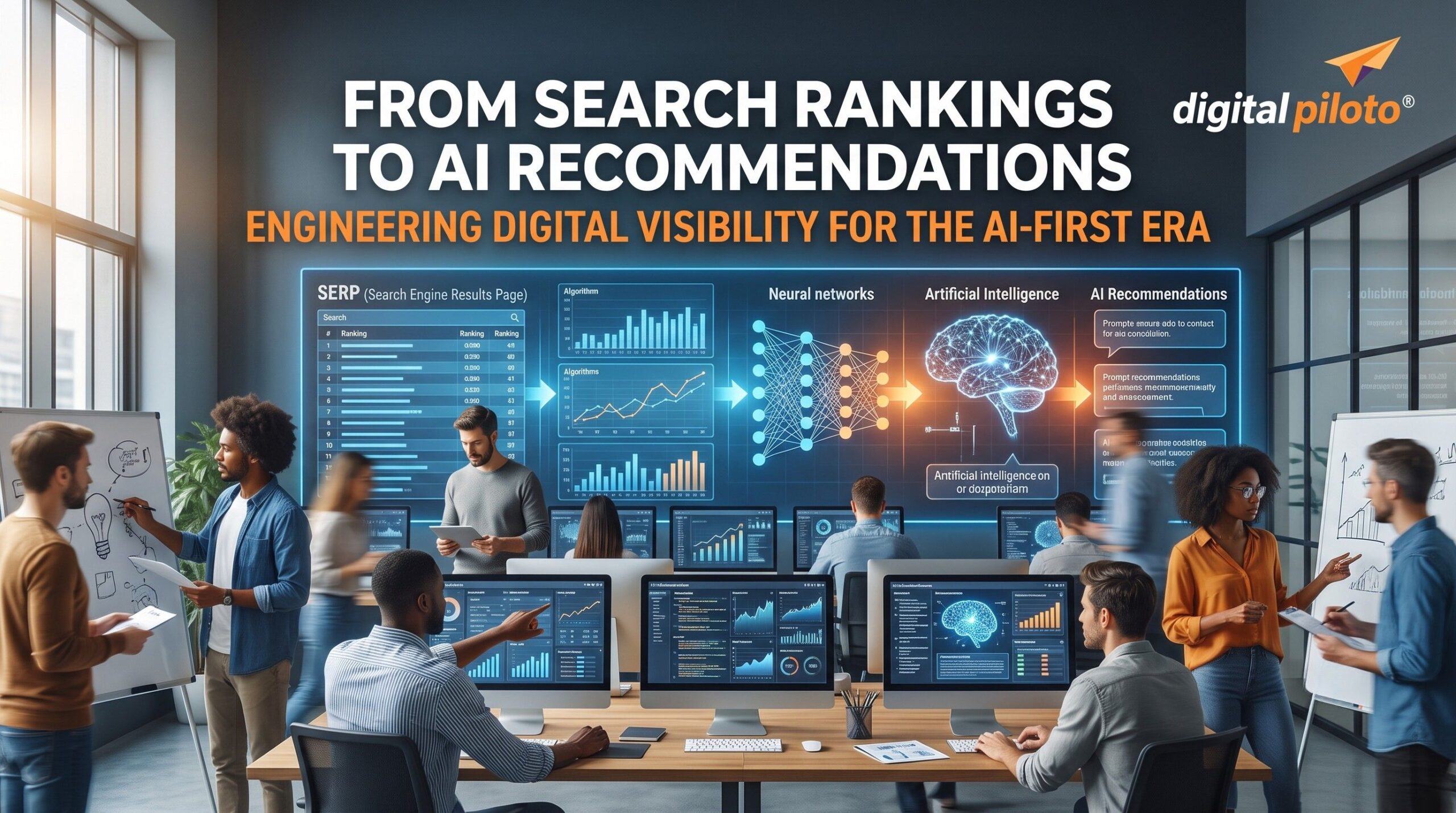
Imagine a potential customer asking an AI assistant to recommend a reliable service provider. Instead of browsing ten blue links, they receive a short list of options, explanations, and supporting sources. Is your brand part of that answer? In the AI-first era, digital visibility means more than earning rankings; it means becoming relevant, recognizable, and trustworthy wherever customers search.
For a digital marketing agency India, this shift changes how online growth should be approached. Traditional SEO remains important, but businesses must also prepare for AI-generated summaries, conversational search, and recommendation systems that help users narrow their choices before visiting a website.
Why Digital Visibility Is Changing
For years, digital marketing followed a fairly familiar path: optimize a page, improve its ranking, attract a click, and guide the visitor toward a conversion. That model still matters. Yet search behavior is expanding beyond conventional result pages.
People now ask detailed questions in conversational interfaces, compare products through AI-assisted tools, and expect answers that combine information from multiple sources. Rather than searching only for “accounting software,” a business owner might ask which platform works best for a growing company with multiple branches and limited administrative staff.
The difference is significant. A simple keyword may lead to a list of pages. A complex question requires context, comparisons, and a useful recommendation. Brands therefore need to provide information that helps answer not just what they sell, but who benefits from it, why it fits, and how it compares with alternatives.
This does not mean traditional search has disappeared or that every customer now uses AI. Search engines, social platforms, referrals, marketplaces, and direct visits continue to play different roles. The practical response is to broaden your visibility strategy instead of abandoning established SEO principles.
Rankings, Mentions, and AI Recommendations Are Different
One reason businesses struggle to measure AI-first visibility is that they treat several distinct outcomes as if they were the same thing.
- Search rankings: Your web pages appear in conventional search results for relevant queries.
- AI citations: An AI-generated answer links to a source supporting part of its response.
- Brand mentions: Your company is named in an answer, even when no direct link appears.
- AI recommendations: A system identifies your product or service as a potentially suitable option for the user’s needs.
These outcomes can overlap, but one does not guarantee another. A page may rank well without appearing in an AI-generated answer. A company might be mentioned because a source discusses its history, not because the system recommends it. Even a recommendation does not guarantee a website visit or purchase.
That distinction should shape reporting. Businesses need to understand where they appear, what the AI says about them, which sources support the answer, and whether the visibility contributes to meaningful customer activity.
Build Content Around Real Customer Questions
In an AI-first environment, content needs to do more than include a target keyword. It should resolve a genuine information need with enough clarity and context to help someone make a decision.
Move from keyword lists to intent clusters
Suppose a company offers cloud migration services. Its audience may search for migration costs, security risks, implementation timelines, provider comparisons, and post-migration support. These queries belong to different stages of the buying journey, even though they relate to the same service.
Organize content around those connected needs. An introductory guide can explain the process, a technical article can explore security considerations, and a comparison page can help decision-makers evaluate approaches. Together, these resources give readers a more complete picture of the business’s expertise.
Answer first, then explain
When a page opens with several paragraphs of generic background, readers may have to work too hard to find the answer. A clearer structure introduces the central point early and follows with supporting evidence, practical examples, limitations, and next steps.
For example, a page about website accessibility should state what accessibility means in practical terms before discussing testing methods and implementation details. Direct answers help human readers, while descriptive headings and coherent page structure can make information easier for search systems to interpret.
Bring original expertise to the page
Repeating information that already appears everywhere gives users little reason to trust or remember your brand. Add something useful: an expert’s explanation, a documented workflow, an original comparison, a real customer example published with permission, or a clear discussion of trade-offs.
Google’s guidance on creating helpful, reliable, people-first content offers a useful starting point. The emphasis is on serving people with useful information, not producing pages simply to attract search traffic.
Make Your Brand Easy to Understand and Verify
Imagine meeting someone who describes their profession differently every time you speak. Eventually, you would struggle to explain what they actually do. A brand can create a similar problem when its website, business profiles, product pages, and external references contradict one another.
Clear brand identity is especially important when search experiences assemble information from different sources. Keep core details consistent, including the official company name, services, locations, product capabilities, leadership information, and relevant qualifications.
Then make those details verifiable. If your business claims a specialist capability, explain the process behind it. If you publish research, describe the methodology. If you reference a certification, identify the issuing organization and link to an appropriate source when available.
Practical actions include:
- Strengthen core pages: Maintain clear About, service, product, contact, and company-information pages.
- Use descriptive structure: Organize pages with meaningful headings, useful internal links, and specific language rather than vague promotional claims.
- Support factual claims: Link to credible primary sources, official documentation, research, or relevant standards.
- Maintain legitimate external profiles: Keep business listings and professional profiles accurate, and encourage authentic customer feedback.
- Review outdated information: Update discontinued services, old statistics, expired offers, and obsolete technical guidance.
These practices do not guarantee that an AI system will select your brand. They do, however, create a clearer and more trustworthy information environment for prospective customers and the systems they use to research options.
Technical SEO Remains the Foundation
It is tempting to treat AI visibility as an entirely new discipline. In reality, many of the basics still matter: accessible pages, logical navigation, useful internal links, reliable performance, and content that search systems can discover and interpret.
Check that important pages can be crawled and indexed where appropriate. Avoid hiding essential information behind elements that prevent users or search systems from accessing it. Use descriptive page titles, sensible URLs, and structured data when it accurately represents the content.
Structured data can clarify details about a page, organization, product, or other supported entity. It is not a magic switch for AI recommendations. Google’s documentation on structured data explains how to use this markup appropriately.
Technical SEO also needs to work alongside editorial quality. A perfectly crawlable page that contains thin, misleading, or outdated information is unlikely to build durable trust with readers. Conversely, excellent content cannot perform as intended if the page is inaccessible or its key information is difficult to find.
Earn Authority Across the Wider Web
Your website tells customers what you want them to know. Independent sources can help them evaluate whether those claims deserve confidence. Industry publications, relevant professional organizations, credible reviews, expert interviews, and genuine customer references may all contribute to a more complete understanding of your brand.
This is where a digital transformation agency India can support a connected visibility strategy by aligning content, technical improvements, analytics, and broader digital operations. The objective is not to create artificial popularity, but to make the brand’s expertise easier to discover and verify across relevant touchpoints.
Focus on relevance rather than sheer volume. A thoughtful mention in a respected industry publication may be more meaningful to your audience than dozens of links from unrelated websites. Likewise, authentic customer reviews provide more credible context than manufactured testimonials.
Avoid shortcuts such as buying low-quality backlinks, publishing fabricated case studies, or creating multiple near-identical pages to target tiny keyword variations. These tactics can undermine credibility and distract teams from building genuinely useful resources.
Measure Visibility in the AI-First Era
AI recommendations are harder to measure than traditional rankings because responses can vary by prompt, platform, location, and context. Some platforms expose citations and referral traffic; others provide limited reporting. A single test is not enough to establish a reliable trend.
Build a consistent monitoring process using questions that reflect how your customers actually research products and services. Test informational queries, provider comparisons, and purchase-oriented prompts across the AI search experiences relevant to your market.
Track a practical combination of measures:
- AI visibility: How frequently your brand appears in a defined set of relevant prompts.
- Citation quality: Whether AI answers link to accurate pages that genuinely support the information presented.
- Recommendation context: Whether the brand is described appropriately and compared fairly with alternatives.
- Organic and referral traffic: Whether relevant visitors arrive from search engines or identifiable AI platforms.
- Business outcomes: Qualified enquiries, conversions, assisted sales, and recurring customer questions.
Use the same prompts and conditions over time where possible, and record the date and platform for each test. Treat results as directional because answers can change. Combine observation with web analytics, customer feedback, and conversion data rather than relying on a single visibility score.
Where SEO Fits Into the New Visibility Model
SEO is not becoming irrelevant; its role is expanding. A well-optimized page can help users discover a business, while useful content and credible supporting information can help them understand why that business may be a good fit.
An experienced Indian SEO company can help align technical SEO, search intent, content development, and conversion paths. The strongest approach treats AI search optimization as an extension of sound search practices rather than a replacement for them.
Relevant terms such as AI search visibility, generative engine optimization (GEO), and AI brand recommendations describe useful parts of this evolving field. Use these concepts to organize strategy, but let customer needs—not keyword density—determine what you publish.
Frequently Asked Questions
1. Is traditional SEO still important in the AI-first era?
Yes. Technical accessibility, useful content, clear site structure, and relevant search visibility remain important. AI-driven discovery adds new ways for people to find information, so businesses should broaden their strategy instead of abandoning SEO fundamentals.
2. How can a brand appear in AI-generated recommendations?
Publish accurate, useful content that answers relevant questions, maintain consistent brand information, support claims with credible evidence, and earn legitimate references from relevant sources. These practices can improve discoverability, but no method guarantees an AI recommendation.
3. What is the difference between AI citations and AI recommendations?
An AI citation links to a source used to support information in an answer. An AI recommendation presents a brand or product as a potentially suitable option. A company may be cited without being recommended, and recommendations do not always include a direct link.
4. How often should businesses monitor AI search visibility?
Monthly checks can be a practical starting point, with additional monitoring after significant content or website changes. Use a consistent set of relevant prompts, record results by platform, and assess trends alongside referral traffic and business conversions.
Final Thoughts
Digital visibility is no longer a contest for rankings alone. Businesses also need to become understandable, useful, and credible sources in the environments where customers research their choices. Strong SEO, original expertise, consistent brand information, and meaningful external references provide a sensible foundation. You cannot control every AI recommendation, but you can give customers—and the systems helping them—better reasons to recognize your value.
Blog Development Credits
The concept was developed by Amlan Maiti, supported by AI-assisted research and drafting, then refined for search relevance by Digital Piloto Private Limited.