

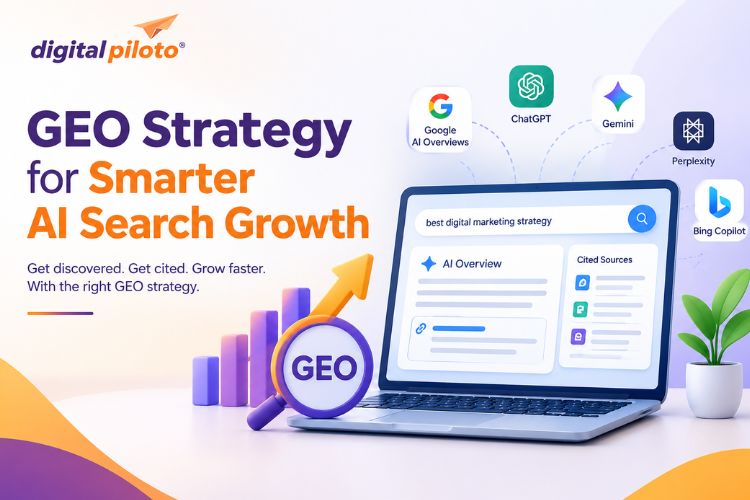
A GEO strategy is a repeatable system for making a brand easier for AI-powered search to find, understand, trust and cite. It does not replace SEO: Google says the same foundational SEO practices remain relevant for AI Overviews and AI Mode, while current generative-search systems add new visibility opportunities around citations, entities and answer inclusion.
For brands in India, the practical starting point is to combine technical accessibility, clear brand/entity information, answer-ready content, credible third-party evidence and continuous measurement. A generative engine optimization specialist can help turn those elements into one coordinated search strategy rather than a collection of disconnected AI tactics.
Also Read: ChatGPT Ads Manager: The Complete Guide to Advertising on ChatGPT in 2026
Why GEO Matters for Digital Marketing Growth
Search is becoming more conversational and more answer-led. Google reported in May 2026 that AI Mode had surpassed one billion monthly users, while its newer AI search experience is designed to support deeper exploration and follow-up questions.ChatGPT search also returns links to web sources, showing that AI answers can create a new discovery layer between a user’s question and a company website.
The implication is simple: visibility is no longer only about ranking for a keyword. A brand also needs to be understandable and useful when a system synthesizes an answer from multiple sources.
A Practical GEO Strategy Framework
1. Build a Strong Technical Foundation
Start with the fundamentals: crawlability, indexability, internal linking, fast page experience, accessible text and consistent structured data. Google explicitly says there are no special technical requirements, AI-only files or special schema needed to qualify for AI Overviews or AI Mode.That makes technical SEO the foundation of GEO—not a separate technical trick.
2. Strengthen Entity Clarity
AI systems need to understand exactly who your business is, what you offer, where you operate and which entities are connected to you. Keep business descriptions, services, locations, authorship and organization details consistent across the website and important public profiles. Clear entity relationships reduce ambiguity and make your expertise easier to interpret.
3. Create Answer-Ready Content
Write for real questions, not just keyword strings. Lead important sections with a direct answer, then add evidence, context, examples and limitations. Use descriptive headings, concise definitions, comparison tables and original insights where they genuinely help. The foundational GEO research reported visibility gains of up to 40% in its benchmark, while also finding that optimization effects varied by domain; this is evidence of an experimental effect, not a guaranteed result on today’s commercial AI platforms.
4. Earn Authority Beyond Your Own Website
AI visibility is influenced by the wider web ecosystem. Industry publications, credible directories, expert commentary, original research, professional profiles and consistent brand mentions can provide supporting evidence around your entity. The goal is not to manufacture mentions; it is to make the public web tell a clear, credible and consistent story about your business.
5. Measure the AI Visibility Loop
Track a fixed set of buyer prompts across relevant AI platforms and record whether your brand is mentioned, cited, accurately described and associated with the right services. Google added dedicated generative-AI visibility reporting to Search Console in 2026, and Bing’s AI Performance reporting exposes citation counts, cited pages, grounding queries and visibility trends.[5][6]
| GEO KPI | What It Tells You |
|---|---|
| Prompt inclusion | Whether your brand appears for priority questions |
| Citation rate | Whether AI answers reference your pages as sources |
| Entity accuracy | Whether services, locations and positioning are described correctly |
| Qualified conversions | Whether AI-driven discovery contributes to business outcomes |
How GEO Fits Into a Wider Marketing Strategy
GEO works best when it is integrated with SEO, content, digital PR, analytics and conversion optimization. SEO helps your content remain discoverable and eligible; GEO adds a layer of prompt, entity, citation and answer visibility. For Kolkata-focused brands, this can work alongside a broader Best Digital Marketing Service In Kolkata strategy rather than replacing it.
The most useful workflow is a continuous loop: identify high-value prompts → audit current AI visibility → fix technical and content gaps → strengthen authority → measure citations and outcomes → refresh the strategy.
What Makes a GEO Strategy Smarter?
A smarter strategy avoids chasing every new AI feature. Instead, prioritize the questions that matter to revenue, create information that deserves to be cited, make the brand entity unambiguous, and measure changes over time. This approach also keeps the strategy resilient as individual AI interfaces and models evolve.
Conclusion
Generative search is expanding the definition of digital visibility. The winning mindset is not “SEO versus GEO,” but a unified system in which technical SEO, helpful content, entity clarity and authority reinforce one another. Brands that build this foundation can be easier for both search engines and AI systems to discover, interpret and reference.
Also Read: Top Quantum SEO Trends for 2026
Blog Development Credits:
This article was envisioned by Amlan Maiti. Research and drafting were supported by advanced AI platforms including ChatGPT, Google Gemini, and Copilot, while the final editorial review, SEO refinement, and optimization were completed by Digital Piloto Private Limited.