

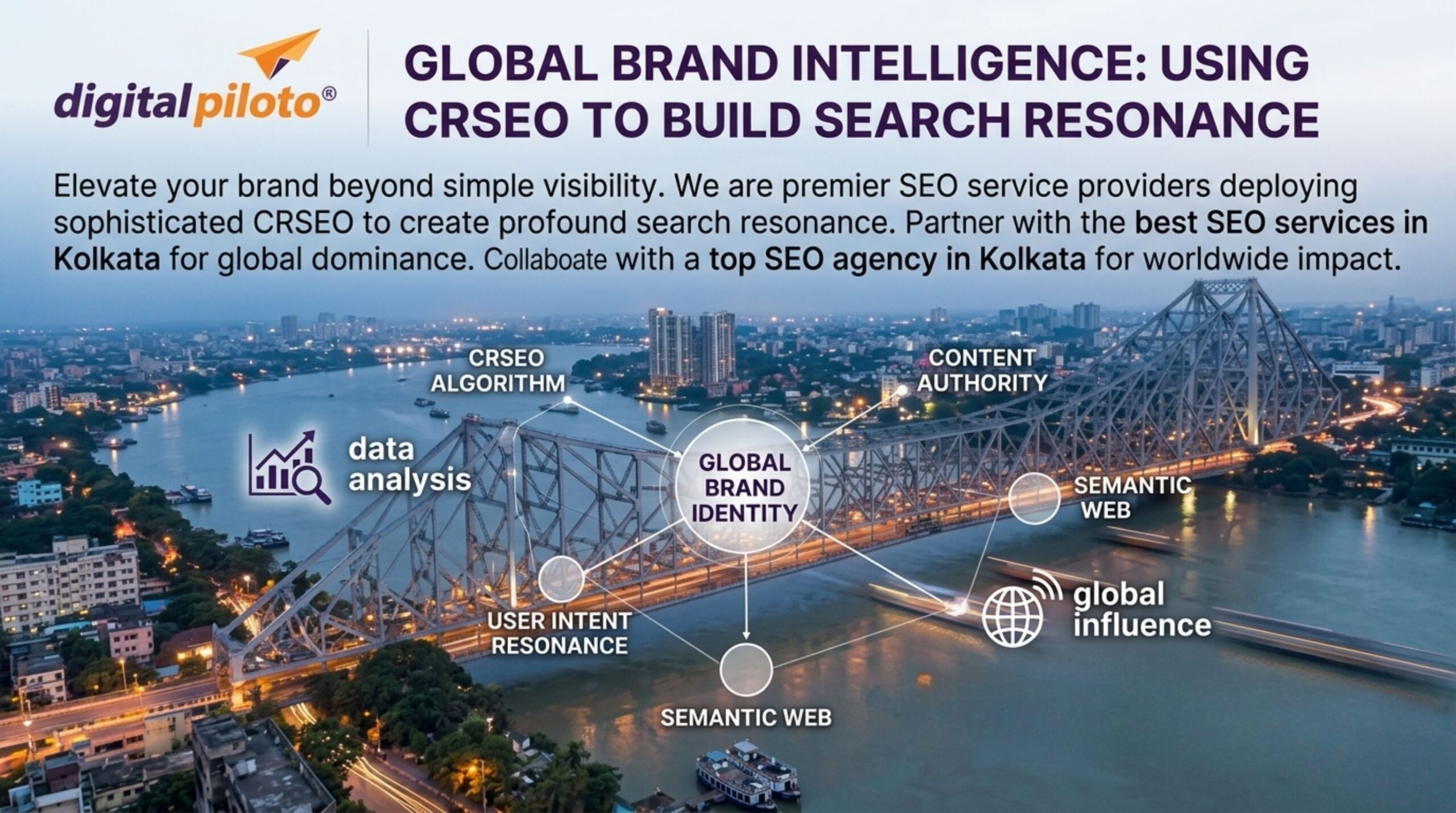
Global brands no longer compete only for rankings; they compete to be understood. Customers move between search engines, AI assistants, marketplaces, social platforms, reviews, and communities before making decisions. The challenge is connecting those scattered signals into one recognizable identity—where a digital marketing agency in India can help turn fragmented visibility into lasting search resonance.
What Is Search Resonance?
Imagine a customer hearing your brand name in three different places. One article describes what you do. A review explains how customers use your product. An AI assistant later mentions your company when someone asks for a recommendation in your category.
Those interactions are not isolated. Together, they create a mental and digital picture of your brand.
That is the basic idea behind search resonance: the ability of a brand’s identity, expertise, reputation, and relevance to remain consistent across the places where people—and increasingly machines—discover information.
CRSEO can be viewed as a strategic approach to this problem. Rather than treating search optimization as a narrow ranking exercise, it connects content, reputation, relevance, search behavior, and brand intelligence into one framework.
The distinction matters because modern search increasingly blends conventional results with AI-generated answers. Google says its generative AI features use Search’s underlying systems and that established SEO practices remain relevant to visibility in these experiences.
Why Global Brands Need Intelligence, Not Just SEO
A global brand can perform brilliantly in one market and strangely in another.
A product may be widely recognized in the United States but relatively unknown in India. A European audience may associate the same company with sustainability, while customers elsewhere know it primarily for convenience or price. Even the language people use to describe the category can change.
This is where conventional keyword reporting starts to feel a little too small.
Global brand intelligence looks at the broader information environment surrounding a company. It asks questions such as:
- How do customers describe the problem in different countries?
- Which competitors are associated with the category?
- What attributes repeatedly appear alongside the brand?
- Which questions trigger branded or unbranded discovery?
- Where does the brand’s message become inconsistent?
- Which third-party sources reinforce—or contradict—the company’s positioning?
The goal is not to make every market sound identical. Quite the opposite. Strong global brands maintain a recognizable core while allowing local search behavior and cultural context to shape the expression.
Search Is Still Massive—and Becoming More Complex
It would be easy to assume that AI search has already replaced conventional search. The data does not support such a simple conclusion.
StatCounter reported that Google accounted for about 91.1% of worldwide search-engine market share in August 2026, with Bing at roughly 4.5%. These figures vary by platform and geography, but they illustrate why traditional search remains commercially important even as AI-powered discovery expands.
At the same time, search itself is changing. Google now documents AI Overviews and AI Mode as part of its Search experience, while its current guidance emphasizes creating useful, original content rather than chasing special technical tricks for generative AI.
So the opportunity is not “SEO versus AI.” It is understanding how the two increasingly overlap.
CRSEO and the Shift From Rankings to Recognition
Traditional SEO often revolves around a sequence that looks familiar: identify a keyword, create a page, optimize it, earn authority, and monitor rankings.
CRSEO expands the lens.
Instead of asking only whether a page ranks for “enterprise cybersecurity software,” for example, a brand intelligence approach asks what happens when a buyer searches for the problem without knowing which company to choose.
They might search:
- “How do large companies reduce third-party cyber risk?”
- “What should enterprises look for in vendor risk software?”
- “Which cybersecurity platforms integrate with existing procurement workflows?”
These are not simply keyword variations. They represent different stages of understanding.
A brand that consistently appears around those questions has a stronger chance of becoming part of the buyer’s mental shortlist. That is search resonance in action.
The Five Layers of Global Brand Intelligence
1. Entity intelligence
First, the brand needs a stable identity.
Search systems should be able to determine what the company is, what it offers, which markets it serves, and which entities are closely associated with it. A vague homepage filled with fashionable marketing phrases makes that harder than it needs to be.
Clear product descriptions, organization information, author credentials, structured data where appropriate, consistent naming, and accessible content all contribute to a stronger entity footprint.
2. Query intelligence
Customers rarely use the same vocabulary as marketers.
A company may call something “AI-enabled customer intelligence,” while buyers search for “software that tells sales teams which leads are likely to convert.” Both may refer to the same solution.
CRSEO therefore studies the language surrounding customer problems—not just the company’s preferred terminology.
3. Reputation intelligence
Search visibility increasingly depends on what exists beyond the corporate website.
Reviews, industry publications, expert commentary, interviews, community discussions, analyst coverage, partner websites, and customer references can all contribute to how a brand is interpreted.
This does not mean manufacturing mentions. In fact, artificial reputation-building tends to create a brittle footprint. The more sustainable approach is to create genuinely useful things that other people have a reason to reference.
4. Competitive intelligence
Competitors reveal how a market is being framed.
Suppose three competitors repeatedly appear in AI-generated answers for a particular category. A brand intelligence audit should investigate why. Are those companies better known? Do they publish stronger research? Are their product pages clearer? Do independent sources describe them more frequently?
The answer may have very little to do with keyword density.
5. Regional intelligence
Global does not mean generic.
A brand expanding into India, Germany, Singapore, Brazil, or the Middle East needs to understand local search vocabulary, buying concerns, regulations, cultural context, and competitive narratives.
A single global content template can easily flatten these differences. Search resonance works better when the brand’s central identity stays consistent while the surrounding context becomes locally relevant.
From Search Data to Brand Intelligence
One of the most useful changes a company can make is to stop treating Search Console, analytics, social listening, reviews, and keyword platforms as completely separate information silos.
Instead, bring the signals together.
- Search data shows what people actively look for.
- Website behavior shows what information attracts attention or causes friction.
- Review data reveals how customers describe real experiences.
- Competitive data shows which associations surround rival brands.
- AI-search monitoring reveals how conversational systems describe and compare companies.
When those signals are viewed together, patterns become easier to spot.
Perhaps customers repeatedly praise reliability in reviews, while the website emphasizes innovation. Perhaps competitors own the “easy to implement” narrative while your company dominates technical performance. Perhaps customers in one country search by industry while another market searches by use case.
Those are brand intelligence findings—not merely SEO findings.
Building Resonance Across AI Search
This is where a generative engine optimization specialist can become part of a broader brand strategy.
AI systems increasingly generate answers by synthesizing information from multiple sources. Google describes AI Overviews and AI Mode as experiences that can draw from a variety of web sources.
That creates a different challenge from ranking one webpage.
A brand needs a coherent information footprint. If the homepage says one thing, product documentation says another, review sites describe something else, and industry publications use inconsistent terminology, the resulting picture can become blurry.
Search resonance improves when the important facts are consistent while the content itself remains diverse.
That means publishing original research in one place, detailed product documentation somewhere else, expert commentary through industry publications, useful educational resources on the website, and authentic customer evidence where appropriate.
The objective is not to repeat the same paragraph everywhere. It is to create multiple pieces of evidence that independently reinforce the same underlying brand identity.
How a Global Brand Can Operationalize CRSEO
CRSEO becomes much more practical when turned into a recurring workflow rather than a one-time audit.
- Build a brand vocabulary map. Document products, services, categories, problems, audiences, competitors, experts, locations, and important attributes.
- Map customer questions. Separate informational, commercial, comparison, local, technical, and brand-specific searches.
- Monitor market narratives. Track how customers, publishers, competitors, and AI systems describe the category.
- Identify resonance gaps. Find situations where the company’s desired positioning does not match what searchers or third-party sources actually associate with it.
- Create evidence. Develop content, research, documentation, expert commentary, and customer proof that genuinely addresses those gaps.
- Measure again. Look for changes in visibility, branded search behavior, citations, referral traffic, qualified leads, and the consistency of brand descriptions.
This continuous loop is important because brand perception is not static. Markets move. Competitors reposition. New product categories appear. Customer language changes. AI systems change how they present information.
Why Content Alone Cannot Create Search Resonance
Publishing 100 articles does not necessarily create a strong brand.
In some cases, it creates the opposite: a large pile of disconnected pages that compete with each other and leave readers unsure what the company actually stands for.
Google’s current guidance for generative AI search emphasizes the continuing importance of fundamental SEO and useful, distinctive content. It also warns against approaches designed primarily to manipulate Search rather than provide value.
That principle translates well to CRSEO.
Think less about content volume and more about informational coverage. If a buyer has five important questions before choosing your product, your website should answer all five clearly. If a journalist needs reliable background information, make it easy to find. If an AI system encounters your company for the first time, the basic facts should not require detective work.
The Role of an SEO Company in India in Global Strategy
Global brand intelligence does not mean every business needs a multinational marketing operation. A focused team can build the framework, then scale it market by market.
An experienced SEO company in India can support this process by combining technical SEO, content strategy, search analytics, competitor research, entity optimization, and international search considerations.
The critical point is integration. Technical optimization should support discoverability. Content should reinforce positioning. Digital PR should strengthen credibility. Analytics should reveal behavior. AI-search monitoring should expose new discovery patterns.
When these activities work separately, the brand may appear fragmented. When they reinforce one another, search becomes a much stronger source of brand intelligence.
Metrics That Matter for Search Resonance
Rankings still have their place, but they are only one part of the picture.
A broader CRSEO measurement framework might examine:
- Brand-query growth: Are more people searching specifically for the company or its products?
- Unbranded visibility: Does the brand appear around important category and problem-based searches?
- AI representation: How accurately do AI search experiences describe the company?
- Citation diversity: Which independent sources repeatedly appear alongside the brand?
- Market consistency: Does the core brand identity remain recognizable across countries?
- Commercial impact: Are qualified visits, enquiries, sign-ups, or assisted conversions improving?
There is no universal benchmark that tells every company what “good” looks like. The useful benchmark is often your own baseline and its movement over time.
FAQs
What does CRSEO mean in brand marketing?
CRSEO can be used as a strategic framework for connecting search, reputation, customer language, and brand intelligence. Rather than focusing only on rankings, it examines how consistently a brand is understood and discovered across modern search environments.
How is CRSEO different from traditional SEO?
Traditional SEO primarily focuses on improving a website’s visibility for relevant searches. CRSEO takes a broader view by considering brand identity, customer language, third-party reputation, competitive narratives, regional differences, and AI-powered discovery alongside conventional SEO.
Why is brand intelligence important for global SEO?
Customers in different markets may use different terminology, prioritize different benefits, and trust different information sources. Brand intelligence helps companies identify those differences while maintaining a consistent core identity.
Can CRSEO help with AI-powered search?
Yes, as a strategic approach. AI-powered search systems can synthesize information from multiple sources, so brands benefit from having clear positioning, useful content, credible references, and consistent information across their wider digital footprint. Google also confirms that fundamental SEO remains relevant to its generative AI Search experiences.
Final Thoughts
Global search visibility is becoming less about occupying one position and more about building a recognizable information footprint.
CRSEO offers a useful way to think about that change. The strongest brands are not simply optimized for algorithms; they are understood by people, consistently represented across markets, and supported by enough credible information to remain discoverable when the search journey becomes conversational.
That is the real meaning of search resonance. When your brand keeps making sense wherever customers encounter it, visibility stops being a collection of isolated rankings and starts becoming a durable business asset.
Blog Development Credit
Conceptualized by Amlan Maiti, researched and developed with ChatGPT, Google Gemini and Copilot, then refined and SEO-optimized by Digital Piloto Private Limited.