
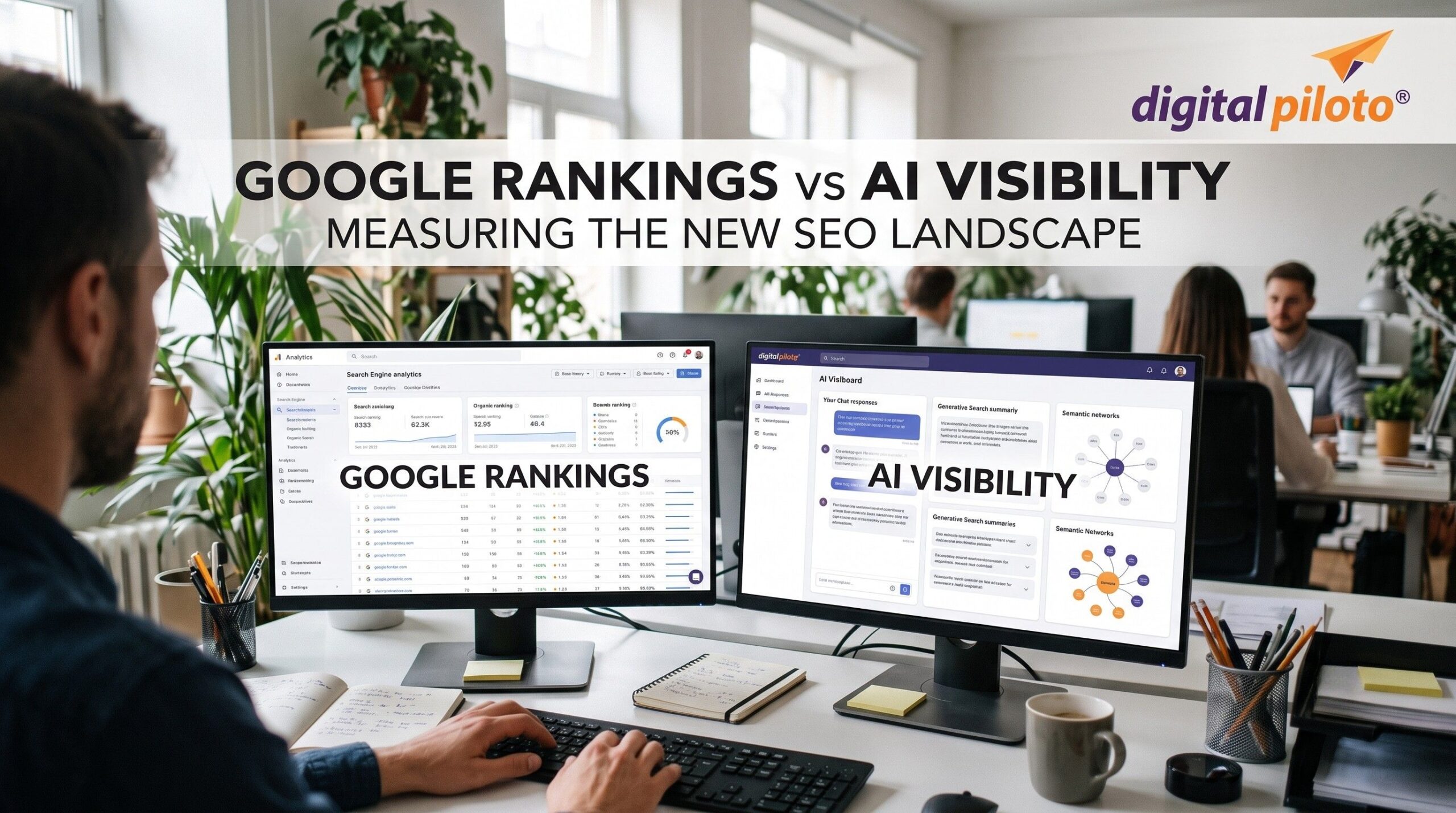
For years, SEO success could be summed up with three numbers: rankings, clicks, and traffic. AI search is making that scoreboard feel incomplete. A page can rank well and still be absent from an AI answer, while another brand can influence a recommendation without receiving the click. For an SEO service provider in India, that changes what meaningful visibility looks like.
Search Visibility Is Splitting Into Two Worlds
Imagine a customer standing outside two shops.
One shop has a huge sign and sits on the busiest street. The other is mentioned by a knowledgeable local guide who tells the customer exactly why it is worth considering.
Traditional SEO has largely focused on getting the biggest sign on the busiest street. AI search introduces the guide.
Google rankings still matter. They determine whether pages can be discovered through conventional search results, and they remain part of the systems that support Google’s generative search experiences. But AI-powered interfaces can also summarize information, combine sources, answer follow-up questions, and recommend options without requiring the user to inspect ten separate pages.
Google’s own guidance makes the relationship clear: SEO remains relevant because AI Overviews and AI Mode are rooted in Google’s core Search ranking and quality systems. Google also explains that retrieval-augmented generation helps these features retrieve relevant and current pages from its Search index.
So the future is not “SEO versus AI.” It is SEO plus a broader visibility layer.
What Is the Difference Between Ranking and AI Visibility?
A traditional ranking answers a relatively straightforward question:
Where does my page appear for a particular search?
AI visibility asks something more fluid:
Does my brand, content, expertise, or source appear when an AI system answers questions relevant to my business?
Those sound similar. They are not.
A company can rank number one for a commercial keyword and still fail to appear when a user asks a conversational question that leads to an AI-generated recommendation.
Likewise, a brand may appear as a supporting source in an AI response even though the referenced page is not ranking first for the exact wording of the user’s question.
This creates a new measurement problem. Ranking position is relatively easy to visualize. AI visibility is contextual.
It depends on the question, the retrieved sources, the user’s context, the search experience, and sometimes the wording of the interaction itself.
Why Traditional SEO Metrics Are No Longer Enough
Let’s be clear: rankings, clicks, impressions, and organic traffic should not be thrown away. They remain essential.
The problem is assuming that they tell the whole story.
Consider someone researching a B2B service. They ask an AI search engine for the best providers, read a generated comparison, notice your company, and then search your brand directly two days later.
Your analytics system might attribute the eventual visit to branded search.
The original AI exposure can disappear from the obvious conversion story.
That matters because AI search is changing how people gather information. Pew Research Center analyzed 68,879 Google searches from March 2025 and found that traditional result links were clicked on 8% of visits when an AI-generated summary appeared, compared with 15% when there was no AI summary. Links within the AI summaries themselves were clicked in about 1% of visits. The study covered a specific U.S. sample and period, so the figures should not be treated as a universal CTR benchmark.
The takeaway is not that clicks no longer matter.
It is that exposure can happen before the click—or without one.
The New SEO Scorecard
A more complete measurement model should combine conventional SEO with AI-specific signals.
Think of it as a dashboard with several dials rather than one speedometer.
- Search rankings: How strongly do important pages perform for target queries?
- Organic impressions: How frequently are those pages being surfaced?
- AI visibility: How often does the brand appear in relevant AI-generated answers?
- Citations: How frequently are brand-owned or authoritative sources referenced?
- Brand demand: Are branded searches and direct interactions increasing?
- Business outcomes: Are visibility gains contributing to qualified leads, sales opportunities, or revenue?
Each metric answers a different question. Rankings tell you about conventional search positioning. AI visibility tells you whether your expertise is entering generative discovery. Business metrics tell you whether either form of visibility is commercially useful.
Google Is Making AI Visibility More Measurable
One of the biggest changes to the measurement landscape came directly from Google.
In June 2026, Google announced dedicated generative AI performance reports in Search Console for features including AI Overviews and AI Mode. Google said the reports provide information such as impressions, appearing pages, countries, devices, and performance over time. As of August 31, 2026, Google reported that these insights had been rolled out to websites worldwide.
That is a major step forward for marketers.
Instead of relying entirely on third-party estimates, website owners can now use Google’s own reporting environment to understand visibility within its generative AI search features.
But there is a catch—and it is an important one.
An impression is not a conversion.
Seeing a URL in an AI feature tells you that visibility happened. It does not automatically tell you whether the user trusted the information, remembered the brand, clicked, searched again, or eventually purchased.
That is why AI visibility should be connected to the rest of the marketing funnel.
Measure Visibility at the Query Level
One of the easiest ways to make AI visibility measurable is to stop trying to measure everything.
Build a focused set of questions that matter to your business.
For example, a company offering SEO and digital marketing services could monitor questions such as:
- Which SEO providers are suitable for Indian businesses?
- What should a company consider before hiring an SEO agency?
- How can a business improve visibility in AI search?
- Which agencies specialize in generative search optimization?
- What is the difference between SEO and GEO?
Track these questions consistently across relevant AI-search environments.
Do not expect identical responses every time. That would defeat the point. Instead, record patterns.
For each query, note whether your brand appears, how it is described, which page or source is cited, which competitors are mentioned, and whether the answer accurately reflects your positioning.
A simple AI visibility rate
You can create an internal benchmark using:
AI Visibility Rate = Relevant queries where your brand appears ÷ Total tracked queries × 100
This is a custom business metric, not an official Google ranking score. Label it accordingly.
The real value comes from comparing it over time and segmenting it by topic, service, geography, intent, and competitor set.
Track Citation Quality, Not Just Mentions
Suppose your brand appears in 40 AI answers this month.
Sounds great.
Now imagine 35 of those mentions are buried in low-value informational questions that have no commercial relevance. Suddenly, the number looks less impressive.
This is why AI citations deserve qualitative analysis.
Ask whether your brand is appearing for the subjects you actually want to own.
A useful citation review should examine:
- Context: Was your brand mentioned in a relevant answer?
- Accuracy: Did the AI system describe your company correctly?
- Authority: Was your content used as supporting evidence?
- Intent: Was the query informational, commercial, navigational, or transactional?
- Competition: Which brands appeared alongside you?
This helps separate visibility from vanity.
Where GEO Fits Into the New SEO Landscape
Generative Engine Optimization is best viewed as an extension of search visibility—not a replacement for conventional SEO.
A generative engine optimization agency can help businesses examine how their content, entities, expertise, and brand information are represented across AI-driven discovery experiences.
The practical work may include mapping conversational queries, strengthening topic clusters, improving internal relationships between pages, clarifying business entities, creating original evidence-backed resources, and monitoring how AI systems describe the brand.
There is also an important strategic distinction here.
GEO is not about stuffing phrases into pages in the hope that an AI system will magically mention a company. It is about making the brand genuinely useful as a source of information.
Google’s current guidance supports this broader approach. Its documentation recommends continuing with established SEO fundamentals and warns marketers to be cautious about third-party services claiming access to secret or internal Google AI ranking signals.
Measure the Gap Between Rankings and AI Visibility
One of the most interesting reports a business can create is a ranking-versus-AI visibility matrix.
Put your important topics into four groups:
- High ranking + high AI visibility: Protect and strengthen these areas.
- High ranking + low AI visibility: Investigate whether content answers broader conversational questions poorly.
- Low ranking + high AI visibility: Examine why the brand is being surfaced despite weaker traditional positions.
- Low ranking + low AI visibility: These areas may require foundational SEO and content work first.
This is where the new SEO landscape becomes genuinely interesting.
A high-ranking page is not automatically a strong AI-search asset. Likewise, weak conventional rankings do not necessarily mean a brand has zero influence in generative discovery.
The gap between those two measurements can reveal opportunities that a traditional SEO report would miss.
Connect AI Visibility to Brand Demand
AI visibility often works further upstream than the final conversion.
A person might encounter your brand in an AI-generated answer, leave without clicking, and later search the company name. Another person might see your brand in an AI recommendation and mention it to a colleague.
Neither action necessarily appears as an AI referral in analytics.
So track supporting signals:
- Branded search impressions and clicks.
- Direct and returning website traffic.
- New versus returning leads.
- Assisted conversion paths.
- Sales conversations where prospects mention AI or search recommendations.
Do not claim that an increase in branded searches was caused by GEO unless you have evidence to support that conclusion. Advertising, PR, social activity, seasonality, offline campaigns, and competitor changes can all influence brand demand.
Instead, look for correlated movement across several indicators.
Do Not Let AI Volatility Distort Your Reporting
This is perhaps the hardest lesson for marketers.
You search on Monday and your brand appears.
You search again on Wednesday and it does not.
Should you rewrite the entire website?
Probably not.
AI-generated responses can change as retrieval results, content freshness, query formulation, and search systems evolve. A single observation is therefore weak evidence.
Use repeated measurements.
For priority queries, establish a regular monitoring schedule. Record the results, identify meaningful patterns, and resist the urge to react emotionally to every fluctuation.
It is similar to watching stock prices. A single day’s movement may be interesting, but the trend is what helps you make a better strategic decision.
Don’t Forget Multimodal Search
The measurement landscape is also expanding beyond typed queries.
In September 2026, Google announced Search Console reporting for web multimodal searches, covering experiences such as Google Lens, Circle to Search, image uploads, and Google’s “Search this image” functionality. The reporting is available through new filters in Search performance and generative AI reporting.
For visual industries, this matters considerably.
Product images, diagrams, locations, screenshots, videos, and other visual assets can become part of discovery. The definition of “search visibility” is gradually becoming broader than a blue link and a text query.
Build a Balanced SEO and AI Dashboard
A practical monthly dashboard does not need fifty metrics. In fact, that usually makes decision-making worse.
Focus on a compact set that answers three questions:
- Are we discoverable? Track rankings, impressions, AI visibility, citations, and branded exposure.
- Are we relevant? Evaluate the topics, queries, entities, and commercial contexts where the brand appears.
- Are we growing? Connect visibility to qualified leads, conversions, pipeline, and revenue.
Then compare these measures over meaningful periods rather than obsessing over day-to-day movement.
A best digital marketing company in India should be able to explain not just where a website ranks, but how the brand is being discovered and represented across the wider search ecosystem.
Frequently Asked Questions
Is Google ranking still important with AI search?
Yes. Google says its generative AI search experiences are rooted in core Search ranking and quality systems. Traditional SEO remains an important foundation for AI visibility.
What is AI visibility in SEO?
AI visibility describes how frequently and accurately a brand, website, product, or source appears in AI-generated search answers and related generative discovery experiences.
How can businesses compare rankings with AI visibility?
Create a consistent set of commercially important queries and compare traditional rankings with AI mentions, citations, competitors, branded demand, and business outcomes for the same topics.
Can AI visibility be measured in Google Search Console?
Yes. Google introduced dedicated generative AI performance reporting in Search Console for features such as AI Overviews and AI Mode. The reports provide visibility data that can be analyzed alongside conventional Search Console metrics.
Final Thoughts
The new SEO landscape is not asking marketers to choose between rankings and AI visibility. It is asking them to understand both.
Rankings tell you where your pages stand in traditional search. AI visibility tells you whether your expertise is entering the conversations happening inside generative search experiences.
The strongest strategy connects the two.
Keep improving technical SEO. Keep creating useful content. Keep earning authority. But also start measuring whether your brand is being surfaced, cited, understood, and remembered when customers ask AI systems the questions that matter to your business.
Because in modern search, the most valuable position may not always be the first blue link. Sometimes, it is being part of the answer itself.
Blog Development Credit
This article was conceived by Amlan Maiti, developed through research and AI-assisted drafting, then refined with SEO enhancements by Digital Piloto Private Limited.