

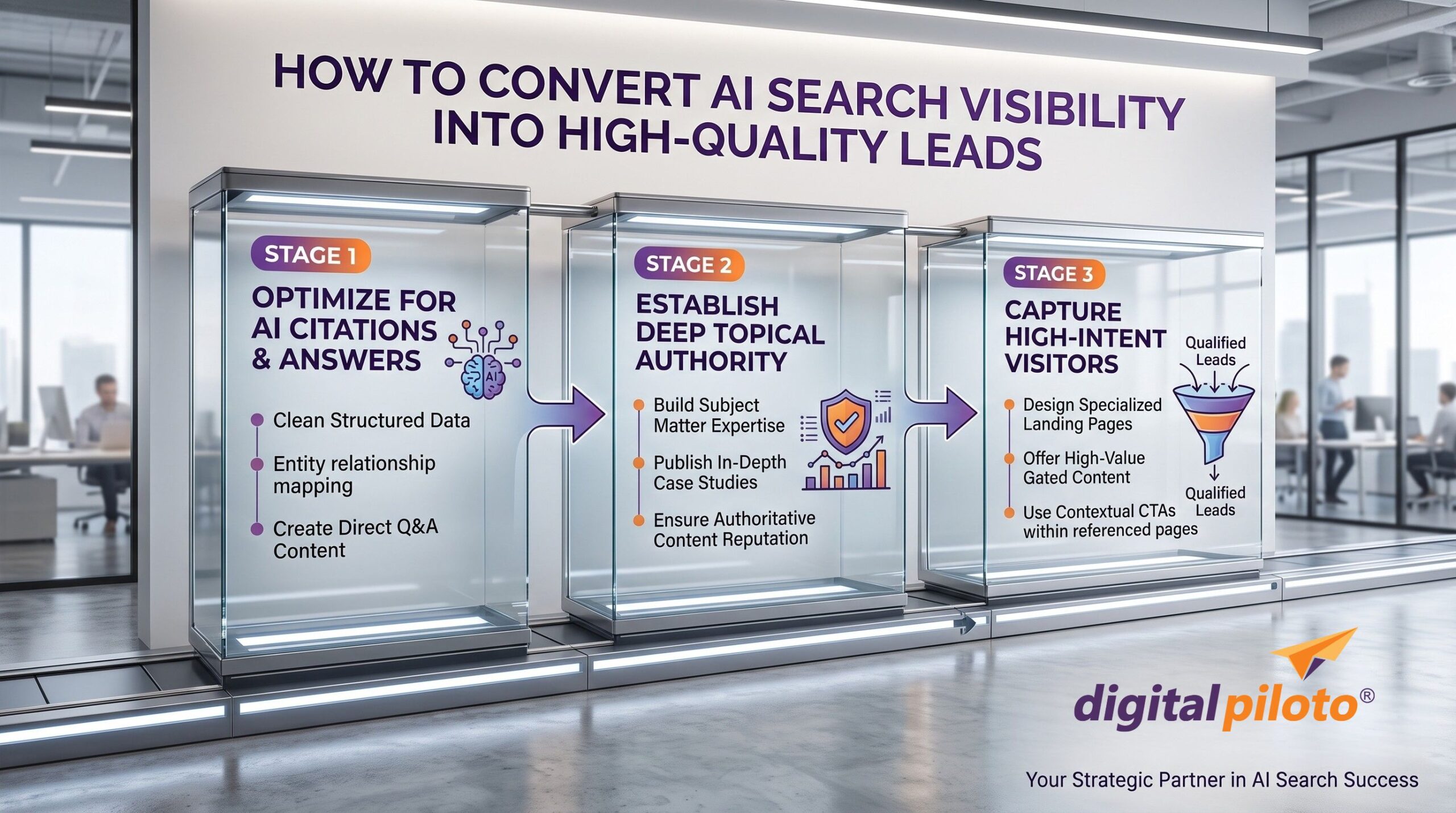
AI search visibility becomes valuable when it leads to meaningful business action. To convert that visibility into high-quality leads, brands need to align AI-discoverable content with buyer intent, build strong proof, create relevant landing experiences, and make the next step easy. For a digital marketing service provider in India, the goal should be qualified demand—not simply being mentioned by an AI system.
What Is AI Search Visibility?
AI search visibility is a brand’s ability to appear, be referenced, or be recommended within AI-generated answers and conversational search experiences.
It is different from traditional rankings. A company can gain visibility even when a user never sees a conventional list of ten blue links.
But visibility alone is not a lead-generation strategy. A brand may be mentioned in an AI answer thousands of times and still generate little commercial value if the content behind that visibility does not address buyer needs.
Why AI Visibility Does Not Automatically Create Leads
AI search often changes the user’s journey before they reach your website. The user may already have compared solutions, learned basic terminology, and narrowed down their options.
That means the website visit can happen later in the decision process. The visitor is no longer asking, “What is this?” They may be asking, “Can this company solve my specific problem?”
AI-referred visitors may want to know:
- Whether your solution fits their particular situation.
- How your offering differs from alternatives.
- What results or outcomes they can realistically expect.
- How much implementation may cost or involve.
- Whether your company has relevant experience.
This is why conversion strategy must start with intent rather than traffic volume.
1. Map AI Search Visibility to Commercial Intent
Not every AI-generated mention has equal business value. A brand appearing for an educational question may gain awareness, while visibility for a comparison or solution-specific question can have much stronger lead potential.
A useful approach is to classify AI search opportunities according to the user’s likely stage.
A simple intent framework:
- Informational: The user is learning about a problem or concept.
- Problem-aware: The user understands the challenge and is exploring solutions.
- Commercial: The user is comparing providers, products, or approaches.
- High-intent: The user is looking for a provider, quote, demo, consultation, or purchase.
The closer the query is to a commercial decision, the more important conversion-focused content becomes.
2. Create Content That Gives AI Systems Something Useful to Cite
If you want AI search engines to understand and reference your brand, vague marketing language is rarely enough. Useful content contains specific answers, clear entities, relevant evidence, and information that genuinely helps the reader.
For example, instead of saying, “We provide world-class SEO,” explain which problems you solve, how your process works, what types of businesses you serve, what outcomes you measure, and where your approach may not be appropriate.
This kind of structured expertise can serve two purposes at once: it improves the user’s understanding and gives AI systems clearer material to interpret.
3. Build a Landing Experience for the AI-Referred Visitor
One of the biggest mistakes brands make is sending every AI-discovered visitor to a generic homepage.
If someone reaches your site after asking an AI system about a specific business problem, the destination should continue that conversation.
Step-by-step landing page approach:
- Identify the triggering intent. Determine what question or problem likely brought the visitor.
- Answer immediately. Put the core answer or value proposition near the top of the page.
- Explain the solution. Show how your product or service addresses the specific problem.
- Provide proof. Use case studies, examples, reviews, credentials, data, or demonstrations.
- Address objections. Explain pricing factors, timelines, limitations, requirements, or alternatives where appropriate.
- Offer one clear next step. Use a relevant CTA such as consultation, demo, enquiry, assessment, or quote request.
The principle is straightforward: continue the user’s journey instead of restarting it.
4. Turn Brand Mentions Into Trust
An AI recommendation may get someone to your website, but it does not guarantee that they will trust you.
In fact, AI-referred visitors may be more skeptical because they know an AI system has summarized multiple options. Your website must provide the evidence needed to validate the recommendation.
Strong trust signals include:
- Detailed case studies with measurable outcomes.
- Customer testimonials that explain specific experiences.
- Transparent company and service information.
- Original research, insights, or industry observations.
- Relevant credentials and demonstrated expertise.
- Clear explanations of processes and deliverables.
- Real examples instead of generic promotional claims.
Think of this as a trust bridge: AI visibility creates the initial expectation; your website has to prove that expectation is justified.
5. Use AI Search Content to Qualify Leads
High-quality lead generation is not about converting everyone. It is about helping the right prospects recognize that your solution fits their needs.
Your content can therefore act as a qualification layer.
For example, a B2B technology company might clearly explain which company sizes, technical environments, and use cases are best suited to its platform. That transparency can discourage poor-fit enquiries while making qualified prospects more confident.
This is where a generative engine optimization specialist can add strategic value: the objective is not merely to increase AI mentions but to connect AI discovery with content that supports qualified commercial intent.
6. Make the Conversion Path Frictionless
Once an AI-referred visitor decides to contact you, unnecessary friction can destroy the opportunity.
Review the conversion path for:
- Long or unnecessary enquiry forms.
- Unclear calls to action.
- Slow mobile pages.
- Missing pricing or service information.
- Too many competing conversion options.
- Weak confirmation or follow-up processes.
A useful rule is to ask: “What is the smallest reasonable action this visitor can take to move forward?”
For a high-intent prospect, that might be booking a consultation. For someone earlier in the journey, it could be downloading a useful guide or requesting an assessment.
7. Connect AI Visibility With Lead Quality
Traditional SEO reporting often focuses heavily on impressions, rankings, clicks, and organic sessions. Those metrics remain useful, but they do not tell the complete story of AI-driven discovery.
Businesses should increasingly examine whether AI visibility contributes to meaningful commercial outcomes.
Useful AI search lead metrics include:
- Qualified leads influenced by AI discovery.
- Conversion rate from AI-referred visitors.
- Lead-to-opportunity rate.
- Opportunity-to-customer rate.
- Average deal value from AI-influenced leads.
- Branded search and direct traffic changes.
- Engagement with high-intent landing pages.
The important shift is from “How often are we visible?” to “What business value does that visibility create?”
8. Use SEO and AI Search as One Acquisition System
AI search does not make traditional SEO irrelevant. Strong technical foundations, authoritative content, internal linking, structured information, and relevant search visibility still support discoverability.
The difference is that businesses now need to consider how their content can work across multiple discovery environments.
A capable SEO company India should therefore look beyond rankings and evaluate whether content is understandable, useful, trustworthy, commercially relevant, and capable of supporting the journey after discovery.
A Practical AI Visibility-to-Lead Framework
Businesses can use a simple five-stage model:
- Discover: Make your brand relevant to important AI-driven questions.
- Understand: Provide clear, structured, useful information.
- Validate: Support claims with credible evidence and experience.
- Convert: Match the CTA to the visitor’s intent and readiness.
- Qualify: Use forms, conversations, and CRM processes to identify genuine opportunities.
This approach prevents AI search optimization from becoming a visibility exercise disconnected from revenue.
FAQs About AI Search Lead Generation
1. How can AI search visibility generate leads?
AI search visibility can generate leads when brand mentions or recommendations lead users to relevant pages that answer their needs, establish trust, and provide a clear conversion path.
2. Is being mentioned by ChatGPT enough to generate leads?
No. A mention creates awareness or discovery, but lead generation depends on relevance, trust, website experience, conversion design, and effective follow-up.
3. What type of content attracts high-quality AI search leads?
Content that addresses specific problems, commercial questions, comparisons, use cases, implementation concerns, and buyer objections is more useful for qualified prospects.
4. How should businesses measure AI-generated leads?
Measure qualified leads, conversion rates, opportunity creation, customer acquisition, deal value, and assisted conversions rather than relying only on AI mentions or traffic.
5. Should businesses create separate pages for AI search?
Not necessarily. Existing pages can perform well when they clearly match user intent, demonstrate expertise, provide useful evidence, and support the next step in the buying journey.
Conclusion
AI search visibility is becoming a new entry point into the buyer journey, but visibility itself is not the finish line. The real opportunity is to turn discovery into confidence, confidence into action, and action into a qualified business conversation.
The brands that win will not necessarily be those mentioned most often. They will be the ones whose content makes the next decision easier. In AI search, being discoverable gets attention; being useful earns the lead.
Blog Development Credits
This article was conceptualized by Amlan Maiti, developed through AI-assisted research, and professionally refined for SEO by Digital Piloto Private Limited.