

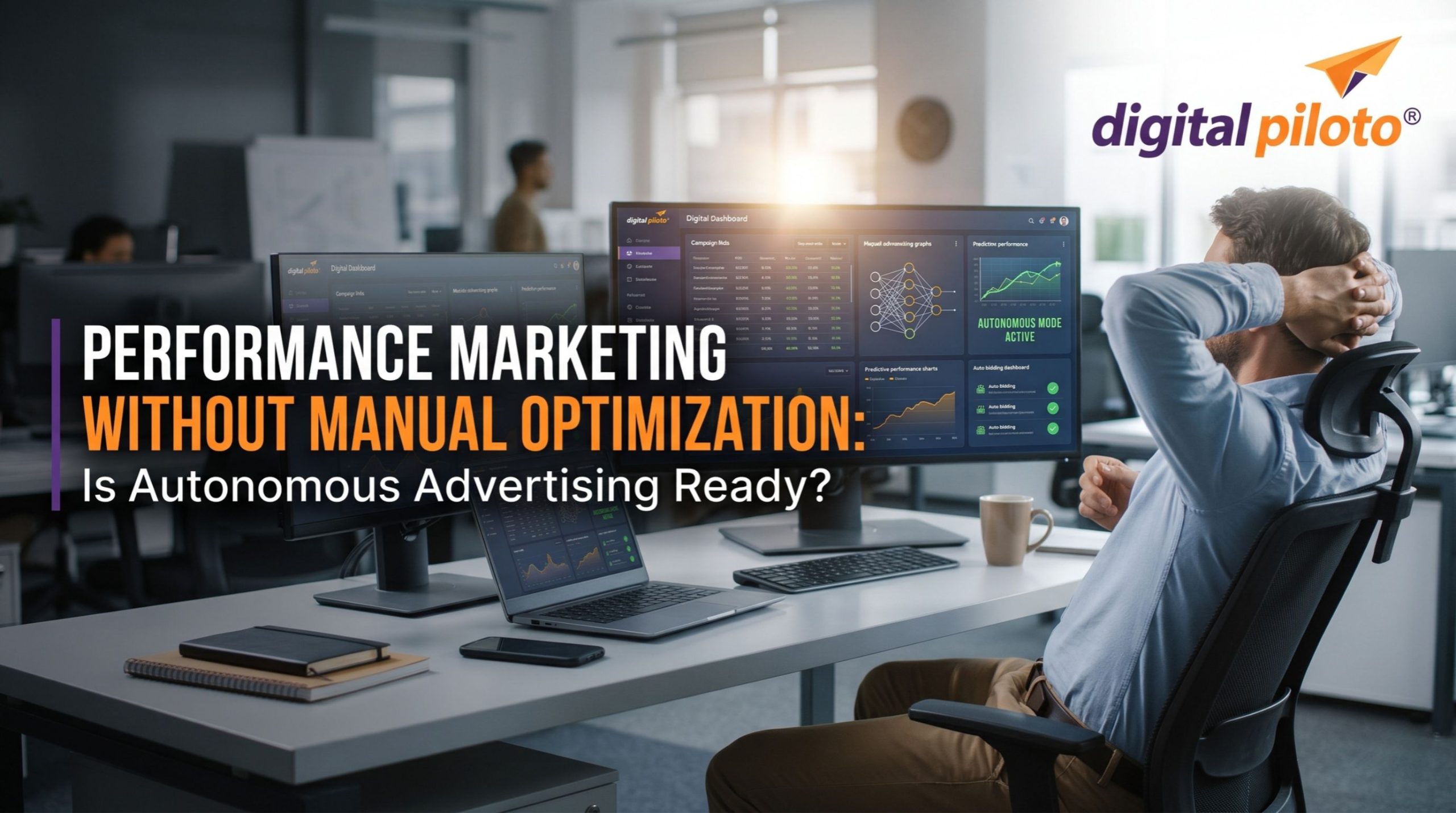
Imagine launching an advertising campaign, going to sleep, and waking up to find that your system has adjusted bids, shifted budgets, tested creative variations, and identified new audiences—all without waiting for a marketing executive to make those changes. It sounds convenient, perhaps even inevitable. But is autonomous advertising genuinely ready to manage business growth without constant human intervention?
For any business investing in a digital marketing service in India, this question is becoming increasingly relevant. AI-powered advertising platforms can already automate several campaign decisions. The bigger question is whether they can understand business priorities, protect brand reputation, and consistently deliver profitable outcomes without human supervision.
What Does Autonomous Advertising Actually Mean?
Autonomous advertising refers to marketing systems that use artificial intelligence, machine learning, and automated decision-making to manage significant parts of the advertising process. Instead of simply following rules created by a campaign manager, these systems analyze incoming signals and adjust campaign activity according to defined objectives.
Think of the difference between cruise control and a self-driving vehicle. Cruise control maintains a selected speed, while a more advanced system can interpret its surroundings and respond to changing conditions. Similarly, basic advertising automation follows predefined instructions, whereas autonomous advertising aims to make a wider range of decisions independently.
Depending on the platform and setup, an autonomous advertising system may be able to:
- Adjust bids and budget distribution according to campaign performance.
- Identify audience segments and discover new targeting opportunities.
- Generate, personalize, and test advertising messages.
- Select placements, formats, and landing pages based on predicted relevance.
- Monitor performance signals and recommend or implement campaign changes.
However, there is an important distinction between automating individual tasks and independently managing an entire marketing strategy. Most current platforms are closer to the first category, even as their capabilities continue to expand.
Why Manual Campaign Optimization Is Changing
Traditional performance marketing often involves a familiar routine. A marketer checks campaign reports, identifies expensive keywords, adjusts bids, pauses weak advertisements, tests new creatives, and reallocates budgets. These activities can be useful, but they also consume time.
More importantly, digital advertising environments move quickly. An audience that responds well in the morning may behave differently during the evening. Competitors can change their offers, customer demand can shift, and advertising costs can fluctuate within a short period.
Human teams cannot realistically examine every signal across hundreds of campaigns in real time. AI systems, on the other hand, can process large volumes of information continuously and make adjustments much faster.
This does not mean human campaign managers have become unnecessary. Their role is gradually moving away from repetitive account maintenance and towards strategy, experimentation, creative direction, and performance governance.
Where Autonomous Advertising Is Already Happening
1. AI-powered search advertising
Search advertising is moving beyond the traditional process of selecting keywords, writing fixed advertisements, and manually managing every bid. Google’s AI Max for Search campaigns, for example, introduces AI-supported search term matching, text customization, and final URL expansion.
According to Google’s official AI Max documentation, the system can use signals from keywords, advertisements, and website content to identify relevant searches, customize messaging, and direct visitors towards suitable landing pages.
That is a meaningful shift. A marketer no longer needs to anticipate every possible search phrase or manually create an advertisement for every variation of customer intent. The platform can explore additional opportunities within the controls established by the advertiser.
Still, this automation depends on conversion-based bidding strategies and useful campaign information. Poor conversion tracking or unclear landing-page content can limit the value of the system.
2. Automated social media campaigns
Social advertising has also moved towards greater automation. Meta’s Advantage+ solutions use machine learning to support audience selection, budget allocation, creative delivery, and campaign optimization.
Meta’s engineering team has described how its Andromeda advertising retrieval system supports the growing volume of personalized advertising possibilities. In its technical explanation of Andromeda, Meta discusses the system’s role in selecting relevant advertisements from a much larger pool of available creative options.
For businesses, this creates an opportunity to test more variations without manually managing every audience and placement combination. However, automated delivery still needs strong creative inputs. A platform cannot reliably compensate for an unclear offer or an advertisement that fails to communicate customer value.
3. Automated creative production and testing
Another major development is the use of generative AI to produce headlines, descriptions, images, and other advertising assets. Systems can create multiple variations and use performance signals to identify which messages deserve further testing.
Imagine an online furniture store promoting a new sofa collection. It might test messages focused on comfort, design, durability, or affordability. AI can help generate variations and identify which combinations attract stronger engagement from different audiences.
But there is a catch. High engagement does not always mean high-quality business results. An attention-grabbing advertisement may generate inexpensive clicks while attracting visitors who never intend to purchase. Creative optimization must therefore connect with meaningful conversion data.
What the Industry Data Tells Us
AI adoption in advertising is no longer a distant prediction. The Interactive Advertising Bureau’s August 2025 research, conducted with Aymara, found that more than half of surveyed marketers were already using generative AI for activities such as creative development and audience targeting. The same research also highlighted concerns about responsible use.
More than 70% of the surveyed advertising professionals had encountered an AI-related incident, including issues involving inaccurate outputs, bias, or content that did not fit the brand. Yet fewer than 35% planned to increase investment in AI governance and brand-integrity oversight over the following year.
These findings come from 125 US advertising industry executives, so they should not be treated as a universal measurement of global adoption. Nevertheless, they reveal an important tension: organizations are embracing automation faster than they are developing safeguards.
In other words, the technology is advancing, but operational maturity is still catching up.
The Biggest Benefits of Autonomous Advertising
When implemented thoughtfully, autonomous advertising can improve several aspects of performance marketing.
- Faster optimization: Systems can respond to changing performance signals without waiting for a scheduled manual review.
- More testing opportunities: Automated creative and audience experiments can help teams explore more combinations.
- Improved operational efficiency: Marketers can spend less time on repetitive adjustments and more time understanding customers.
- Scalable campaign management: Businesses operating across multiple products, regions, or platforms can manage complexity more efficiently.
- More responsive budget decisions: Automated bidding and allocation tools can adjust delivery according to selected objectives and available signals.
For a growing ecommerce business, these advantages can be particularly useful. A small marketing team may not have the resources to monitor dozens of campaigns throughout the day. Automation can take care of routine adjustments while people focus on product positioning, customer experience, and profitability.
Why Fully Autonomous Advertising Is Not Ready Yet
Despite its advantages, handing over every advertising decision to AI would be premature for many businesses. The limitations are not just technical. Some are rooted in the nature of marketing itself.
1. AI does not automatically understand business strategy
A platform can optimize towards conversions, but it may not know that a company wants to prioritize premium customers, protect profit margins, enter a new market, or build long-term brand awareness.
Consider a business selling both budget and premium products. An automated system might generate more conversions by promoting the cheaper range. That could look successful inside the advertising dashboard, even if the company’s wider strategy depends on higher-margin products.
The system needs clear business objectives and suitable conversion-value signals. Without them, it may optimize the wrong outcome very efficiently.
2. Poor data creates poor decisions
Automation is only as dependable as the information it receives. If conversion tracking counts duplicate purchases, lead forms are filled with irrelevant enquiries, or revenue data is incomplete, an AI system may learn the wrong patterns.
This is particularly important in B2B advertising, where a large number of inexpensive leads may look attractive but produce very few qualified opportunities. Businesses need reliable CRM integration and meaningful conversion definitions before trusting automated optimization with significant budgets.
3. Brand safety and creative accuracy remain concerns
Generative systems can produce convincing advertising copy, but convincing does not always mean correct. An AI-generated message could exaggerate a product benefit, use an outdated offer, or create wording that conflicts with a company’s approved communication guidelines.
In regulated sectors such as finance, healthcare, and education, such mistakes can have serious consequences. Human approval, clear restrictions, and regular creative reviews remain essential.
4. Platform optimization is not the same as business profitability
Advertising platforms generally optimize towards the objectives and signals they receive. A low cost per lead or strong reported return on ad spend does not necessarily translate into sustainable profit.
Businesses should examine the full commercial picture, including product margins, fulfilment expenses, cancellations, repeat purchases, customer lifetime value, and sales-team costs. Otherwise, automated campaigns may produce impressive dashboard numbers without improving the actual business.
How Businesses Can Prepare for Autonomous Advertising
The sensible approach is not to switch everything to automation at once. Instead, businesses should introduce autonomy in stages, beginning with activities that are relatively easy to measure and supervise.
- Set clear business objectives: Define whether the priority is profitable sales, qualified leads, customer acquisition, retention, or market expansion.
- Improve conversion data: Check tracking accuracy, remove duplicate events, and connect advertising platforms with reliable sales or CRM information.
- Establish brand rules: Define approved claims, prohibited language, target markets, budget limits, and landing-page restrictions.
- Test automation gradually: Start with automated bidding or creative testing before expanding into broader campaign controls.
- Monitor business outcomes: Evaluate profit, lead quality, customer value, and incremental growth rather than relying on platform-reported metrics alone.
- Keep human approval for sensitive decisions: Retain oversight of major budget changes, regulated claims, strategic positioning, and unusual performance patterns.
Businesses working with a digital transformation agency India can also benefit from connecting advertising technology with CRM systems, analytics, ecommerce platforms, and internal reporting. This creates a stronger foundation for automation because campaign decisions are informed by business outcomes rather than isolated advertising metrics.
The New Role of Performance Marketers
As automation takes over more repetitive tasks, performance marketers will need a different mix of skills. Their value will increasingly depend on the quality of the decisions they make before and around the automated system.
That includes understanding customer psychology, developing persuasive creative strategies, interpreting business data, designing experiments, and identifying when an algorithm’s recommendations do not make commercial sense.
Search visibility will remain part of this wider picture, too. Paid advertising does not operate in isolation from organic discovery. A company investing in search engine optimization services India can strengthen its organic presence while using paid campaigns to capture demand, test messaging, and reach specific audiences.
The strongest marketing teams will not necessarily be those with the most automation. They will be the ones that know where automation adds value, where human judgment matters, and how both can work together.
Frequently Asked Questions
1. What is autonomous advertising?
Autonomous advertising uses AI and machine learning to manage advertising activities such as bidding, targeting, budget adjustments, creative testing, and campaign delivery with limited manual intervention. The level of autonomy depends on the platform and advertiser controls.
2. Can AI completely replace performance marketers?
No. AI can automate many repetitive campaign tasks, but it does not independently understand every business priority, customer motivation, regulatory requirement, or brand consideration. Human professionals remain important for strategy, oversight, creative direction, and commercial decisions.
3. Is autonomous advertising suitable for small businesses?
It can be, provided the business has reliable conversion tracking, clear objectives, and a manageable budget. Small businesses can begin with automated bidding and creative testing, then expand their use of automation as their data and experience improve.
4. How can businesses measure whether autonomous advertising is working?
Businesses should evaluate meaningful outcomes such as profitable revenue, qualified leads, customer acquisition cost, conversion quality, and customer lifetime value. Platform metrics should be compared with CRM, sales, and financial data to understand the wider impact.
Final Thoughts: Autonomy Needs Accountability
Autonomous advertising is no longer science fiction. AI already handles important parts of campaign targeting, bidding, creative delivery, and optimization. But fully hands-off performance marketing is not yet a sensible default for every business. The winning approach is likely to combine machine speed with human judgment. Let AI handle repetitive decisions, give it reliable data and clear boundaries, and keep people responsible for the strategy and the results.
Blog Development Credits
Developed from an original concept by Amlan Maiti, this article was researched with AI assistance and refined for search performance by Digital Piloto Private Limited.