

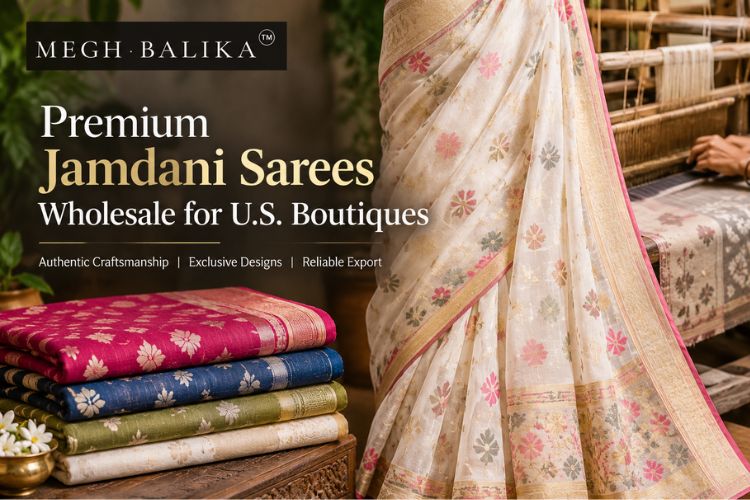
For a U.S. boutique, sourcing Premium Jamdani Sarees Wholesale is about more than finding attractive designs. Buyers need authentic craftsmanship, dependable quality, suitable minimum quantities, clear product information and an export-ready supplier.
Jamdani is a heritage handloom tradition known for intricate motifs created through supplementary-weft weaving. India’s handicrafts authority identifies active Jamdani weaving communities in West Bengal, including Phulia, Katwa and Kalna, while UNESCO recognizes the traditional art of Jamdani weaving as intangible cultural heritage.
Why Jamdani Works for Premium Boutiques
Jamdani can give a boutique a differentiated assortment because each design combines textile craftsmanship with visual detail. Fine cotton, silk and blended constructions can serve different retail positions, from lightweight everyday collections to occasion-focused pieces.
For premium positioning, buyers should examine the actual weave, fabric composition, motif definition, finishing and consistency between samples and production pieces rather than relying only on product photography.
What to Check Before Placing a Wholesale Order
- Weave and craftsmanship: Confirm whether the piece is hand-loomed and how the motifs are constructed.
- Fabric specification: Request the exact fiber composition and fabric details.
- Sample approval: Compare approved samples with production pieces.
- MOQ: Choose quantities that allow assortment testing without excessive inventory exposure.
- Design consistency: Clarify acceptable variations in handmade products.
- Documentation: Request commercial invoices, origin information and applicable product documentation.
Why Supplier Documentation Matters in the USA
U.S. buyers should treat labeling and origin information as part of sourcing—not as an afterthought. CBP states that imported textiles generally require country-of-origin identification, while FTC requirements address textile labeling and care information. Exact obligations depend on the product and import circumstances.
Build a Boutique-Friendly Assortment
Instead of ordering many unrelated designs, start with a controlled collection: complementary colors, several motif scales and a small number of fabric categories. This makes merchandising easier and gives the boutique useful sales data before expanding the range.
Jamdani can also sit alongside complementary Bengal craftsmanship. For example, boutiques can explore Kantha Stitch Wholesale USA when building a broader heritage-textile assortment.
Why India Is Relevant to U.S. Buyers
India already has a substantial apparel trade relationship with the United States. USITC reported approximately $4.65 billion in U.S. apparel imports from India in 2023, demonstrating the established role of India in American apparel sourcing.
What a Premium Wholesale Supplier Should Provide
A useful supplier relationship should make the buying process transparent: product specifications, samples, MOQ, pricing structure, quality inspection, packaging, lead times and export documentation should be discussed before the order is confirmed.
For example, Megh Balika’s current Jamdani collection describes hand-loomed production, wholesale pricing on request, a stated export MOQ of 12 pieces per design and quality inspection before dispatch.
Final Takeaway
For U.S. boutiques, premium Jamdani sourcing works best when craftsmanship and commercial discipline are evaluated together. Select suppliers based on authentic construction, consistent quality, practical MOQ, transparent documentation and the ability to develop a collection that fits your customers—not simply on the lowest wholesale price.
For wholesale enquiries: Explore Megh Balika’s Jamdani collection and discuss your boutique’s preferred designs, quantities and sourcing requirements.
Also Read: Best Jamdani Importer USA for Quality Sarees
Blog Development Credits:
This article was developed for Megh Balika, combining original research with AI-assisted drafting through ChatGPT, Google Gemini, and Copilot, followed by human-led SEO refinement.