

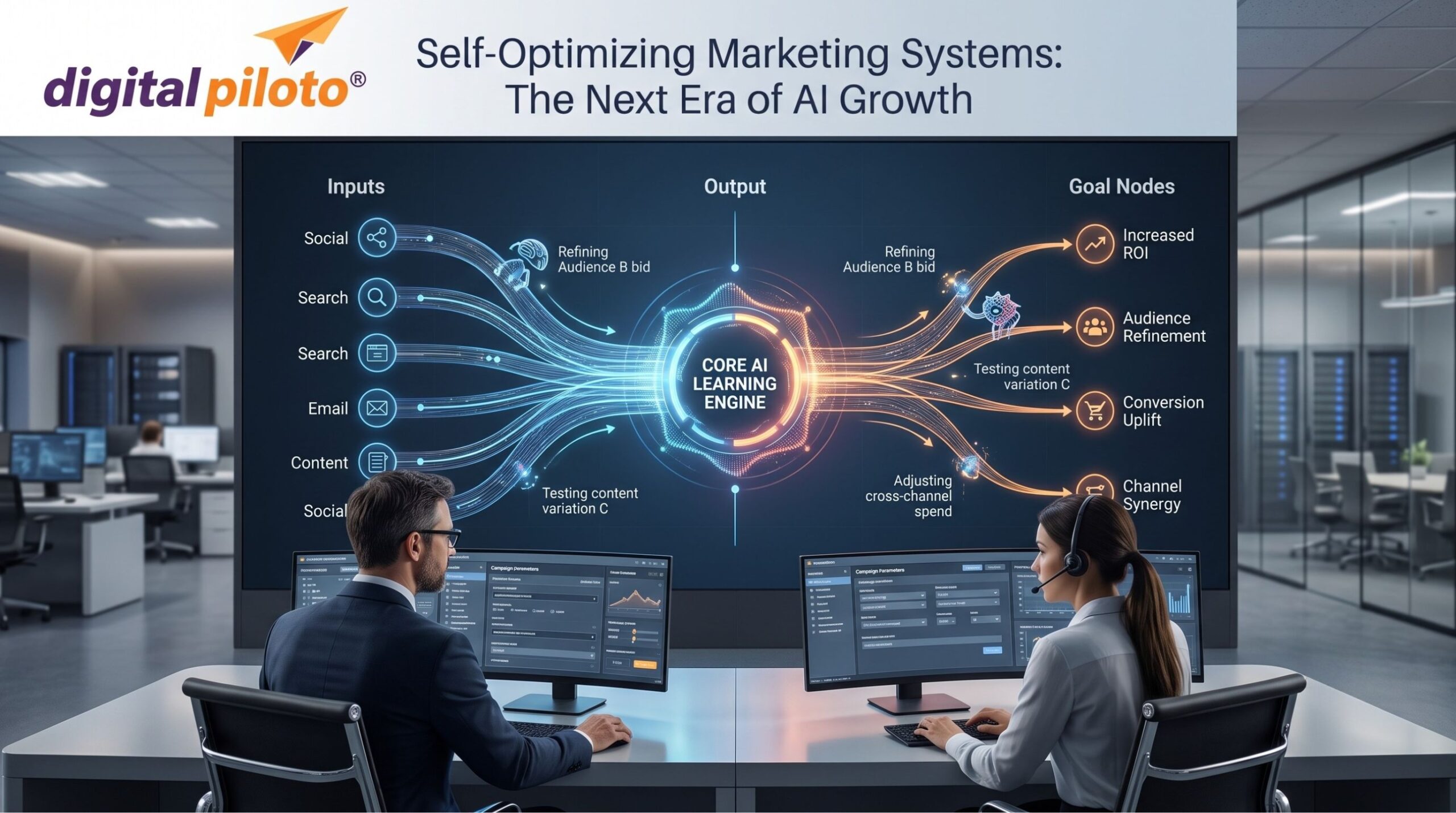
Marketing has always involved a loop: launch, measure, learn, adjust, and launch again. The difference now is speed. AI can observe thousands of signals, spot patterns, recommend changes, and increasingly execute them. The next generation of growth will not simply use AI to make campaigns faster; it will build marketing systems that continuously learn what works and adapt themselves.
For a modern digital marketing agency India, this represents a fundamental shift in how growth can be designed. Instead of treating every campaign as a separate project, marketers can begin connecting data, content, customer journeys, experimentation, and AI agents into one living system. It sounds futuristic. In practice, pieces of it are already appearing.
What Is a Self-Optimizing Marketing System?
A self-optimizing marketing system is not simply a collection of AI tools.
That distinction is important.
You can have an AI copywriting tool, a predictive analytics platform, an automated email system, and a chatbot without having anything resembling an intelligent growth engine. They may all work well individually while remaining disconnected from one another.
A self-optimizing system works differently. It creates a continuous feedback loop in which customer signals influence decisions, decisions trigger actions, outcomes are measured, and those outcomes inform what happens next.
Imagine a marketing team managing an ecommerce campaign. Traditionally, someone reviews the dashboard, notices that one audience is responding better, adjusts the budget, changes an advertisement, and checks the results a few days later.
Now imagine the system identifying the same pattern within hours, testing a new message, reallocating part of the budget within predefined limits, and feeding the result back into its next decision.
The marketer has not disappeared. The marketer has moved upward—from manually moving every lever to designing and supervising the machine that moves the levers.
The Shift From Campaigns to Continuous Growth
Campaign thinking is built around beginnings and endings.
You plan a campaign. You launch it. You measure performance. Then you move to the next campaign.
That model made sense when data arrived slowly and optimization required significant manual effort.
AI changes the economics of iteration.
McKinsey describes the emerging model as a move toward marketing operating as a continuous growth engine, with AI connecting insights, content, personalization, commerce, and performance in an ongoing loop. Its 2026 research also notes that while many organizations are experimenting with AI, fewer than 10% have scaled AI or captured value across marketing workflows. McKinsey’s 2026 analysis of AI capabilities in marketing provides the research context.
The difference is subtle but powerful: AI is not merely becoming another production tool. It is becoming part of the operating model.
Why continuous optimization matters
Customers do not behave according to campaign calendars.
Their interests change. Competitors change their offers. Search behavior shifts. Prices move. New products appear. Economic conditions alter buying priorities.
A campaign can therefore be perfectly optimized on Monday and less relevant two weeks later.
A continuous system has a chance to respond.
- Observe: Monitor customer, content, channel, and conversion signals.
- Interpret: Identify meaningful changes rather than reacting to every fluctuation.
- Decide: Select the next action based on business rules and evidence.
- Act: Adjust content, audiences, journeys, offers, or channel activity.
- Learn: Feed the outcome back into future decisions.
That loop is the foundation of self-optimizing marketing.
AI Agents Take the Loop a Step Further
Predictive AI has been helping marketers make better decisions for years. The newer development is the rise of agentic AI: systems capable of planning and executing multiple steps within defined workflows.
That distinction matters because prediction alone does not change a campaign.
An agent can potentially connect prediction with action.
Suppose an AI system detects that returning customers are responding strongly to a particular product category. A traditional analytics system might display the insight in a dashboard.
An agentic system could potentially interpret the signal, identify eligible customer segments, generate or select appropriate creative variations, recommend budget changes, initiate an approved experiment, and report the outcome.
McKinsey estimates that agentic AI could eventually power a substantial share of marketing activities, including automated content generation, synthetic audience testing, and audience-based media planning. Its April 2026 research estimates that agentic systems could eventually power around two-thirds of current marketing activities, although adoption and value capture remain at an early stage. McKinsey’s research on reinventing marketing workflows with agentic AI explains the distinction between isolated AI assistance and workflow-level transformation.
The important word is eventually. Businesses still need reliable data, governance, integration, and human oversight before autonomous action becomes appropriate.
Data Becomes the Nervous System
There is an uncomfortable truth about AI marketing: sophisticated models cannot rescue disconnected information.
If customer data lives in one system, website behavior in another, advertising information somewhere else, and sales feedback in spreadsheets, an AI layer may simply automate the confusion.
That is why unified data is becoming one of the least glamorous—and most important—parts of AI-driven growth.
Salesforce’s 2026 India State of Marketing research found that 81% of surveyed Indian marketers had adopted AI, while fragmented or irrelevant customer data remained a significant barrier. The study also reported that 86% of respondents would trust AI to respond to customers, but data quality and connectivity continue to constrain that ambition. Salesforce’s 2026 India marketing findings provide the survey details.
In practical terms, a self-optimizing system needs to know what happened before it can intelligently decide what should happen next.
The data foundation should connect signals such as:
- Customer profiles and lifecycle stages.
- Website behavior and content engagement.
- Search and advertising interactions.
- CRM activity and sales outcomes.
- Purchase history and product usage.
- Campaign responses across channels.
- Customer feedback, preferences, and support interactions.
The objective is not to collect everything. It is to connect the information that actually changes decisions.
Personalization Moves From Segments to Situations
Traditional personalization often means dividing audiences into groups.
“Customers aged 25–34.”
“Enterprise prospects.”
“Repeat purchasers.”
Useful, certainly. But a person can belong to several segments while still being in a very specific situation at a particular moment.
Imagine someone who has purchased from a company twice, recently visited its pricing page, downloaded an implementation guide, and contacted support about integrating a new product.
The most meaningful signal is not necessarily their age or broad customer segment. It is what they appear to be trying to accomplish right now.
AI can help marketing systems move from static segmentation toward contextual decision-making.
That might mean changing the next email, suppressing an irrelevant advertisement, presenting a more appropriate product recommendation, or routing the customer toward human assistance.
McKinsey’s 2026 marketing research describes agentic experiences as adaptive and continuously learning, with AI potentially orchestrating personalized customer journeys across channels. Its analysis of AI-driven marketing capabilities highlights this movement toward dynamic orchestration.
Experimentation Becomes Faster—and More Intelligent
Testing has always been central to growth marketing.
The frustrating part is the waiting.
Write two headlines. Launch the campaign. Collect enough data. Compare the results. Build the next test.
AI can compress parts of that cycle.
A self-optimizing system might generate several hypotheses, identify suitable audience groups, predict potential outcomes, launch approved experiments, and evaluate results continuously.
But there is a catch.
More experiments do not automatically mean better learning.
If a business tests random variables without understanding why performance changed, it simply creates a faster stream of noise.
Good experimentation still needs a hypothesis.
For example:
- Observation: Visitors from organic search convert more frequently when they read implementation content.
- Hypothesis: Visitors may need practical proof before committing.
- Test: Add implementation examples earlier in the conversion journey.
- Measure: Compare qualified conversion behavior rather than page clicks alone.
- Learn: Feed the result into future content and journey decisions.
AI makes the loop faster. Human strategy gives the loop meaning.
Content Starts Optimizing for Discovery Everywhere
Self-optimizing growth is not limited to paid advertising or email automation.
Search itself is becoming more dynamic.
Google’s current guidance says its generative AI search experiences continue to rely on core Search systems and established SEO fundamentals. Google also emphasizes the value of unique, useful, non-commodity content for appearing in generative AI features. Google’s guide to optimizing for generative AI features provides the current guidance.
This creates another feedback opportunity.
Businesses can observe which topics attract meaningful engagement, which questions repeatedly appear in customer interactions, which pages support conversions, and which areas of expertise generate discovery through AI-powered search.
A generative engine optimization services company can help businesses think through this broader discovery layer, particularly where content needs to work across conventional search and generative experiences.
The goal should not be to create content simply because an AI system might cite it. The better objective is to create information that remains genuinely useful whether the reader discovers it through Google, an AI assistant, a recommendation engine, or a direct referral.
Marketing Automation Becomes Marketing Orchestration
Automation typically follows rules.
If this happens, do that.
Orchestration is broader.
Given everything we know about this customer and the current business context, what should happen next?
That distinction could define the next generation of marketing technology.
Consider an abandoned-cart journey. A basic automation sends an email after a set period. A more intelligent system might consider product availability, customer history, previous engagement, current campaign activity, discount sensitivity, and whether another channel has already reached the customer.
The next action becomes contextual rather than merely chronological.
That is the promise of AI marketing automation: not simply more automation, but better decisions about when and why automation should happen.
Self-Optimization Needs Guardrails
There is a reason “self-optimizing” should not be confused with “fully autonomous.”
Marketing decisions can have consequences.
An AI system that automatically increases ad spend might chase a temporary performance spike. An automated personalization engine could make an inappropriate assumption about a customer. A content system might optimize engagement while quietly weakening brand trust.
That is why human governance remains essential.
A responsible architecture should define:
- Which decisions AI can make independently.
- Which actions require human approval.
- What budget or operational limits apply.
- How experiments are evaluated.
- How incorrect decisions are detected and reversed.
- How customer data is protected and governed.
McKinsey’s research on agentic AI repeatedly emphasizes governance, unified data, and workflow redesign as prerequisites for meaningful value. The lesson is straightforward: autonomy without controls is not sophisticated marketing. It is unmanaged risk. McKinsey’s research on moving AI from promise to impact discusses the importance of end-to-end workflow change and governance.
What Happens to the Marketing Team?
The self-optimizing model does not necessarily mean smaller marketing teams.
It means different work.
Instead of spending hours building reports, copying data between systems, creating minor campaign variations, and manually checking performance, marketers can spend more time on positioning, creative direction, customer understanding, strategic experimentation, and brand development.
That is particularly important because AI can produce options far faster than humans can meaningfully evaluate them.
The scarce resource becomes judgment.
A marketer may eventually supervise several specialized agents: one analyzing audience behavior, another monitoring content performance, another coordinating experiments, another managing personalization, and another watching conversion signals.
The human becomes the conductor rather than the person playing every instrument.
How Businesses Can Start Building One
Trying to make the entire marketing operation autonomous from day one is unnecessary.
A better approach is to identify one workflow where faster learning would create measurable value.
- Choose a high-value bottleneck: Pick a workflow such as lead qualification, content optimization, campaign testing, or retention.
- Map the current process: Document data sources, decisions, human handoffs, and delays.
- Define the outcome: Decide whether the objective is higher conversion, lower acquisition cost, faster response, stronger retention, or another measurable result.
- Connect reliable data: Give the system access to the information it actually needs.
- Introduce AI gradually: Start with recommendations before allowing autonomous execution where risk is higher.
- Create feedback loops: Ensure every important action produces measurable learning.
- Expand only after evidence: Scale the workflow when the results justify broader automation.
This is also where a capable SEO service provider in India can become part of a broader growth conversation. Search optimization is increasingly connected to content intelligence, customer intent, AI discovery, conversion paths, and the feedback signals that tell a marketing system what deserves improvement next.
The Real Competitive Advantage Is the Learning Loop
AI tools will become easier to access. Features that look sophisticated today will eventually become standard software capabilities.
That means the tool itself is unlikely to remain a durable advantage.
The advantage will come from how quickly an organization can learn.
One company may publish content and wait six months to review its performance. Another may connect search behavior, customer questions, conversion data, and AI visibility into a continuous learning loop.
Both may use AI.
Only one has redesigned the organization around learning.
That distinction is likely to matter more as AI becomes embedded across marketing platforms.
Frequently Asked Questions
What is a self-optimizing marketing system?
A self-optimizing marketing system continuously uses performance and customer signals to improve marketing decisions and actions. It combines data, AI, experimentation, automation, and feedback rather than treating each campaign as an isolated project.
Is self-optimizing marketing completely autonomous?
No. The strongest systems typically combine AI-driven execution with human oversight. Businesses should establish clear boundaries around data access, budgets, customer communication, experimentation, and decisions that require approval.
How does agentic AI improve marketing?
Agentic AI can connect multiple steps of a workflow. Instead of merely generating an insight or piece of content, an agent may interpret a signal, decide on an approved action, execute it through connected systems, and evaluate the result.
What is the first step toward AI-driven growth?
Start with one measurable, high-value workflow. Identify its bottlenecks, connect the relevant data, define success, introduce AI gradually, and build a feedback loop before expanding the system across other marketing functions.
Final Thoughts
The next era of AI growth will not be defined by who has the most AI tools.
It will be defined by who has built the smartest learning system.
Marketing is moving toward an environment where customer signals can trigger decisions, decisions can trigger actions, and actions can generate new learning almost continuously. Humans still set the direction, protect the brand, define the boundaries, and make the calls that require judgment.
AI simply makes the loop faster.
And when that loop becomes the operating system for growth, marketing stops behaving like a sequence of campaigns and starts behaving like a living system—one that gets a little smarter every time it learns.
Blog Development Credit
The concept was developed by Amlan Maiti, with AI-supported research and drafting, followed by final SEO enhancement and optimization from Digital Piloto Private Limited.