

Digital marketing is entering a new phase. AI is no longer just a tool for generating content, writing ad copy, or automating reports. It is becoming part of the operating system behind research, personalization, search discovery, campaign optimization, customer journeys, and decision-making. For businesses, the strategic question is no longer whether to use AI, but how to redesign marketing around it without losing human judgment, trust, and differentiation.
What Is AI-First Digital Marketing?
AI-first digital marketing is a strategy in which artificial intelligence is built into the core marketing workflow rather than added as an occasional productivity tool. AI can support customer research, data analysis, content operations, personalization, campaign optimization, search visibility, automation, and forecasting, while humans remain responsible for strategy, positioning, creativity, verification, and business judgment.
This distinction matters. Using an AI writing assistant to produce a blog post does not automatically make a company AI-first. An AI-first organization changes how information moves through its marketing system: customer signals are captured, interpreted, acted upon, measured, and fed back into future decisions.
That shift is already visible across the market. McKinsey reported in 2025 that an average 71% of organizations surveyed were using generative AI in at least one business function, with marketing and sales among the most common areas of application. The number is less important than the direction: AI is moving from experimentation toward operational adoption.
Why Digital Marketing Is Moving Toward an AI-First Model
Traditional digital marketing was largely organized around campaigns. A business defined an audience, created an offer, launched advertisements or content, measured the results, and then planned the next campaign.
AI makes it possible to shorten that loop.
Instead of treating customer insight, content production, media buying, analytics, and conversion optimization as separate activities, businesses can connect them into a continuously learning system.
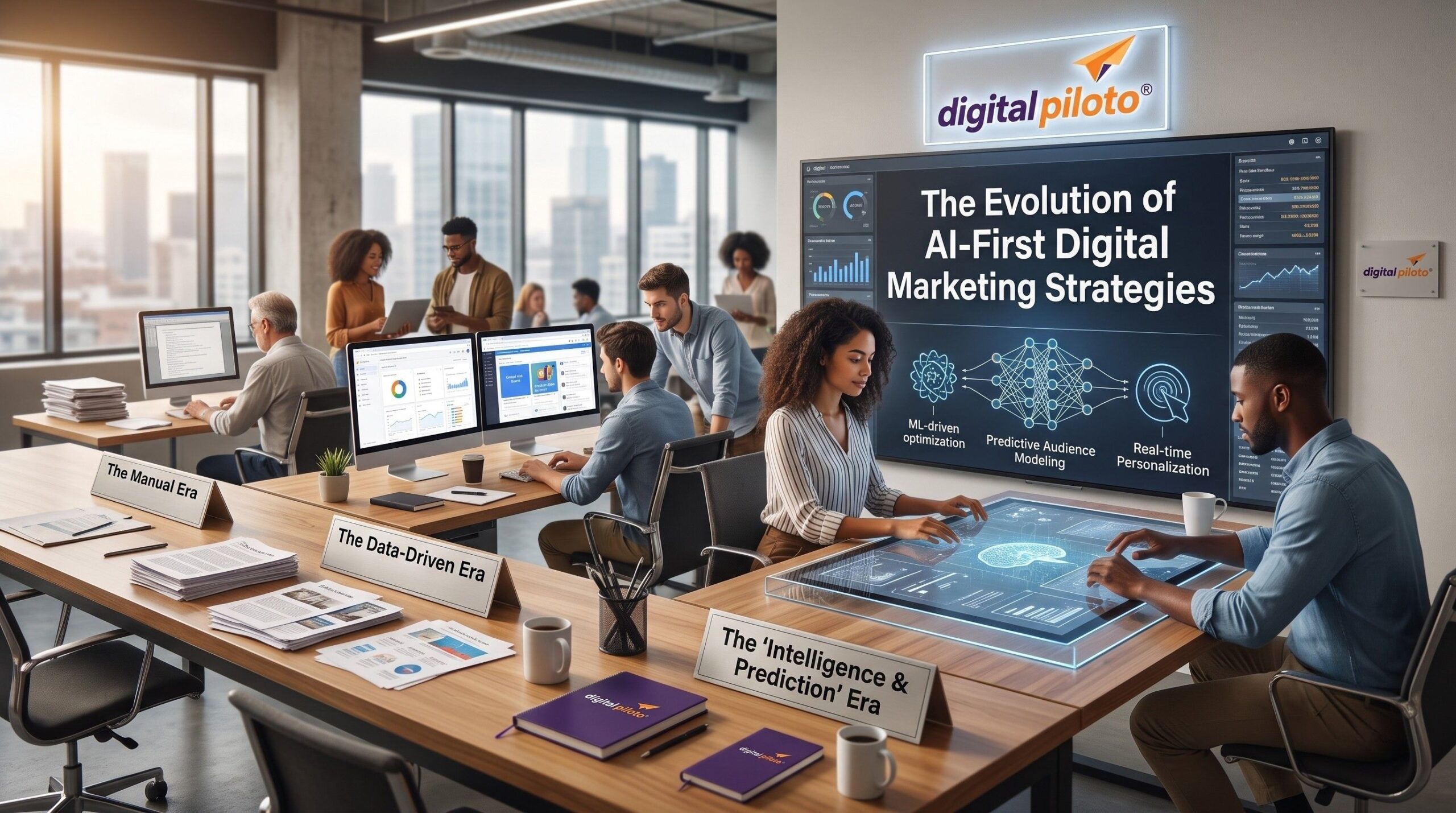
The evolution looks roughly like this:
- Digital marketing: Reach customers through digital channels.
- Data-driven marketing: Use performance and customer data to improve decisions.
- Marketing automation: Automate repetitive workflows and customer communications.
- AI-assisted marketing: Use AI to accelerate individual marketing tasks.
- AI-first marketing: Design the marketing operating model around connected AI capabilities.
- Agentic marketing: Allow increasingly autonomous systems to execute defined workflows under appropriate human governance.
The important transition is therefore not from humans to machines. It is from disconnected marketing activities to an intelligent, continuously optimized system.
AI-First Does Not Mean AI-Only
One of the biggest misunderstandings about AI-first marketing is the idea that companies should automate as much human involvement as possible.
The stronger model is different. AI handles scale, pattern recognition, repetitive execution, and large volumes of information. Humans handle meaning, accountability, strategic choices, brand differentiation, and context.
A practical division of responsibility looks like this:
- AI: detect patterns across large datasets.
- AI: generate and test content variations.
- AI: identify customer segments and behavioral signals.
- AI: automate repetitive workflows.
- AI: summarize and classify information.
- Humans: define positioning and business priorities.
- Humans: validate claims and protect brand trust.
- Humans: make high-impact strategic decisions.
- Humans: understand cultural, emotional, and commercial context.
The best AI-first strategy is therefore not “replace people with AI.” It is “remove unnecessary friction so people can spend more time on high-value decisions.”
The Search Funnel Is Changing
Search is one of the clearest reasons AI-first marketing matters.
Google has expanded AI Overviews and introduced AI Mode, while conversational search products such as ChatGPT Search allow users to ask questions and receive synthesized answers with links to relevant web sources.
Google reported in 2025 that AI Overviews were driving more than a 10% increase in Google usage for query types that showed AI Overviews in major markets including the United States and India. In 2026, Google announced that AI Mode had surpassed one billion monthly users.
These developments do not mean traditional search has disappeared. They mean discovery is becoming more conversational, contextual, multimodal, and answer-oriented.
A potential customer may now discover a company through:
- A traditional Google result.
- A Google AI Overview.
- Google AI Mode.
- ChatGPT Search.
- Another generative search experience.
- A social platform’s recommendation system.
- An AI-powered shopping or product discovery experience.
- An automated recommendation or comparison workflow.
This creates a broader marketing objective: be discoverable wherever customers and AI systems perform research.
SEO Is Not Disappearing — Its Role Is Expanding
The rise of AI search does not make SEO obsolete. Google explicitly states that its established SEO best practices remain relevant to AI features such as AI Overviews and AI Mode.
Google’s generative AI search guidance explains that these experiences rely on core Search systems to retrieve relevant information from the web. That means crawlability, indexability, useful content, relevance, authority, technical quality, and clear information architecture remain important.
The strategic difference is that SEO can no longer be viewed only as a ranking exercise.
Modern search optimization increasingly needs to answer several questions:
- Can search engines discover the page?
- Can they understand what the business does?
- Can they identify the entities, products, people, and relationships described?
- Can AI systems extract a clear answer from the content?
- Does the website demonstrate genuine expertise?
- Are important claims supported by credible sources?
- Is the brand consistently represented across the wider web?
For businesses evaluating best SEO agency India options, this broader view is increasingly important. Technical SEO, content, entity clarity, authority, and conversion strategy should work together rather than operate as isolated services.
From Keywords to Customer Signals
Keywords remain useful, but AI-first marketing requires a wider understanding of intent.
A keyword tells you something about what someone typed. A customer signal can reveal considerably more: what the person is researching, what stage of the buying journey they are in, what content they consumed previously, which product category interests them, and what action they are likely to take next.
This creates a shift from keyword-centric marketing toward signal-centric marketing.
Useful signals may include:
- Search behavior.
- Website interactions.
- Product views.
- Content engagement.
- Form activity.
- CRM events.
- Purchase history.
- Customer-service conversations.
- Repeat visits.
- Conversion events.
The objective is not to collect every possible data point. It is to identify the signals that actually improve a marketing decision.
AI-First Content Is More Than AI-Generated Content
One of the easiest mistakes businesses can make is confusing AI-first content strategy with automated article production.
Producing 100 generic articles faster does not necessarily create a stronger marketing system. Google’s guidance specifically warns against using generative AI to create large volumes of pages without adding value for users.
An AI-first content engine should instead use AI across the entire content lifecycle:
- Identify customer questions and information gaps.
- Analyze existing content and competitor positioning.
- Cluster related topics and search intents.
- Develop an evidence-backed content brief.
- Use AI to accelerate research and production where appropriate.
- Add original analysis, expertise, examples, and editorial judgment.
- Optimize content for humans and search systems.
- Repurpose valuable content into other formats.
- Measure engagement and business outcomes.
- Feed performance insights into future content decisions.
The difference is significant. AI becomes part of a quality-controlled content system rather than a replacement for editorial thinking.
Generative Engine Optimization Becomes Part of the Discovery Strategy
When customers use AI systems to research products, services, companies, or solutions, visibility increasingly depends on whether the brand can be understood and referenced by those systems.
This is where Generative Engine Optimization, or GEO, becomes relevant.
GEO should not be treated as a magic ranking shortcut. It is better understood as an extension of digital visibility: making a company’s expertise, entities, evidence, products, services, and differentiators easier for AI-powered discovery systems to understand and accurately represent.
Businesses working with a generative engine optimization specialist should therefore look beyond isolated prompt testing. The underlying website and brand ecosystem still matter.
A strong GEO foundation can include:
- Clear entity definitions.
- Consistent company information.
- Expert-authored content.
- Evidence-backed claims.
- Structured and understandable pages.
- Strong topical coverage.
- Relevant third-party references.
- Clear product and service descriptions.
- Useful question-and-answer content.
- Technically accessible web pages.
Personalization Moves From Segments to Individual Journeys
Traditional personalization often means showing different content to broad audience segments. AI makes more dynamic personalization possible.
Instead of asking only, “Which segment does this visitor belong to?”, an AI-enabled system can consider current behavior, historical interactions, product interest, intent, and context to determine what experience may be most relevant.
For ecommerce, this can influence product recommendations, merchandising, email sequences, search results, promotional messaging, and customer support.
For B2B companies, it can influence lead qualification, content recommendations, account prioritization, sales enablement, and nurture workflows.
But personalization must remain responsible. More data does not automatically mean better marketing. Businesses need clear data governance, appropriate consent practices, security controls, and sensible limits on automated decision-making.
AI Agents Will Change Marketing Operations
The next evolution is moving beyond AI that answers prompts toward AI systems capable of performing multi-step workflows.
Gartner has described this transition as movement from AI as a tool toward AI as an actor. In marketing, that could eventually include systems that monitor signals, identify anomalies, recommend actions, create campaign variants, update workflows, and coordinate tasks across platforms.
The critical issue is governance.
Businesses should decide in advance:
- Which actions AI can perform independently.
- Which actions require human approval.
- Which data sources AI can access.
- Which decisions require documented reasoning.
- How errors will be detected.
- How sensitive customer information will be protected.
- How performance will be audited.
Agentic marketing should therefore be treated as an operational design problem, not merely a software purchase.
The New AI-First Marketing Architecture
A practical AI-first marketing system can be understood through seven connected layers.
1. Signal Layer
Capture meaningful customer, market, product, search, and campaign signals.
2. Intelligence Layer
Use analytics and AI to identify patterns, opportunities, risks, and customer intent.
3. Strategy Layer
Convert those insights into positioning, audience priorities, offers, content themes, and campaign decisions.
4. Experience Layer
Personalize website experiences, content, communications, product discovery, and customer journeys.
5. Execution Layer
Use automation and AI to accelerate content production, campaign operations, reporting, lead workflows, and repetitive tasks.
6. Discovery Layer
Optimize the brand for traditional search, AI search, social discovery, marketplaces, recommendation systems, and other emerging discovery environments.
7. Learning Layer
Feed performance results back into the system so future decisions become more informed.
This final layer is what separates a collection of AI tools from an AI-first marketing engine.
What Should Businesses Change First?
Businesses should not begin by purchasing every new AI marketing platform. The better starting point is identifying where intelligence or automation can create measurable business value.
Start with the highest-friction marketing processes.
- Map the current customer journey. Identify where customers discover, evaluate, compare, convert, and return.
- Audit your data. Determine which signals exist and which important signals are missing.
- Audit search visibility. Examine traditional rankings, AI discovery, brand mentions, content coverage, and technical accessibility.
- Identify repetitive work. Find reporting, research, content operations, segmentation, and workflow tasks that can be safely accelerated.
- Prioritize high-value use cases. Choose applications tied to revenue, efficiency, customer experience, or strategic insight.
- Build human review points. Decide where AI needs approval rather than unrestricted autonomy.
- Measure business outcomes. Track leads, revenue, conversion rates, retention, efficiency, and customer value rather than AI usage alone.
How AI-First Marketing Changes KPIs
AI-first marketing requires a broader measurement framework.
Traditional metrics such as rankings, impressions, clicks, and traffic remain useful, but they should not be the entire measurement system.
Businesses should also monitor:
- Qualified traffic.
- Conversion rate.
- Customer acquisition cost.
- Revenue per visitor.
- Lead quality.
- Customer lifetime value.
- Content-assisted conversions.
- AI-search visibility.
- Brand mentions in relevant AI discovery experiences.
- Marketing productivity.
- Time saved through automation.
- Incremental revenue from personalization.
The central question should be: Did AI make the marketing system more commercially effective?
If a company publishes five times more content but produces no additional qualified demand, the system has improved production volume rather than marketing performance.
The Role of an AI-Driven Digital Marketing Partner
As marketing becomes more interconnected, businesses may increasingly need partners that understand strategy, search, content, technology, analytics, automation, and conversion rather than treating each discipline separately.
A modern digital marketing companies in India comparison should therefore consider more than service lists. Businesses should evaluate whether an agency can connect marketing execution with business outcomes and adapt its strategy as discovery behavior changes.
The right partner should be able to explain:
- How AI will improve the existing marketing system.
- Which processes should remain human-led.
- How search strategy will evolve for AI discovery.
- How data and automation will be governed.
- How success will be measured.
- How the strategy will change as AI platforms evolve.
Common AI-First Marketing Mistakes
Using AI without a strategy
Buying tools before defining the business problem creates technology clutter rather than competitive advantage.
Producing more content instead of better content
Generative AI can dramatically increase output. That does not automatically increase authority, trust, or conversions.
Automating decisions that need judgment
Some decisions involve brand reputation, legal considerations, customer sensitivity, or commercial risk. These should not be delegated blindly.
Ignoring technical foundations
AI cannot compensate for a website that is inaccessible to crawlers, poorly structured, slow, confusing, or difficult to understand.
Measuring AI activity instead of business impact
The number of prompts, generated articles, automated tasks, or AI tools used is not a meaningful success metric by itself.
Assuming AI search replaces SEO
Current Google guidance says the opposite: established SEO fundamentals remain relevant to AI-powered Search experiences.
What We Would Prioritize in 2026
For most businesses, the priority should not be “become fully automated.” A more practical roadmap is to build the foundations that allow AI to create value safely.
First, strengthen the information architecture. Make the website easy for users and machines to understand.
Second, improve data quality. AI systems are only as useful as the signals and context they receive.
Third, build authoritative content. Focus on original expertise, useful explanations, evidence, clear entities, and genuine information gain.
Fourth, connect SEO with AI discovery. Traditional search visibility and generative discovery should be treated as connected parts of a broader visibility strategy.
Fifth, automate repetitive workflows. Use AI where speed and scale matter, while preserving human review where accuracy and judgment matter.
Finally, measure commercial impact. The goal is not to become the company that uses the most AI. The goal is to become the company that uses AI most effectively to create customer and business value.
The Future of AI-First Digital Marketing
Some developments are already confirmed: AI is embedded across marketing workflows, generative search is expanding, Google is integrating AI more deeply into Search, and conversational search is becoming a meaningful discovery interface.
Other developments remain emerging: autonomous campaign management, AI agents coordinating multiple marketing systems, increasingly personalized customer journeys, and AI-mediated purchasing decisions.
A reasonable professional prediction is that the competitive advantage will shift away from simply having access to AI. Access will become increasingly commoditized.
The harder advantage will be having better data, clearer positioning, stronger proprietary knowledge, more trustworthy content, better customer signals, more disciplined workflows, and stronger human judgment.
In other words, AI may make execution cheaper and faster. That makes strategic differentiation more important, not less.
AI-First Marketing Is a Business Transformation
The evolution of digital marketing is not simply about adding artificial intelligence to existing campaigns. It is about redesigning how marketing learns, decides, creates, communicates, and improves.
Search is becoming more conversational. Customer journeys are becoming more dynamic. Content production is becoming increasingly automated. Marketing systems are becoming more predictive and, in some cases, increasingly autonomous.
But the fundamentals remain remarkably stable: understand customers, create something valuable, communicate clearly, earn trust, make discovery easy, and measure whether marketing contributes to business growth.
The companies that thrive in the AI-first era will not necessarily be those with the largest collection of AI tools. They will be the businesses that build an intelligent marketing system around strong strategy, reliable information, technical foundations, human expertise, and continuous learning.
That is the real evolution of AI-first digital marketing.
Frequently Asked Questions
What is AI-first digital marketing?
AI-first digital marketing is an operating approach where AI is embedded into core marketing processes such as customer research, analytics, personalization, content, search optimization, automation, and performance measurement. Humans remain responsible for strategic judgment, creativity, governance, and accountability.
Is AI-first marketing the same as using ChatGPT?
No. Using ChatGPT or another AI tool for individual tasks is AI-assisted marketing. AI-first marketing goes further by redesigning connected marketing workflows around AI, data, automation, and continuous learning.
Will AI replace traditional SEO?
No. Google states that established SEO best practices remain relevant to AI-powered Search features. AI search expands the discovery environment rather than making technical SEO, useful content, relevance, and accessibility irrelevant.
What is the relationship between SEO and GEO?
SEO focuses broadly on improving visibility in search engines, while GEO focuses on making information more understandable and useful for generative AI discovery experiences. The two approaches overlap substantially because AI search systems still rely on web content, retrieval, relevance, authority, and technical accessibility.
How should a business start an AI-first marketing strategy?
Start by auditing customer journeys, data, search visibility, content operations, repetitive workflows, and measurement. Then prioritize AI applications that solve clear business problems instead of adopting tools simply because they are new.
Does AI-generated content hurt SEO?
AI-generated content is not automatically harmful. The important issue is whether the content provides genuine value and complies with search-quality and spam policies. Google specifically warns against using generative AI to create large amounts of low-value content without meaningful user benefit.
Final Takeaway
AI-first digital marketing is not the end of SEO, content, creativity, or human marketing expertise. It is the next operating model that connects those disciplines with intelligent automation, customer signals, predictive analysis, personalization, and emerging AI discovery channels.
Businesses that start by improving their foundations — data, content quality, technical SEO, customer understanding, measurement, and governance — will be better positioned to take advantage of whatever AI-powered discovery looks like next.
If your marketing ecosystem needs to evolve from fragmented digital activity into a more connected, AI-ready growth system, the next step is to audit where intelligence, automation, search visibility, and conversion optimization can create the greatest commercial impact.