

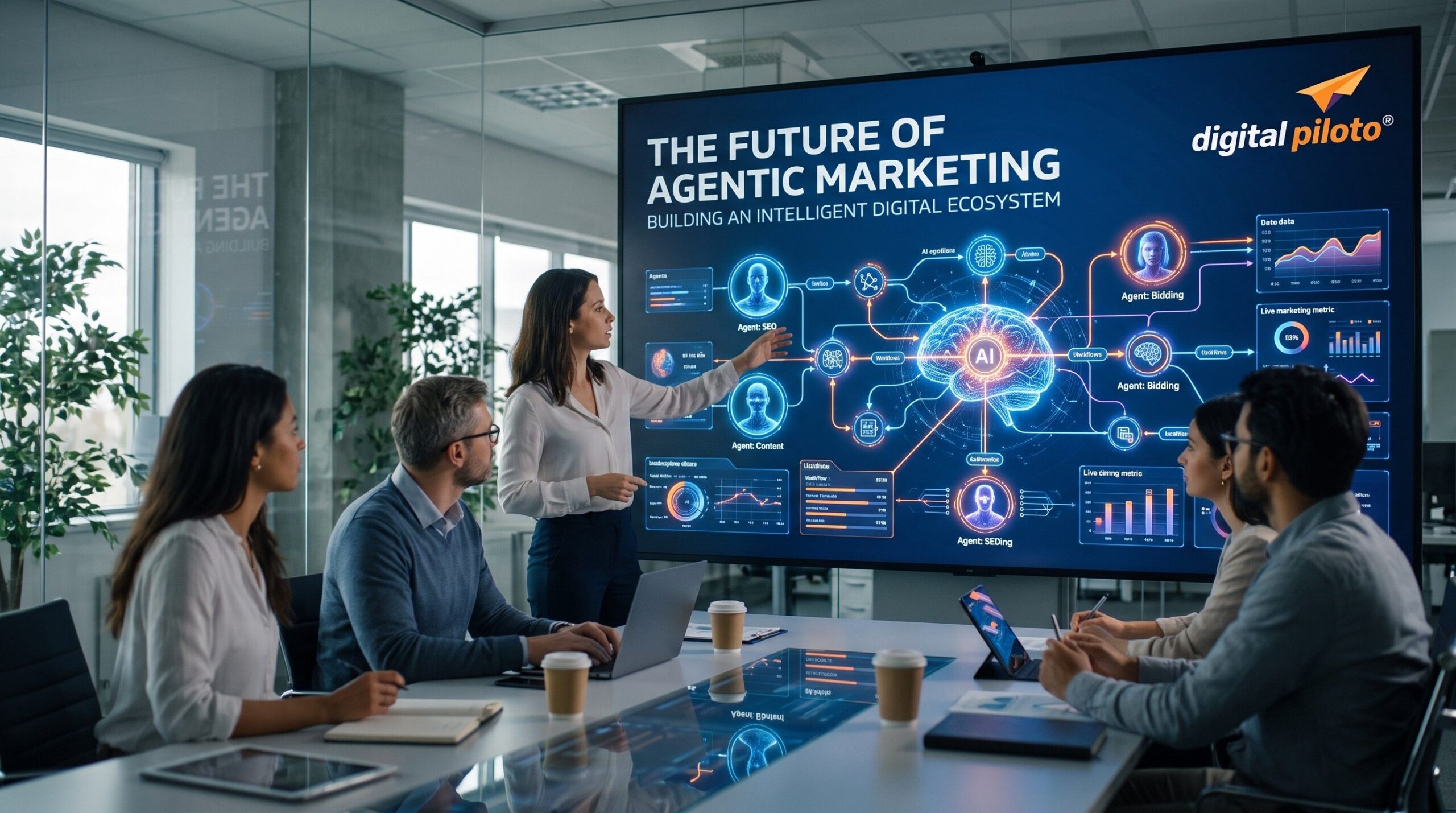
Imagine a marketing system that does more than report yesterday’s campaign results. It notices changing customer behaviour, identifies an opportunity, recommends a response, and carries out approved actions while your team focuses on strategy. This is the promise of agentic marketing. As AI evolves, businesses are moving towards connected digital ecosystems that can learn, adapt, and coordinate work.
For companies planning sustainable growth, partnering with a digital marketing service provider in India can help bridge the gap between conventional campaigns and intelligent automation. The opportunity goes beyond adopting another AI tool. It involves connecting customer insights, content, advertising, sales, and retention into a coordinated system that responds to real business needs.
What Is Agentic Marketing?
Agentic marketing uses AI agents to support or perform marketing activities by interpreting information, working towards defined goals, selecting appropriate actions, and using connected tools. Depending on their design and permissions, these agents may assist with audience research, campaign optimization, lead qualification, content workflows, and customer engagement.
To understand the difference, consider a traditional marketing automation platform. It might send an email three days after someone downloads a guide. An AI agent could potentially examine the prospect’s expressed interests, retrieve relevant information, and recommend a suitable follow-up instead. In a more advanced setup, it might execute that approved action and record the result in a CRM.
That distinction matters. Automation typically follows predetermined rules, while agentic systems can handle more varied situations within their operating boundaries. However, the two are not competitors. Rules, workflows, and human approvals often provide the structure that makes AI agents useful and safe.
Agentic marketing is not about giving software unlimited freedom. It is about assigning specific responsibilities to intelligent systems and connecting those responsibilities to measurable business objectives.
Why Marketing Is Moving Towards Intelligent Ecosystems
Most businesses already use multiple digital tools. Their website attracts visitors, analytics platforms measure behaviour, advertising systems generate traffic, CRM software stores customer records, and email platforms support nurturing. The trouble is that these systems do not always work together smoothly.
A marketing manager might discover that paid advertising generates enquiries but struggle to connect those enquiries with eventual sales. Another team may produce content without knowing which questions sales representatives hear most frequently. Valuable information exists, yet it remains scattered across departments and platforms.
An intelligent digital ecosystem aims to reduce this fragmentation. Connected AI agents can help interpret information across approved systems, identify potential opportunities, and coordinate tasks that would otherwise require repeated manual intervention.
Imagine an ecommerce business noticing that visitors repeatedly abandon a particular product category. An intelligent workflow could investigate available analytics, flag possible issues, suggest improvements to product information, and prepare a campaign adjustment for review. A human marketer remains responsible for evaluating the recommendation and deciding whether it makes commercial sense.
The advantage is not simply speed. It is the ability to connect signals that might otherwise remain separate.
The Core Building Blocks of Agentic Marketing
1. Customer intelligence and predictive insights
Effective marketing begins with understanding people. AI systems can help analyze permitted customer data, website interactions, purchase histories, and campaign responses to identify patterns that deserve attention.
For example, a subscription business might detect that customers who never complete onboarding are more likely to cancel. An agent could identify eligible accounts and recommend a helpful onboarding message before disengagement becomes a larger problem.
These predictions are not guarantees. Data can be incomplete, behaviour can change, and historical patterns may not apply to every customer. Businesses should test recommendations rather than treating model-generated scores as unquestionable facts.
2. Connected content and campaign operations
Content production involves research, planning, drafting, editing, publishing, distribution, and performance review. Agentic workflows can help coordinate these stages, provided that the business defines clear standards and approval checkpoints.
An agent might identify a recurring customer question, prepare a content brief, suggest relevant internal links, and route a draft to an editor. Another workflow could help adapt an approved article into social posts or an email newsletter.
Human expertise remains essential for checking factual claims, brand voice, originality, and relevance. Producing more content is not a meaningful achievement if the content does not answer customers’ questions.
3. Marketing, sales, and service coordination
The customer journey does not stop at a marketing-qualified lead. Prospects may need a sales conversation, while existing customers may require onboarding or technical assistance.
Connected agents can help summarize interactions, update approved records, route enquiries, and provide teams with useful context. When a prospect asks a complicated question, the system can escalate the conversation rather than forcing an automated response that misses the point.
This coordination can create a more consistent customer experience. It also requires careful access controls so that each agent sees only the information needed for its assigned role.
How Agentic Marketing Can Transform the Customer Journey
Discovery: Becoming visible when customers need answers
Customers discover businesses through search engines, social platforms, recommendations, online communities, and increasingly, AI-assisted experiences. An intelligent marketing ecosystem can help businesses understand which questions customers ask and where relevant information should be available.
Clear service pages, useful educational content, credible brand information, and a technically sound website remain foundational. AI agents can support research and workflow coordination, but they cannot guarantee that a brand will appear in every search or AI-generated answer.
Consideration: Making decisions easier
Once customers discover a business, they need reasons to trust it. Depending on the purchase, those reasons might include transparent pricing, detailed comparisons, genuine reviews, demonstrations, or evidence of relevant experience.
AI can help organize these resources around different buyer needs. A first-time visitor may need an introductory guide, while an experienced buyer might prefer a feature comparison or implementation checklist. The content should reflect the decision the person is trying to make, not simply repeat the company’s sales pitch.
Conversion and retention: Acting at the right moment
Agentic workflows can help identify incomplete enquiries, prepare relevant follow-ups, and recommend next steps based on available information. After purchase, they can support onboarding, answer routine questions, or identify customers who may need additional guidance.
Consider a software company that detects a customer has not configured an important feature. A well-designed system could offer a short tutorial and provide a route to human support. That is more useful than sending a generic promotional email simply because a certain number of days has passed.
The Role of SEO and GEO in Agentic Marketing
An intelligent marketing ecosystem still needs a reliable way to attract relevant audiences. Search engine optimization supports organic discovery through useful content, technical accessibility, relevant pages, and a well-structured website. AI-driven workflows can help teams maintain these activities, analyze opportunities, and prioritize improvements.
Meanwhile, a generative engine optimization agency can help businesses develop strategies for improving how their information may be understood, surfaced, and referenced in AI-generated responses. GEO complements SEO by considering visibility across generative search experiences, although neither discipline guarantees inclusion in an AI answer.
For businesses exploring seo marketing in india, the bigger opportunity lies in connecting organic visibility with lead quality, customer intent, and revenue outcomes.
In practice, an intelligent ecosystem can support several connected activities:
- Search intelligence: Identify recurring customer questions, content gaps, and relevant search opportunities.
- Content coordination: Help create, review, update, and distribute useful information across suitable channels.
- Lead management: Connect content engagement with approved CRM workflows and appropriate follow-up actions.
- Performance learning: Evaluate which pages, campaigns, and customer journeys contribute to meaningful business outcomes.
The objective is to build continuity between discovery and conversion, rather than managing every marketing channel as an isolated activity.
Building an Agentic Marketing System Step by Step
Businesses do not need to replace their existing technology stack to begin. A gradual implementation usually makes it easier to understand costs, manage risk, and identify where autonomous decision-making adds genuine value.
- Choose a specific business problem. Start with a recurring challenge such as slow lead routing, inconsistent campaign reporting, or time-consuming content research.
- Map the existing workflow. Document the information required, decisions involved, tools used, and points where human judgment is necessary.
- Connect reliable data sources. Integrate only the relevant systems and establish clear rules for data quality, permissions, and access.
- Define the agent’s boundaries. Specify what it can read, recommend, create, or execute, and which actions require approval.
- Test before expanding. Evaluate accuracy, failure handling, security, and business outcomes in a controlled pilot.
- Improve using evidence. Review performance, gather team feedback, and expand the workflow only when results justify the additional complexity.
For instance, a business could begin with an agent that categorizes incoming enquiries and drafts response suggestions. Once the team has verified its reliability, it might allow automatic routing for routine cases while keeping unusual or high-value enquiries under human supervision.
Governance, Privacy, and Human Oversight
Greater autonomy brings greater responsibility. An agent with access to customer records or advertising accounts can potentially make mistakes at a scale that manual workflows would not reach as quickly.
Businesses should establish clear safeguards before expanding agent permissions. These include:
- Data minimization: Use only the personal information necessary for the task and handle it according to applicable privacy requirements.
- Permission controls: Separate read-only access from actions that modify customer records, budgets, or campaigns.
- Approval checkpoints: Require human authorization for sensitive decisions, major spending changes, and external commitments.
- Monitoring and accountability: Maintain records of important actions, review failures, and assign responsibility for resolving problems.
- Reliable escalation: Make it easy to transfer complex issues to a qualified human rather than allowing an agent to guess.
It is also worth remembering that AI-generated recommendations can reflect poor data or flawed assumptions. Human review should challenge those recommendations when necessary, not simply approve them because they appear confident.
Measuring the Real Impact of Agentic Marketing
A sophisticated system is not automatically a successful one. The right measures depend on the business objective, and activity metrics should never replace commercial outcomes.
Useful indicators include qualified lead volume, conversion rates, customer acquisition cost, campaign return on investment, response time, customer retention, and the time employees spend on repetitive tasks. Businesses should also monitor error rates, inappropriate actions, and customer satisfaction.
Establish a baseline before launching a pilot, then compare performance over a suitable period. Account for seasonal changes, pricing adjustments, and other campaigns that might influence results. Where possible, controlled experiments can help determine whether the new workflow actually caused an improvement.
Most importantly, measure the full cost of implementation, including integrations, oversight, training, maintenance, and troubleshooting. The best system is the one that creates sustainable value, not the one with the most impressive demonstration.
Frequently Asked Questions
1. What is agentic marketing in simple terms?
Agentic marketing uses AI agents to interpret information, work towards defined marketing goals, and perform approved tasks. These tasks may include research, lead qualification, campaign support, and customer nurturing, depending on the system’s capabilities and permissions.
2. How is agentic marketing different from marketing automation?
Traditional automation generally follows predefined rules and sequences. Agentic marketing can involve systems that interpret changing contexts, select suitable actions, and use connected tools within defined boundaries. Both approaches can work together in one marketing ecosystem.
3. Can small businesses benefit from agentic marketing?
Yes. Small businesses can start with focused applications such as enquiry classification, content research, lead routing, or customer support. A limited pilot with clear goals and human oversight can help establish whether the investment is worthwhile.
4. Does agentic marketing replace SEO and human marketers?
No. SEO remains important for organic discovery, and GEO can support visibility in generative AI experiences. Human marketers provide strategic judgment, creativity, relationship-building, and accountability. AI agents can assist these efforts but do not replace every aspect of them.
Final Thoughts: Build a System That Thinks Together
The future of agentic marketing is not about filling a business with disconnected AI tools. It is about building an intelligent digital ecosystem where customer insights, content, campaigns, sales, and service work towards shared goals.
Start small, connect reliable information, define clear boundaries, and measure what changes. When AI agents handle appropriate repetitive work and people remain responsible for judgment and relationships, marketing becomes more coordinated without losing its human purpose. That balance is likely to matter far more than adopting every new AI capability as soon as it appears.
Blog Development Credits
This article was conceptualized by Amlan Maiti, developed with AI-assisted research and drafting, and refined for clarity and search relevance by Digital Piloto Private Limited.