

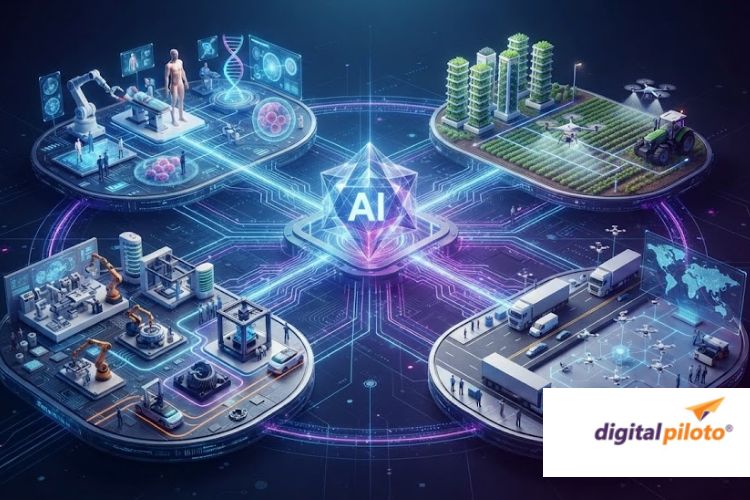
The Impact of AI Across Industries
Artificial intelligence is reshaping modern industries by improving decision-making, automating repetitive work, uncovering hidden insights in data, and enabling businesses to operate with greater speed and precision. What makes today’s AI revolution different is that it is no longer limited to technology companies. From hospitals and factories to retail stores and property firms, AI has become a practical business tool rather than an experimental technology.
The effects are already visible across sectors that traditionally relied heavily on manual processes. Even industries focused on customer acquisition, such as Real Estate Lead Generation, are using AI to predict buyer intent, score prospects, and personalize communication at scale.
What Is Artificial Intelligence in a Business Context?
Definition: Artificial intelligence refers to computer systems that can analyze information, recognize patterns, make predictions, and perform tasks that typically require human intelligence.
In business environments, AI does not replace human expertise. Instead, it extends human capabilities by processing information faster and identifying opportunities that might otherwise remain hidden.
The most successful organizations use AI as an enhancement tool rather than a replacement strategy.
Why Is AI Affecting So Many Industries at Once?
Three major developments have accelerated AI adoption across industries:
- Cloud computing reduced infrastructure costs.
- Data collection became easier and more affordable.
- Machine learning tools became accessible to non-technical businesses.
Ten years ago, implementing AI required large budgets and specialized research teams. Today, businesses can access sophisticated AI capabilities through software platforms they already use every day.
How AI Is Transforming Healthcare
Healthcare has moved beyond simple digitization.
AI systems are helping medical professionals detect diseases earlier, prioritize urgent cases, and improve diagnostic accuracy.
Examples include:
- Medical image analysis for early detection.
- Predictive analytics for patient outcomes.
- AI-powered virtual assistants for patient support.
- Drug discovery acceleration.
The important point is that AI supports clinicians rather than replacing them. Human judgment remains essential in healthcare decisions.
How AI Is Changing Manufacturing
Manufacturing may be one of the industries experiencing the most measurable return on AI investments.
Predictive maintenance systems can identify equipment failures before breakdowns occur, reducing downtime and maintenance costs.
Modern factories also use AI for:
- Quality inspection automation.
- Supply chain forecasting.
- Production scheduling optimization.
- Energy consumption management.
In many cases, AI enables factories to become more efficient without requiring major physical expansion.
How AI Is Reshaping Retail
Retail has evolved from selling products to understanding customer behavior.
AI helps businesses analyze browsing habits, purchase patterns, and customer preferences in real time.
This has become particularly valuable in Retail Digital Marketing, where personalized recommendations and predictive inventory planning directly influence revenue growth.
Retail organizations increasingly use AI for:
- Dynamic pricing strategies.
- Personalized product recommendations.
- Demand forecasting.
- Customer support automation.
The future of retail may belong to businesses that understand customer intent before customers explicitly express it.
How AI Is Influencing Financial Services
Financial institutions process enormous amounts of information every day, making them ideal candidates for AI adoption.
AI systems are currently helping banks and financial firms:
- Detect fraud in real time.
- Evaluate credit risk.
- Automate compliance checks.
- Improve customer service experiences.
Speed matters in finance, and AI dramatically reduces the time required for analysis and decision-making.
How AI Is Transforming Real Estate
The real estate industry is becoming increasingly data-driven.
AI tools can analyze market conditions, estimate property values, identify investment opportunities, and predict buyer preferences.
Property professionals who combine local expertise with AI-driven insights often make faster and more informed decisions.
How Businesses Can Successfully Adopt AI
Step-by-Step Framework:
Step 1: Identify Repetitive Processes
Focus first on tasks that consume time but provide limited strategic value.
Step 2: Start with Existing Data
AI systems perform best when businesses organize and improve their data quality.
Step 3: Choose Specific Business Problems
Avoid implementing AI simply because it is popular. Solve measurable problems instead.
Step 4: Combine Human Expertise with Automation
The strongest results typically come from collaboration between employees and intelligent systems.
Challenges Businesses Should Expect
AI adoption is not without obstacles.
- Data privacy concerns.
- Integration with older systems.
- Employee training requirements.
- Regulatory compliance challenges.
- Model transparency issues.
Organizations that address these concerns early often achieve smoother implementation outcomes.
The Bigger Picture: AI as Infrastructure
Many businesses still view AI as a separate initiative or technology project.
In reality, AI is gradually becoming business infrastructure in the same way the internet became infrastructure two decades ago.
The companies that benefit most may not be those with the most advanced algorithms, but those that integrate AI thoughtfully into everyday decision-making.
Frequently Asked Questions
What industries are benefiting most from AI?
Healthcare, manufacturing, retail, finance, logistics, and real estate are among the fastest adopters of AI technologies.
Will AI replace human workers?
AI is more likely to automate tasks rather than entire jobs, allowing employees to focus on higher-value activities.
Why is AI important for businesses?
AI improves efficiency, enhances decision-making, reduces costs, and creates better customer experiences.
Can small businesses use AI?
Yes. Many affordable AI tools are designed specifically for small and medium-sized businesses.
What is the biggest challenge in AI adoption?
Data quality and integration with existing systems remain the most common implementation challenges.
Conclusion
The impact of AI across modern industries is not a future prediction; it is already happening. Businesses that approach AI with clear goals and realistic expectations are discovering that the technology delivers its greatest value when it strengthens human expertise rather than attempting to replace it.
Blog development credits
This article was developed through a combination of strategic industry research, AI-assisted analysis, and editorial refinement. The original concept was inspired by insights from Amlan Maiti, with final SEO optimization and content enhancements contributed by Digital Piloto.