

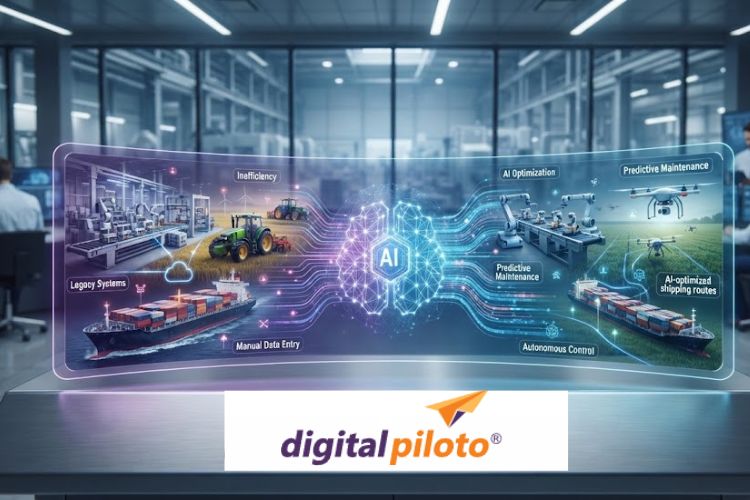
Artificial intelligence is transforming traditional industries by improving decision-making, automating repetitive work, predicting future outcomes, and uncovering efficiencies that were previously invisible. Rather than replacing established sectors, AI is helping them evolve, modernize operations, and compete in increasingly digital markets.
What makes this shift remarkable is that AI is no longer limited to technology companies. Manufacturing plants, logistics firms, hospitals, retailers, and agricultural businesses are actively deploying intelligent systems to solve long-standing challenges. Even organizations investing in growth strategies through a Paid Marketing Agency are finding that AI-driven insights produce faster and more measurable outcomes.
What Does AI Transformation Actually Mean?
AI transformation is the process of integrating machine learning, predictive analytics, automation, and intelligent decision systems into existing business operations to improve efficiency and outcomes.
This is an important distinction because many businesses assume digital transformation means replacing everything they already use.
In reality, successful AI adoption often starts by improving existing workflows rather than rebuilding them entirely.
Why Traditional Industries Are Embracing AI Now
For years, industries such as manufacturing, construction, logistics, and healthcare relied heavily on human experience and manual processes.
While expertise remains essential, the volume of modern business data has simply become too large for humans to process effectively on their own.
AI helps organizations:
- Process massive amounts of operational data.
- Identify patterns humans may overlook.
- Reduce costly errors.
- Improve forecasting accuracy.
- Increase productivity without increasing workforce size.
Manufacturing Is Becoming Predictive Rather Than Reactive
One of the clearest examples of AI transformation can be seen in manufacturing.
Traditional factories often operated on scheduled maintenance cycles, regardless of actual equipment conditions.
Today, predictive maintenance systems analyze sensor data continuously and identify problems before machinery fails.
The result is reduced downtime, lower maintenance costs, and improved production efficiency.
In many facilities, AI is not replacing engineers. It is giving them earlier warnings and better information.
Healthcare Is Moving Toward Preventive Intelligence
Healthcare has historically been reactive by nature. Patients become sick, then treatment begins.
AI is gradually changing this model.
Machine learning systems can now identify risk factors, analyze medical images, and detect abnormalities earlier than traditional approaches in certain situations.
The goal is not replacing physicians but helping them make faster and more informed decisions.
Retail Is Becoming Hyper-Personalized
Retail businesses once relied heavily on broad customer segmentation and seasonal trends.
AI has introduced a much more precise approach.
Recommendation engines, dynamic pricing systems, and customer behavior analytics now allow businesses to personalize experiences at scale.
This evolution has significantly increased demand for specialized expertise from an Ecommerce Marketing Agency capable of combining consumer insights with intelligent automation.
Real Estate Is Becoming Data Driven
The real estate sector has traditionally depended heavily on local market knowledge and experience.
Those factors still matter, but AI is adding an entirely new layer of intelligence.
Property valuation models, lead scoring systems, and predictive demand forecasting are helping agencies improve both operational efficiency and customer experiences.
This trend is creating new opportunities for businesses investing in Real Estate Marketing Services that combine AI insights with targeted growth strategies.
Definition: What Makes an Industry AI-Enabled?
An industry can generally be considered AI-enabled when it uses intelligent systems to:
- Collect operational data automatically.
- Analyze information continuously.
- Generate recommendations or predictions.
- Improve performance through learning over time.
Automation alone does not create intelligence. The ability to learn and adapt is what separates AI systems from traditional software.
How Businesses Can Begin Their AI Journey
Step 1: Identify Repetitive Processes
The best AI projects often start with repetitive decisions or manual workflows.
Step 2: Organize Existing Data
AI performs best when information is clean, centralized, and accessible.
Step 3: Start With One Business Problem
Trying to transform everything at once usually creates unnecessary complexity.
Step 4: Measure Results Carefully
Successful AI implementation depends on measurable improvements in efficiency, accuracy, or customer satisfaction.
Step 5: Scale Gradually
Once proven, AI capabilities can expand into additional departments and processes.
The Human Element Is Becoming More Valuable
A common concern surrounding AI adoption is job displacement.
In practice, most organizations discover that AI changes work more often than it eliminates it.
Machines excel at speed, scale, and pattern recognition.
Humans excel at judgment, creativity, negotiation, and empathy.
The strongest businesses of the next decade will combine both strengths rather than choosing one over the other.
The Competitive Advantage Will Belong to Adapters
History shows that industries rarely disappear because of new technologies.
More often, companies struggle because they underestimate how quickly customer expectations evolve.
AI is not creating new industries alone. It is reshaping existing ones from within.
The businesses that embrace intelligent operations today are likely to define market standards tomorrow.
Frequently Asked Questions
How is AI transforming traditional industries?
AI improves efficiency, automation, forecasting, and decision-making across existing business operations.
Which industries benefit most from AI adoption?
Manufacturing, healthcare, logistics, retail, agriculture, and real estate are among the leading beneficiaries.
Does AI replace workers in traditional sectors?
No. In most cases, AI supports employees by automating repetitive tasks and improving decision quality.
What is the first step in adopting AI?
Organizations should begin by identifying repetitive workflows and data-intensive processes.
Is AI adoption only for large enterprises?
No. Advances in cloud technology have made AI solutions accessible to businesses of all sizes.
Conclusion
The story of AI is no longer about technology companies building smarter software. It is about traditional industries discovering new ways to operate, compete, and grow. The organizations that treat AI as a practical business tool rather than a futuristic experiment are already building the next generation of competitive advantage.
Blog development credits
This article was shaped from concepts developed by Amlan Maiti, researched with support from AI platforms including ChatGPT, Gemini, and Copilot, and refined through strategic optimization by Digital Piloto Private Limited.