

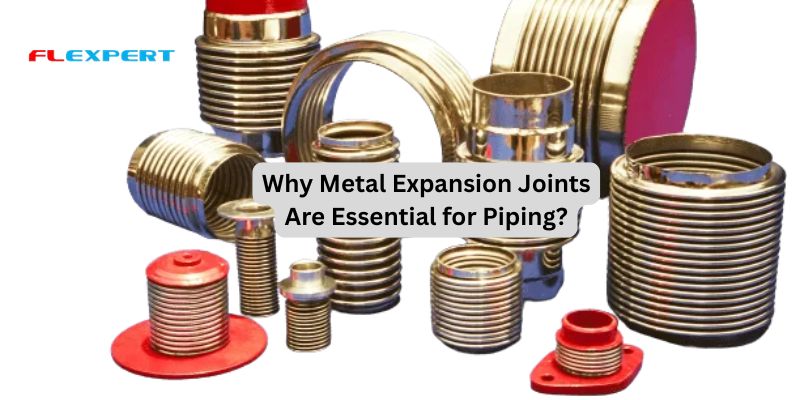
What happens when a piping system repeatedly heats, cools, vibrates, and shifts under operating conditions? It moves. If that movement has nowhere to go, stress can build in pipes, welds, flanges, and connected equipment. That is where Metal Expansion Joints become an important part of thoughtful piping design.
What Makes Piping Move?
Metal may look rigid, but industrial piping is constantly responding to its surroundings. Temperature changes cause materials to expand and contract, while pumps, compressors, fans, and flowing fluids can introduce vibration. Even small movements can become significant when a long pipe run goes through repeated heating and cooling cycles.
NASA engineering references show that metals have measurable coefficients of thermal expansion, meaning a material’s dimensions change as temperature changes. The amount varies considerably between materials, which is one reason thermal movement needs to be considered during piping design. NASA reference data on thermal expansion provides examples across metals and other engineering materials.
Instead of forcing the entire piping network to absorb that movement, an expansion joint provides a controlled area where movement can occur.
Why Metal Expansion Joints Matter?
The real value of an expansion joint is not simply that it “makes a pipe flexible.” Its job is more specific: it helps accommodate predictable movement while reducing unwanted loads elsewhere in the system.
1. They Help Absorb Thermal Movement
Imagine a long stainless-steel pipeline carrying a hot process fluid. As the temperature rises, the pipe wants to grow. When the system cools, it contracts again. If the pipe is tightly restrained, those movements can transfer loads to supports, anchors, equipment nozzles, and joints.
A properly engineered metallic expansion joint can provide the flexibility needed to manage this movement. ASME B31.3 specifically addresses piping flexibility and components used to accommodate expansion, demonstrating how important movement considerations are in process-piping engineering. ASME B31.3 Process Piping is a recognized reference for the design, fabrication, inspection, and testing of process piping.
2. They Can Reduce Stress on Connected Equipment
Piping rarely works alone. It connects to pumps, turbines, heat exchangers, boilers, tanks, compressors, and other equipment. Excessive movement or rigidity can transmit unwanted forces toward those connections.
- Equipment protection: Flexibility can help limit movement-related loads at sensitive connections.
- Pipework reliability: Controlled movement can reduce unnecessary strain on selected components.
- Operational stability: A properly designed system can better tolerate normal thermal cycles and mechanical movement.
ASME’s technical guidance on expansion joints also highlights applications involving thermal expansion, piping fit-up, equipment nozzle loads, and vibration isolation. In other words, these components can solve more than one piping challenge when correctly specified. ASME’s expansion-joint guidance discusses these engineering considerations in greater detail.
Where Metal Bellows Expansion Joints Fit In?
Among the available expansion-joint designs, Metal Bellows Expansion Joints are widely used when engineered flexibility is required in demanding piping environments. Their corrugated bellows element is designed to flex in response to specified movements while maintaining the pressure boundary.
Depending on the application, engineers may need to account for axial movement, lateral movement, angular movement, pressure, temperature, vibration, cycle frequency, material compatibility, and installation conditions. This is why selecting an expansion joint based only on pipe diameter is rarely enough.
Common Applications Include:
- Steam and hot-water piping
- Petrochemical and process plants
- Power-generation systems
- Exhaust and gas-handling lines
- HVAC and industrial utility piping
- Equipment connections requiring controlled flexibility
Selection Is Just as Important as Installation
A good expansion joint cannot compensate for poor system design. The joint needs to match the actual movement, pressure, temperature, piping configuration, and operating conditions. Anchors, guides, supports, and the direction of expected movement also matter.
For example, installing a joint where the surrounding pipework is inadequately guided may prevent the component from moving as intended. Likewise, choosing a unit without considering pressure thrust or cycle requirements can create problems that only become obvious after the system is operating.
Before final selection, engineers should typically review:
- Movement requirements: Determine how much axial, lateral, or angular movement is expected.
- Operating conditions: Consider pressure, temperature, fluid characteristics, and the number of expected cycles.
- System arrangement: Check anchors, guides, supports, equipment connections, and available installation space.
This engineering approach matters because an expansion joint is part of the piping system—not an isolated accessory. If you’re evaluating component choices, it is also worth understanding How Poor Joint Selection Can Increase Industrial Maintenance Costs.
What Happens Without Proper Flexibility?
When thermal and mechanical movement is not properly accommodated, the consequences may appear gradually. Supports can experience excessive loading, connections can become stressed, and repeated movement can contribute to fatigue in vulnerable areas. The result may be more inspections, unexpected maintenance, or unplanned downtime.
That does not mean every piping system needs an expansion joint. Good engineering starts with determining whether one is appropriate and, if so, selecting the correct configuration. Sometimes a piping layout can provide sufficient flexibility through its geometry; in other cases, an engineered expansion joint is the practical solution.
FAQs About Metal Expansion Joints
What is the main purpose of a metal expansion joint?
Its primary purpose is to accommodate specified piping movement, particularly movement caused by temperature changes, while helping control loads and stresses within the piping system.
Are metal expansion joints suitable for high-temperature piping?
They can be suitable for high-temperature applications when the joint materials, construction, pressure rating, movement capacity, and cycle requirements are properly matched to the operating conditions.
Can an expansion joint handle vibration?
Some expansion-joint designs can help accommodate or isolate certain types of vibration. However, vibration requirements should be evaluated during engineering rather than assumed from the presence of an expansion joint.
How do I choose the right expansion joint?
Start with the actual operating conditions: pipe size, pressure, temperature, movement type and amount, fluid, cycle requirements, connection details, and support arrangement. A qualified engineer or manufacturer can then determine an appropriate design.
Final Thoughts
Piping systems are built to carry fluids, but they also have to live with movement. Heat, cooling, vibration, and equipment loads are part of everyday industrial operation. The right expansion joint gives that movement a controlled path instead of allowing it to become an unwanted source of stress. When properly engineered and installed, metal expansion joints can play a valuable role in making piping systems more reliable, flexible, and durable.
Full Audio Version: Click Here