

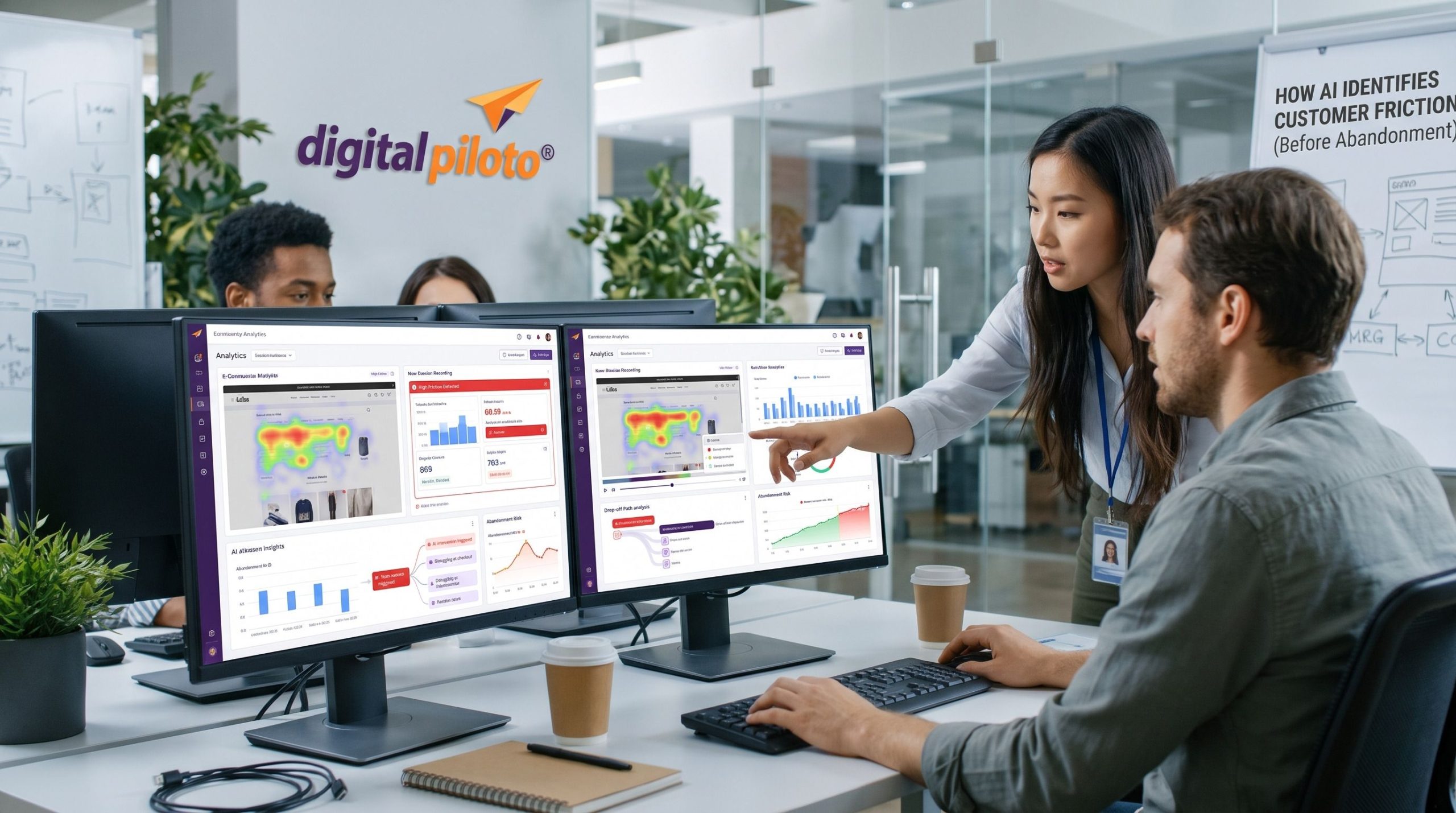
A customer adds a product to their cart, pauses, revisits the delivery information, changes the quantity, and eventually disappears. What went wrong? Perhaps the price felt too high, the payment options seemed unfamiliar, or the checkout simply demanded too much effort. Artificial intelligence can help businesses recognise these warning signs early and respond before hesitation becomes abandonment.
For ecommerce brands, reducing lost sales is no longer just about sending another discount email. It requires understanding why customers hesitate in the first place. Modern digital marketing services in India increasingly need to connect customer behaviour, website experience, analytics, and intelligent automation to identify problems while shoppers are still considering a purchase.
Why Customer Friction Often Goes Unnoticed
Customer friction is anything that makes buying more difficult, confusing, uncertain, or time-consuming than expected. Some obstacles are obvious, such as a payment gateway failure. Others are subtle: a shopper repeatedly checking the return policy, struggling to compare product specifications, or hesitating after seeing delivery charges.
The tricky part is that customers rarely explain why they leave. They do not usually submit a feedback form saying, “I wanted to buy this, but your delivery information appeared too late.” They simply close the tab.
Traditional analytics can reveal where visitors exit a website. However, a basic report may not explain the circumstances leading to that decision. A high exit rate on a checkout page, for example, could indicate unexpected costs, technical errors, trust concerns, or an overly complicated form.
AI adds another layer of understanding. By examining patterns across multiple interactions, it can help identify combinations of behaviours that may signal growing frustration or uncertainty. Rather than waiting for a completed abandonment, businesses can investigate the warning signs while the customer journey is still active.
The Scale of the Cart Abandonment Problem
Cart abandonment is not a small operational inconvenience. It represents a substantial gap between purchase interest and completed transactions.
According to the Baymard Institute’s cart abandonment research, the average documented abandonment rate across 50 studies is approximately 70.22%. Its research also highlights that not every abandoned cart represents a lost sale. Around 42% of surveyed US online shoppers said they had abandoned a cart simply because they were browsing or were not ready to buy.
Among shoppers who abandoned for other reasons, additional costs such as shipping and taxes were the most frequently reported obstacle, followed by delivery delays and concerns about payment security. These findings offer a useful reminder: businesses should distinguish ordinary browsing behaviour from friction that they can realistically address.
AI can help make that distinction more intelligently, although it cannot know a customer’s intentions with complete certainty. Its role is to identify patterns worth investigating, not to treat every pause as a purchase emergency.
How AI Detects Friction Before Abandonment
AI-powered customer behaviour analysis works by examining signals from different parts of the shopping experience. Individually, these signals may appear harmless. Together, they can suggest that a visitor is encountering difficulty.
1. Recognising unusual browsing patterns
Imagine a shopper visiting a product page several times, switching between two similar products, opening the specification section repeatedly, and returning to the price information. This could indicate serious purchase consideration—or unresolved uncertainty.
Machine learning models can compare such behaviour with broader patterns from previous sessions. They may identify combinations of repeated visits, comparison activity, unusual navigation, and prolonged pauses that are associated with lower conversion likelihood.
The business can then consider a relevant response, such as improving product comparisons, displaying clearer specifications, or offering assistance. The objective is not to interrupt every visitor but to make useful information easier to find.
2. Detecting hesitation during checkout
Checkout is where small inconveniences can become expensive. A customer may enter an address incorrectly, repeatedly switch between payment options, or spend an unusually long time on one form field.
AI systems can analyse checkout event data to identify recurring patterns around these moments. For example, if visitors using a particular mobile device frequently abandon after the payment page loads, the issue might involve a technical compatibility problem rather than a lack of purchase interest.
With appropriate monitoring, businesses can investigate the affected device, browser, payment method, or checkout step before the problem affects more customers.
3. Finding hidden problems through session behaviour
Session analytics can capture actions such as clicks, scrolling, navigation changes, form errors, and repeated interactions. AI can help group these events into patterns that suggest friction.
Suppose visitors repeatedly click an element that looks like a delivery-information link but does not open anything. A conventional conversion report may never reveal the problem. Interaction analysis, however, could highlight the repeated behaviour as a potential usability issue.
Heatmaps and session recordings are useful supporting tools, but they should be interpreted carefully. AI-generated summaries can speed up investigation; human review is still needed to understand what visitors were actually trying to accomplish.
4. Analysing customer questions and feedback
Customer support conversations often contain clues that website analytics cannot provide. Questions such as “Will this arrive before Friday?”, “Can I return it if the size is wrong?”, or “Why is the final amount different?” reveal uncertainty that may be preventing a purchase.
Natural language processing can categorise these conversations by topic, sentiment, and recurring concern. When similar questions appear frequently, businesses can use those insights to improve product pages, delivery information, return policies, and checkout communication.
Five Warning Signs AI Can Help Businesses Recognise
There is no single behaviour that proves a shopper is about to abandon a purchase. Context matters. Still, the following patterns can help businesses identify where closer attention may be useful.
- Repeated price checking: A visitor repeatedly moves between the product price, cart total, and delivery information. This may indicate uncertainty about the final cost.
- Unusual checkout delays: A shopper spends significantly longer than usual on a particular step, especially when combined with repeated errors or navigation changes.
- Repeated product comparisons: Visitors switch between similar products several times, suggesting that important differences may not be clearly explained.
- Payment-method switching: A shopper tries multiple payment options or returns to the payment page after an unsuccessful attempt.
- Repeated support searches: Visitors frequently open FAQs or contact support about delivery, warranties, returns, or product compatibility before purchasing.
These are indicators, not definitive conclusions. A customer comparing prices may simply be careful, while a long checkout session could mean they are checking details with someone else. Reliable AI systems should combine several signals and account for normal customer behaviour before triggering an intervention.
Turning AI Insights into Helpful Customer Experiences
Identifying friction is only half the job. The real value appears when businesses use those insights to improve the experience.
Personalised assistance at the right moment
If a visitor repeatedly checks product specifications, a website might make a comparison guide easier to access. If delivery information appears to be a concern, a clear delivery estimate could be displayed earlier. If a customer struggles with a form, contextual guidance may be more helpful than another promotional message.
The timing and relevance of the response matter. Constant pop-ups, aggressive discount offers, and intrusive chat windows can create additional friction. AI should help a business become more considerate, not more persistent.
Predictive customer analytics for smarter intervention
Predictive analytics can estimate the likelihood of an event, such as checkout abandonment, using historical and current behavioural information. A model might identify that certain combinations of device type, payment errors, and checkout delays are associated with a higher risk of unsuccessful purchases.
The business can then prioritise appropriate actions. A technical error may require a support alert, while a missing product detail may call for a content improvement. A shopper who is simply browsing may need no intervention at all.
Well-designed systems also learn from outcomes. If a particular intervention does not improve conversions or customer satisfaction, the business should revise the approach rather than continue showing it automatically.
AI, Website Experience, and the Wider Digital Ecosystem
Customer friction rarely belongs to one department. A confusing product description may be a content issue. A slow checkout may involve development. Unclear delivery promises may originate in logistics. Poorly targeted promotions may reflect a marketing data problem.
That is why friction detection should connect website analytics, CRM platforms, customer support information, ecommerce systems, and marketing automation where appropriate. A joined-up view makes it easier to understand the actual customer experience instead of analysing isolated events.
A capable digital transformation agency India can help businesses approach this challenge as a connected improvement project, bringing together website performance, data integration, automation, and customer experience. The objective should be a practical system that solves identifiable problems, not simply adding AI tools because they are available.
Search visibility also contributes to the journey. Customers arriving from organic search need accurate product information, useful landing pages, and clear answers to their questions. Effective search engine optimization services India can support this discovery process by helping relevant audiences find information that matches their needs. Once visitors arrive, the website experience must deliver on that promise.
How to Implement AI-Based Friction Detection
Businesses do not need a complicated AI infrastructure to begin. A focused implementation is usually more useful than a large system built without a clear problem to solve.
- Map the purchase journey: Identify the main steps from product discovery to payment confirmation. Include mobile and desktop experiences, as well as important traffic sources.
- Collect meaningful behavioural data: Track relevant events such as product views, cart additions, checkout progression, form errors, payment attempts, and completed orders. Respect consent and privacy requirements.
- Establish a baseline: Measure existing conversion rates, checkout completion, error frequency, and abandonment by device or journey stage. This provides a reference for future improvements.
- Choose a specific friction problem: Start with one issue, such as repeated payment failures or confusion about delivery costs. Avoid trying to predict every possible customer action immediately.
- Test AI-supported detection: Use behavioural rules or predictive models to identify relevant patterns. Compare their signals with real customer outcomes and check for false alarms.
- Introduce a measured response: Test a suitable intervention, such as clearer information, contextual assistance, or a technical fix. Compare results against an appropriate control group where possible.
- Review and improve: Monitor conversion, customer satisfaction, complaints, and unwanted interruptions. Refine the model and intervention as customer behaviour changes.
Privacy, Accuracy, and the Human Side of AI
AI-based customer monitoring must be handled responsibly. Businesses should collect only the information they genuinely need, explain relevant data practices, apply appropriate access controls, and follow applicable privacy laws. Sensitive information should not be used casually to infer personal circumstances or manipulate buying decisions.
Accuracy is another concern. A model may incorrectly interpret a slow visit as hesitation or classify a normal comparison as purchase difficulty. If every uncertain signal triggers a discount or pop-up, customers may feel watched rather than supported.
Human oversight helps prevent this. Teams should regularly review model performance, test for misleading patterns, and make sure automated interventions remain useful. In some situations, the best response is not an AI message at all. It is fixing a broken page, simplifying a form, or explaining a policy more clearly.
Frequently Asked Questions
1. How can AI predict cart abandonment?
AI can analyse behavioural signals such as repeated product visits, checkout delays, form errors, payment attempts, and navigation patterns. Machine learning models compare these signals with historical outcomes to estimate abandonment risk. The prediction is an indicator, not a guarantee.
2. What customer friction can AI detect on an ecommerce website?
AI can help identify possible friction involving unclear product information, unexpected costs, checkout complexity, payment difficulties, delivery uncertainty, and repeated support questions. The specific signals depend on the data available and how the website is designed.
3. Can AI automatically prevent customers from abandoning their carts?
AI cannot prevent every abandonment, because some shoppers are only browsing or decide not to buy for reasons unrelated to the website. It can, however, support timely interventions such as clearer information, contextual assistance, and targeted follow-ups.
4. Which data is needed for AI-based friction detection?
Useful data may include website interaction events, device and browser information, checkout errors, purchase history, customer support topics, and transaction outcomes. Businesses should collect only relevant data and handle it according to applicable privacy and consent requirements.
Final Thoughts: Make Buying Feel Easier
The most effective way to reduce abandonment is not to persuade every hesitant customer to complete a purchase. It is to understand what makes buying difficult and remove the obstacles that should never have been there.
AI gives businesses a better opportunity to recognise those obstacles while the customer journey is still unfolding. When its predictions are combined with thoughtful design, reliable data, and human judgement, it can turn hidden frustration into practical improvements—and make the path from interest to purchase feel much more natural.
Blog Development Credits
This article was conceptualised by Amlan Maiti, shaped through AI-assisted research, and editorially refined with SEO enhancements by Digital Piloto Private Limited.