

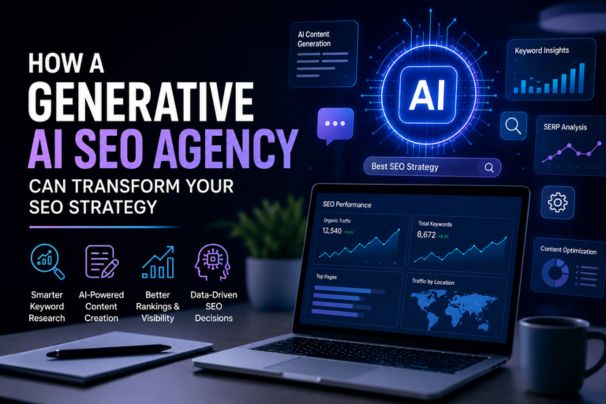
A generative AI seo agency can transform an SEO strategy by helping businesses optimise not only for traditional search rankings, but also for AI-generated answers and conversational search experiences. The approach combines technical SEO, high-quality content, structured information, and AI-focused optimisation to improve how a brand is discovered, understood, and mentioned across modern search platforms.
The important shift is that search is no longer limited to a list of blue links. Users increasingly ask detailed questions and expect direct, contextual answers. Businesses therefore need content that is useful to people and easy for search and AI systems to interpret.
What Is Generative AI SEO?
Generative AI SEO is the practice of optimising a website and its content so that it can be accurately discovered, interpreted, and potentially referenced by AI-powered search and answer systems, alongside conventional search engines.
Traditional SEO often focuses heavily on rankings, keywords, backlinks, crawlability, and organic traffic. Generative AI SEO expands that objective by considering how clearly a business demonstrates its expertise and how easily its information can be extracted and understood in an answer-driven search environment.
Why Is Generative AI Changing SEO?
AI-powered search changes the way users interact with information. Instead of visiting several pages and comparing answers, a user may ask one detailed question and receive a generated response based on information gathered from multiple sources.
That creates a new challenge for businesses: being visible is no longer only about ranking highly for a keyword. Your content must provide information that is clear, trustworthy, specific, and useful enough to become part of the answer ecosystem.
- Search intent matters more: Content needs to answer the actual question behind a query.
- Context becomes important: AI systems need clear information about what a business does, who it serves, and where it operates.
- Structured content helps: Logical headings, concise answers, lists, FAQs, and descriptive page elements make information easier to interpret.
- Authority still matters: Demonstrable expertise and trustworthy information remain important for long-term visibility.
Also Read: SEO vs Paid Ads: How Smart Businesses Build a High-ROI Strategy
How Can an AI SEO Agency Transform Your Strategy?
1. It Moves SEO Beyond Keyword Targeting
Keywords remain useful, but modern search behaviour is much more conversational. A user might search for a broad term such as “digital marketing agency” or ask a detailed question about choosing an SEO provider.
A stronger strategy maps topics, entities, questions, and search intent instead of creating separate pages for every minor keyword variation. This helps a website build topical depth rather than simply accumulating keyword-focused articles.
2. It Builds Content Around Real Questions
An effective AI-focused SEO strategy identifies the questions customers actually ask before, during, and after making a purchase decision. Those questions can become the foundation for service pages, guides, FAQs, comparison content, and educational resources.
For example, a software business might create content covering implementation timelines, security considerations, integration options, pricing factors, and common technical problems. This is more useful than publishing dozens of shallow posts targeting slightly different keyword phrases.
3. It Strengthens Topical Authority
AI search systems need context. A website that consistently publishes accurate, detailed information around a subject gives search engines more evidence about its expertise.
This does not mean publishing content simply for volume. In my view, ten genuinely useful pages that cover a subject from different customer perspectives can be more valuable than fifty generic articles written primarily to target keywords.
What Does a Generative AI SEO Process Look Like?
A practical strategy should combine conventional SEO fundamentals with optimisation for answer-oriented search. A typical process can be broken down into the following steps:
Step 1: Analyse the Existing Search Presence
Start by reviewing technical SEO, existing rankings, content quality, internal linking, backlinks, structured data, and the queries already bringing users to the website. This establishes a baseline before introducing new tactics.
Step 2: Map Topics and Search Intent
Group relevant queries according to informational, commercial, navigational, and transactional intent. Then identify the questions users are likely to ask at each stage of their decision-making process.
Step 3: Create Answer-Focused Content
Build pages that answer important questions directly, while providing enough context and evidence to make the information genuinely useful. Clear headings and concise opening answers can also improve content accessibility for both people and machines.
Step 4: Strengthen Technical and Semantic Signals
Improve crawlability, internal links, structured data where appropriate, page organisation, entity references, and other technical elements. These foundations help search systems understand the relationships between pages and topics.
Step 5: Measure More Than Rankings
Traditional rankings and organic traffic remain important, but an AI-focused strategy should also monitor branded searches, referral patterns, visibility for conversational queries, conversions, and the performance of content answering specific customer questions.
Where Does AI Fit Into the Human SEO Process?
AI can accelerate research, content analysis, query clustering, competitor analysis, and the identification of content gaps. But using AI to produce large quantities of generic articles is not the same as having an effective AI SEO strategy.
Human expertise is still essential for checking facts, adding original insight, understanding customers, making strategic decisions, and ensuring that published information reflects the business accurately. This is especially important for industries where inaccurate information can damage trust.
The same principle applies when technical expertise is involved. For example, collaboration with the best software development company in Kolkata can be useful when SEO recommendations involve website architecture, technical implementation, performance improvements, or custom functionality.
What Should Businesses Prioritise First?
- Fix technical SEO problems: Make sure important pages can be crawled, indexed, and understood.
- Improve existing high-value content: Strengthen pages that already attract impressions or relevant traffic.
- Answer customer questions: Build useful content around genuine problems and decision-making needs.
- Demonstrate expertise: Include credible explanations, original insights, examples, and relevant experience.
- Build logical internal links: Connect related pages so users and search systems can understand the site’s topic structure.
Does Generative AI SEO Replace Traditional SEO?
No. Generative AI SEO should complement traditional SEO rather than replace it. Technical health, crawlability, indexation, relevant content, links, page experience, and search intent remain fundamental.
The difference is that businesses now need to consider additional search surfaces and conversational discovery. A strong strategy therefore combines proven SEO fundamentals with content and technical practices designed for AI-mediated search.
FAQs About Generative AI SEO
What is a generative AI SEO agency?
A generative AI SEO agency helps businesses optimise their websites and content for both traditional search engines and AI-powered search experiences. Its work can include technical SEO, content strategy, entity optimisation, structured information, and conversational search optimisation.
Is generative AI SEO different from traditional SEO?
Yes, but the two approaches overlap. Traditional SEO focuses heavily on organic rankings and search visibility, while generative AI SEO also considers how clearly content can be understood, retrieved, and potentially used in AI-generated answers.
Can generative AI SEO improve website traffic?
It can contribute to improved visibility and qualified traffic when implemented effectively, but no agency can guarantee a specific traffic increase. Results depend on factors such as competition, website quality, content relevance, authority, technical health, and changes in search behaviour.
Does AI-generated content help with SEO?
AI can assist with research, outlining, analysis, and content production, but simply generating large volumes of text does not guarantee better SEO. Content should be accurate, useful, original, relevant to the audience, and reviewed by people with appropriate expertise.
Why is structured content important for AI search?
Structured content makes information easier to navigate and interpret. Clear headings, concise answers, lists, relevant internal links, and appropriate structured data can help search systems understand the subject and relationships within a website.
Conclusion
The biggest change brought by generative AI is not that SEO has become obsolete; it is that the definition of search visibility is expanding. Businesses that focus on useful answers, genuine expertise, strong technical foundations, and clear topical authority will be better prepared for this shift. The smartest strategy is not to chase every new AI trend, but to make your website genuinely worth finding, understanding, and recommending.
Also Read: Generative SEO Specialist: The Future of SEO
Blog Development Credits:
This article idea was originally shaped by Amlan Maiti. It was researched and drafted using AI platforms such as ChatGPT, Gemini, and Copilot, and later refined with SEO insights from Digital Piloto Private Limited.