

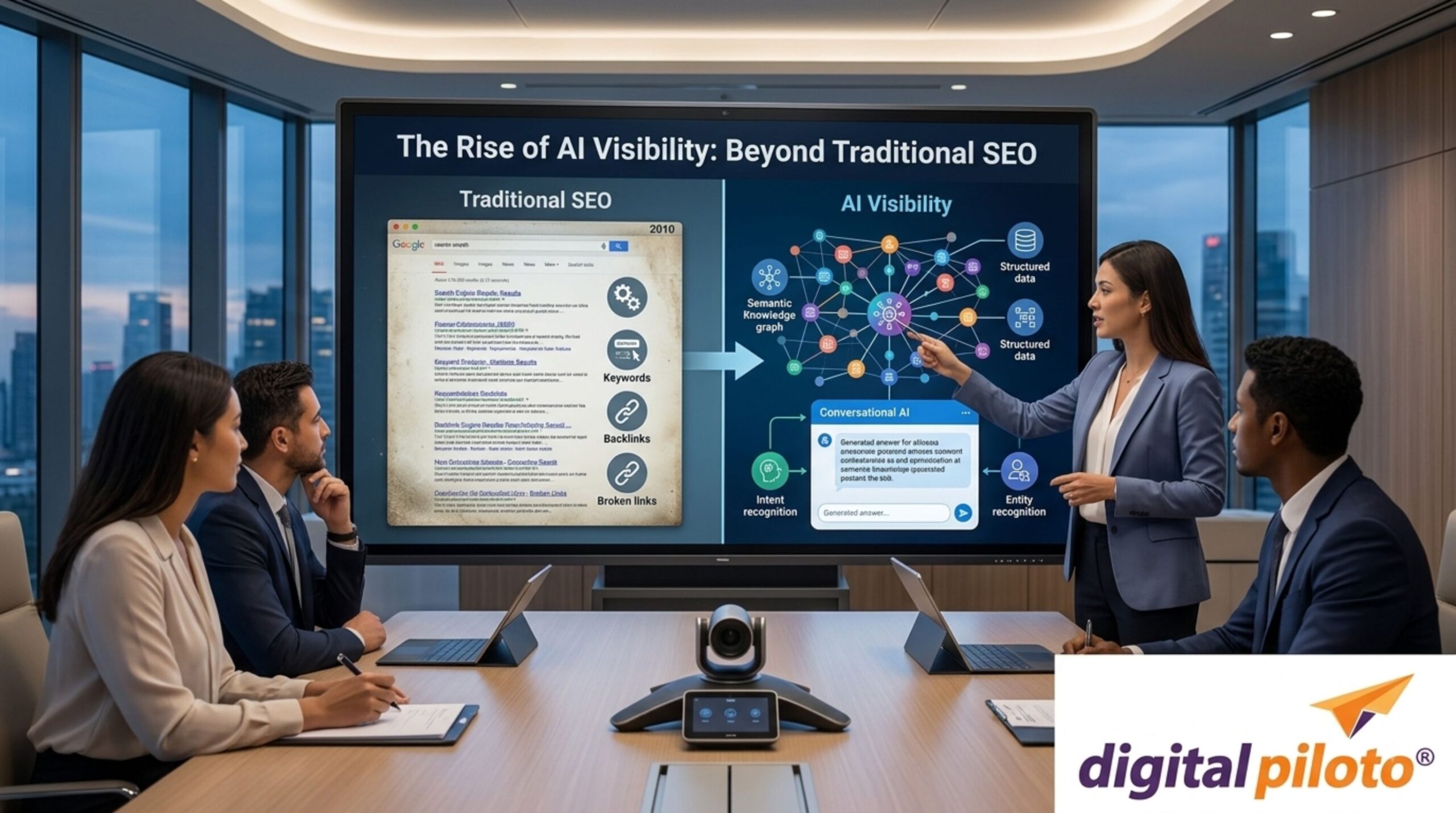
AI visibility is the ability of a brand to be discovered, understood, referenced, and recommended within AI-powered search and answer systems. It goes beyond traditional SEO by focusing not only on rankings, but also on brand entities, context, authority, structured information, and whether AI systems recognize a business as a relevant answer to a user’s question.
For a best digital marketing agency in Kolkata, this represents a fundamental shift in strategy. Search engines once acted mainly as gateways to websites. AI assistants can increasingly summarize information, compare options, answer questions, and influence decisions without sending users through the traditional ten-blue-links journey.
What Is AI Visibility?
AI visibility is a brand’s ability to appear accurately and meaningfully within AI-generated answers, recommendations, summaries, and conversational discovery experiences.
Traditional SEO asks whether a webpage can rank for a query. AI visibility asks a broader question: Does the AI understand this brand well enough to include it when the brand is relevant?
That difference is subtle but important.
A company might rank well for “enterprise SEO services” and still be poorly represented when someone asks an AI assistant, “Which SEO agencies are suitable for a multinational company with multiple regional websites?” The second question requires contextual understanding, not just keyword matching.
Why Traditional SEO Alone Is No Longer Enough
Traditional SEO remains essential. Technical accessibility, relevant content, links, page experience, and search intent still matter.
But AI-driven discovery introduces additional layers of interpretation. AI systems can synthesize information from multiple sources and respond to natural-language questions that do not always resemble conventional keyword queries.
This creates three important shifts:
- From keywords to concepts: AI can understand relationships between topics rather than relying solely on exact phrases.
- From rankings to references: A brand can gain visibility by being mentioned or cited within an AI-generated response.
- From pages to entities: AI systems need to understand the business, its expertise, products, people, locations, and relationships.
In other words, SEO gets a new layer: machine understanding.
What Makes a Brand Visible to AI?
There is no single “AI ranking factor.” Different systems use different models, retrieval methods, indexes, and sources.
However, several characteristics consistently improve a brand’s ability to be understood and surfaced.
1. Clear Entity Identity
AI systems should be able to distinguish your business from similarly named organizations and understand exactly what it does.
2. Strong Topical Authority
A company should demonstrate expertise around the subjects it wants to be associated with. One generic service page rarely provides enough context.
3. Consistent Information
Your website, business profiles, author pages, publications, reviews, and other trusted references should communicate compatible facts about the organization.
4. Independent Evidence
Third-party mentions, customer experiences, industry references, expert contributions, and credible publications can strengthen the overall evidence surrounding a brand.
5. Useful, Structured Content
Clear headings, concise answers, definitions, FAQs, lists, structured data, and logical internal linking help both users and machines understand important information.
How AI Visibility Works: A Step-by-Step View
AI visibility can be understood as a four-stage process.
Step 1: Discovery
The AI system encounters information about a brand through available data sources, websites, publications, business information, or retrieval systems.
Step 2: Interpretation
The system determines what the brand is, what it offers, who it serves, and which topics are associated with it.
Step 3: Relevance Matching
When a user asks a question, the system evaluates which brands, concepts, or sources are relevant to that particular context.
Step 4: Answer Generation
The AI produces a response that may mention, compare, recommend, summarize, or cite relevant brands and information.
This explains why simply publishing content is not enough. The content must contribute to a coherent understanding of the brand.
How to Build an AI-Visible Brand
The most effective approach is to build an interconnected information ecosystem rather than chase isolated AI mentions.
Step 1: Define Your Core Associations
Identify the services, industries, problems, locations, and areas of expertise that should be strongly associated with your brand.
For example, an agency may want to be recognized for technical SEO, AI search optimization, local SEO, and enterprise content strategy rather than simply “digital marketing.”
Step 2: Create Semantic Depth
Develop content that answers the questions surrounding your expertise. Include implementation guides, comparisons, case studies, frameworks, definitions, FAQs, and original insights.
Depth matters because AI systems need context. A single article claiming expertise is weaker than an ecosystem demonstrating it from multiple useful perspectives.
Step 3: Strengthen Your Entity Architecture
Clearly connect your organization with its people, services, locations, expertise, products, and relevant industry concepts.
This is where an AI SEO agency in Kolkata can help businesses align technical SEO, entity optimization, structured content, and AI-focused search strategy.
Step 4: Earn External Validation
Do not expect your own website to establish every aspect of your reputation. Relevant third-party references can provide important corroborating context.
Think industry publications, expert interviews, customer reviews, professional profiles, local references, partnerships, and genuine brand mentions.
AI Visibility and Content Strategy
AI-first content should be written for questions rather than keywords alone.
Instead of creating an article simply because a keyword has search volume, ask what decision or problem sits behind that search.
For example, “best CRM software” is broad. A stronger content strategy might address “best CRM for a five-person sales team,” “CRM with WhatsApp integration,” or “CRM for businesses migrating from spreadsheets.”
Specificity gives AI systems more context and gives users more useful answers.
- Answer the primary question early.
- Define complex concepts in plain language.
- Include practical examples and limitations.
- Connect related topics through internal links.
- Use original experience instead of generic summaries.
The Role of Paid Marketing in AI Visibility
AI visibility does not replace paid acquisition. In fact, paid campaigns can generate valuable insights about customer language, objections, offers, and high-converting intent.
A PPC company in Kolkata can identify which search themes generate qualified leads and use those insights to improve landing pages and broader content strategy.
For example, if customers consistently respond to “same-day service” rather than a generic service proposition, that insight can influence both paid messaging and organic content.
The strongest strategy is therefore integrated: paid search reveals demand, SEO builds discoverability, and AI visibility strengthens machine-mediated discovery.
An AI Visibility Framework for 2026
A practical way to assess your brand is the C.L.E.A.R. framework:
- C — Clarity: Can AI accurately identify what your brand does?
- L — Linkage: Are your brand, services, people, locations, and topics clearly connected?
- E — Evidence: Is your expertise supported by credible sources and real experience?
- A — Answerability: Does your content provide direct answers to meaningful customer questions?
- R — Relevance: Does the brand consistently fit the contexts in which you want to be recommended?
This is a better starting point than obsessing over whether a brand appeared in one AI answer yesterday. AI visibility should be evaluated as a long-term pattern of recognition and relevance.
What Should Businesses Measure?
AI visibility requires broader reporting than conventional ranking dashboards.
- Brand mentions in relevant AI responses
- Accuracy of AI-generated brand descriptions
- Relevant topics associated with the brand
- Competitor inclusion for the same prompts
- AI-driven referral and assisted conversions where measurable
- Changes in visibility across commercially important questions
Testing should be repeatable. Build a fixed prompt set based on real customer questions and monitor the results across time, models, and relevant markets.
FAQs About AI Visibility
What is AI visibility in digital marketing?
AI visibility is a brand’s ability to be accurately discovered, mentioned, cited, or recommended within AI-powered search and answer experiences.
Is AI visibility replacing traditional SEO?
No. Traditional SEO remains an important foundation. AI visibility expands the objective from ranking webpages to ensuring that AI systems can understand and appropriately reference the brand.
How can a brand improve its AI visibility?
Build clear entity information, publish authoritative and useful content, strengthen topical depth, maintain consistent business information, and earn credible third-party references.
Does structured data help AI visibility?
Structured data can make important information easier for machines to interpret, although it does not guarantee inclusion in AI-generated answers.
How should AI visibility be measured?
Use consistent customer-intent prompts and track brand mentions, factual accuracy, topic associations, competitor visibility, citations, and measurable business outcomes.
The Shift From Being Found to Being Understood
The rise of AI visibility does not mean traditional SEO is dead. It means the definition of digital visibility is getting wider.
For years, marketers optimized websites so search engines could find and rank them. Now, brands must also make their expertise, identity, evidence, and relevance understandable to systems that generate answers.
That is the real opportunity. The brands that win in AI-driven discovery will not necessarily be those that publish the most or chase every new optimization trick. They will be the ones that build clear, credible, connected, and genuinely useful digital knowledge.
In the AI era, visibility is no longer just about being found. It is about being understood well enough to become the answer.
Blog Development Credits
This article was conceptualized by Amlan Maiti, researched with support from ChatGPT, Google Gemini, and Copilot, and subsequently refined for SEO quality and optimization by Digital Piloto Private Limited.