

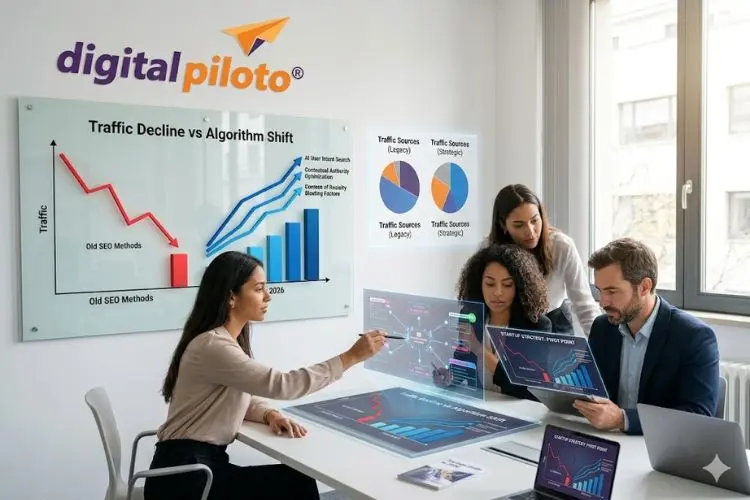
Did your startup’s organic traffic suddenly drop off a cliff this morning? Before you fire your content team or panic-pivot your product roadmap, take a deep breath. You might not actually be losing your audience; you are likely just catching the aftershocks of a massive, industry-wide algorithm evolution. Navigating this shift requires insights from an experienced Digital Marketing Consultant Kolkata to realign your digital footprint.
The 2026 Reality Check: Traffic Decline vs. Systemic Shifts
For years, growth marketing was simple: publish optimized blogs, build some backlinks, and watch your analytics dashboard climb. But in 2026, the traditional blue-link search engine results page (SERP) is rapidly giving way to direct, interactive AI responses. The old playbook is broken, and treating a systemic evolution like a routine penalty will only waste your precious runway.
A true traffic decline happens when your technical SEO breaks, or your content loses relevance against direct competitors. An algorithm shift, however, changes the rules of the entire game. Today, search engines aren’t just indexing webpages; they are synthesizing information to answer queries directly. If users find their answers right on the search page, they won’t click through to your site—resulting in what looks like a drop in traffic, but is actually a change in user behavior.
Why Startups Feel the Algorithmic Burn First
Startups are particularly vulnerable to these sudden core updates. Without the decades of legacy domain authority that enterprise brands rely on, small businesses must adapt fast. According to recent search landscape reports from authoritative analysis platforms like Search Engine Land, informational searches are yielding fewer website clicks globally, while high-intent transactional queries are becoming fiercely competitive.
To survive this transition, your web infrastructure must be flawless. If your platform suffers from slow loading times, poor mobile UX, or broken code, no amount of brilliant content will save you. Partnering with the Best Web Development Company in Kolkata ensures your site has the clean code, schema architecture, and rapid load speeds required to survive modern quality updates.
The Anatomy of a Modern Algorithm Pivot
When search engines shift their core weights, they look for specific trust signals. If you want to stop the bleeding, focus on these three core areas:
- Contextual User Intent: Matching the exact micro-moment of the searcher rather than targeting broad keyword phrases.
- Information Gain: Adding unique data, proprietary case studies, or contrarian expert opinions that an AI cannot simply scrape and replicate.
- Entities Over Keywords: Building a brand presence that search engines recognize as an authority within a specific niche.
Adapting to the Era of Generative AI Search Engine Optimization
The solution isn’t to stop doing SEO; it’s to change how you define it. We are firmly in the age of Generative AI Search Engine Optimization (GEO). This strategy focuses on optimizing your brand visibility not just for standard search indexes, but for the large language models and generative engines that power modern search summaries.
To optimize for generative engines, your content needs to be highly structured, factual, and deeply integrated with digital PR. When an AI bot pulls data to answer a user’s question, your startup needs to be cited as the definitive source. This requires a robust content hub strategy and clean information architecture.
Your 2026 Survival Checklist
If your startup is trying to recover from a recent visibility drop, pull your marketing team into a room and run through this strategic checklist:
- Audit Your Zero-Click Footprint: Look at how your brand appears in featured snippets, AI overviews, and knowledge panels. Visibility here often compensates for lost traditional clicks.
- Prioritize High-Intent Commercial Keywords: Shift your content creation toward transactional and commercial intent terms where users genuinely want to visit a website to buy, compare, or sign up.
- Implement Advanced Schema Markup: Make it incredibly easy for search bots to parse your pricing, product features, author bios, and company milestones.
Also Read: Machine-Level Brand Trust Signals: The New SEO Ranking Factor?
Frequently Asked Questions
Q. Why is my organic traffic dropping even though my rankings haven’t changed?
A. This is a classic symptom of an algorithm shift involving interactive AI features. If search engines are answering user queries directly on the SERP via AI overviews or enhanced snippets, users get the information they need without clicking your link. To fix this, pivot your content strategy toward deep-dive, action-oriented topics that require a full website visit.
Q. How can a startup compete with enterprise brands during massive core updates?
A. Startups have the advantage of agility. While enterprise companies take months to update content, you can pivot in days. Focus on hyper-niche, long-tail query clusters, publish original data or proprietary research, and ensure your site’s technical SEO foundation is perfectly optimized.
Q. What role does web development play in algorithm recovery?
A. Search engines prioritize user experience metrics like Core Web Vitals, secure HTTPS protocols, and clean mobile rendering. If your site
has technical debt, search engines will demote your pages during a core update. A fast, well-coded website is the baseline requirement for any successful recovery plan.
Q. Should I stop targeting high-volume informational keywords?
A. Not entirely, but you should change how you use them. Instead of relying on broad informational blogs for direct traffic, use them to build topical authority and fuel your email newsletters or retargeting funnels. Shift your primary organic traffic expectations toward high-intent, bottom-of-the-funnel keywords.
Final Thoughts
Traffic fluctuations in 2026 aren’t a sign to give up on organic growth—they are an invitation to innovate. By understanding the difference between a temporary technical drop and a permanent shift in search technology, your startup can build a resilient digital footprint that outlasts the competition. Stay adaptable, prioritize genuine user value, and build an authoritative brand that engines cannot afford to ignore.
Blog Development Credits:
This blog post was envisioned by Amlan Maiti and brought to life with the help of AI-driven tools such as ChatGPT, Gemini, and Copilot, followed by careful optimization from the SEO specialists at Digital Piloto Private Limited.