

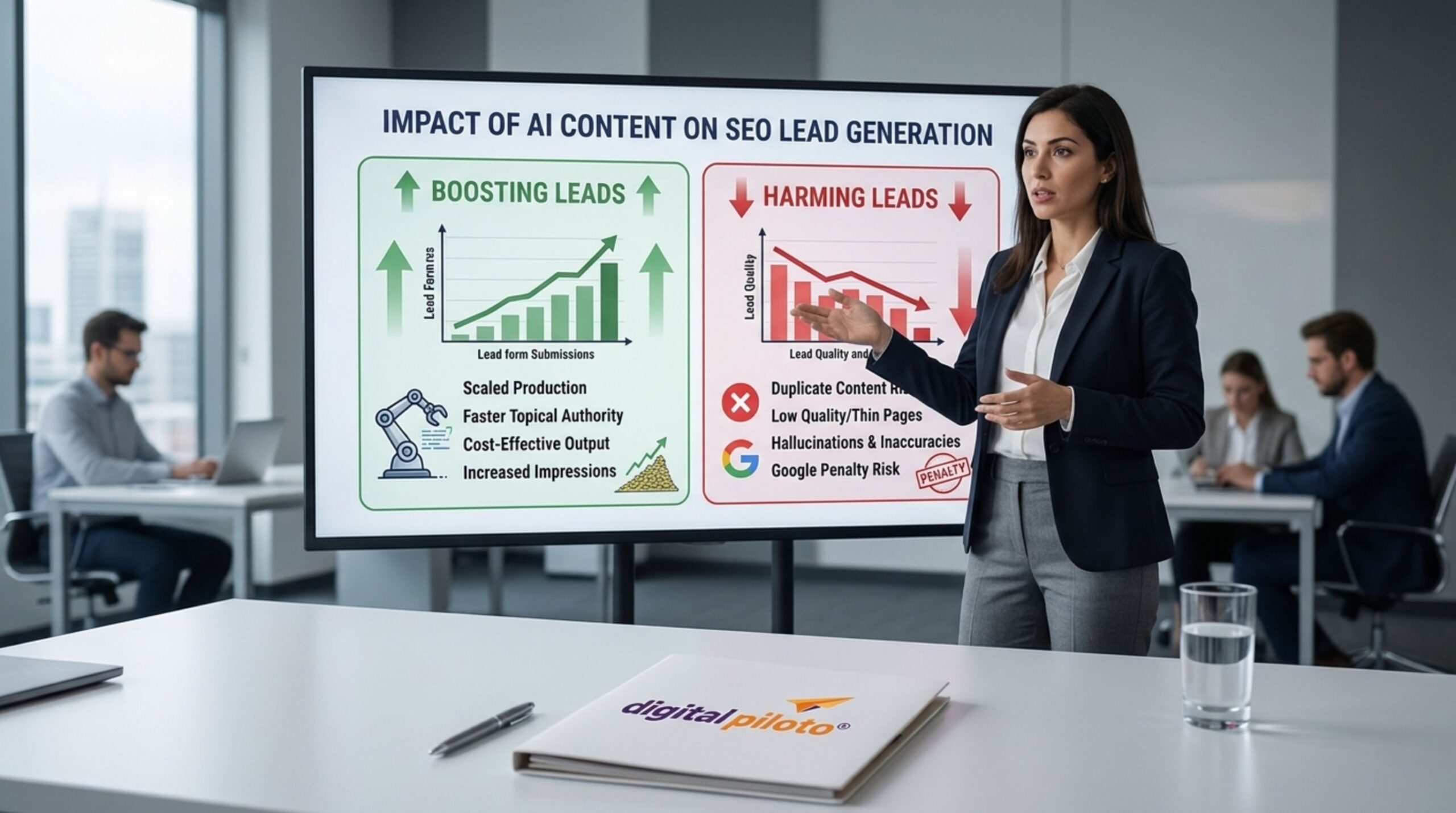
AI-generated content can boost SEO lead generation when it is accurate, useful, original, and shaped around real customer needs. It can hurt when businesses publish large volumes of generic, unchecked content that attracts the wrong audience or fails to build trust. The best approach is not “AI versus humans,” but using AI efficiently while keeping expertise and judgment human-led.
What Is AI-Generated Content in SEO?
AI-generated content is website content created wholly or partly with artificial intelligence tools, including articles, product descriptions, FAQs, landing-page drafts, and supporting resources.
Its SEO value does not come from the fact that AI produced it. Search performance depends on whether the finished content satisfies users, demonstrates useful knowledge, matches search intent, and provides information worth consuming.
That distinction matters. AI can make content production dramatically faster, but speed is not the same thing as search visibility or qualified leads.
How Can AI Content Improve Lead Generation?
The biggest advantage of AI is operational. A marketing team can research topics, create outlines, identify content gaps, summarize customer questions, and produce initial drafts much faster.
Used properly, that efficiency allows businesses to spend more time improving the parts that actually influence conversions.
1. It Helps Build Topic Coverage Faster
Businesses often know their core service but struggle to cover the questions customers ask before contacting them.
AI can help identify supporting topics around a central service, creating a more complete content ecosystem. For example, an SEO business might develop content around technical audits, local SEO, keyword intent, Google Business Profile optimization, and conversion-focused SEO.
2. It Can Accelerate Content Testing
Instead of spending days creating the first draft of every article, teams can use AI to develop several angles and then select the strongest one.
This is particularly useful for testing headlines, FAQs, content structures, calls to action, and different explanations of complex subjects.
3. It Can Support Personalization
AI can help adapt content for different industries, locations, customer stages, or use cases without requiring every piece to be written from scratch.
That becomes valuable when a business has clearly defined audiences and genuinely different needs between them.
Why Can AI Content Damage SEO Lead Generation?
The problem starts when AI becomes a publishing shortcut rather than a productivity tool.
Imagine publishing 100 articles that all explain familiar concepts using slightly different wording. The website may become larger, but it has not necessarily become more useful.
Worse, those pages may attract visitors who never had a realistic reason to buy from the business.
Common risks include:
- Generic information: Content repeats what users can find everywhere else.
- Weak expertise: Important claims lack original experience, evidence, or practical context.
- Search-intent mismatch: The article answers a different question from the one the visitor actually has.
- Fact errors: AI-generated claims can be inaccurate or outdated and require human verification.
- Low differentiation: The content sounds interchangeable with dozens of competing pages.
- Unqualified traffic: Broad informational topics may produce visits without meaningful commercial opportunities.
This is where a professional SEO company Kolkata should look beyond rankings and evaluate whether content is contributing to qualified organic demand.
AI Content Needs a Human Value Layer
The strongest AI-assisted content usually contains something the model could not simply invent from general knowledge: genuine experience.
That might be an unusual customer problem, an original framework, a lesson from a campaign, a comparison based on actual results, or an expert explanation of why a common recommendation fails.
Think of AI as the drafting engine. Human expertise provides the steering wheel.
Step-by-Step: Build AI Content That Generates Leads
- Start with a customer problem: Identify what your target buyer genuinely needs to understand or solve.
- Define search intent: Decide whether the user is learning, comparing options, evaluating providers, or ready to act.
- Use AI for research support: Generate outlines, question clusters, content angles, and initial drafts.
- Add proprietary insight: Include examples, processes, observations, data, opinions, and practical experience.
- Verify every important claim: Human review is essential for facts, statistics, technical details, and industry-specific statements.
- Connect content to the buyer journey: Give readers a logical next step rather than forcing an irrelevant sales pitch.
- Measure qualified outcomes: Track enquiries, calls, demos, sales opportunities, and revenue—not just organic sessions.
This workflow turns AI from a content-volume machine into a genuine marketing productivity system.
Traffic Is Not the Same as Lead Generation
One of the biggest mistakes businesses make with AI content is measuring success through traffic alone.
A broad article may attract thousands of visitors because the topic has substantial search demand. But if those visitors are students, researchers, early-stage browsers, or people outside the company’s market, the traffic has limited commercial value.
A smaller article targeting a specific business problem may attract fewer users and generate several strong enquiries.
The better metric is not “How much traffic did AI content generate?” but “What business value did that traffic create?”
How AI Content Can Strengthen the Conversion Journey
Content should not exist as an isolated SEO asset. It should help move a potential customer from uncertainty toward confidence.
A useful article might answer a technical question, demonstrate expertise, explain possible solutions, and then point the reader toward a relevant service or consultation.
That transition should feel natural. If someone reads a detailed guide about technical SEO problems and the next visible step is simply “Buy Now,” the journey feels disconnected.
AI can help create supporting content and variations, but humans should decide what the customer needs next.
Where Paid Search Data Can Help
Paid campaigns can provide useful evidence about which messages and search terms attract commercially relevant audiences.
A PPC company in Kolkata can use campaign data to identify search queries, landing pages, and messaging that generate stronger actions.
Those insights can influence AI-assisted SEO content. If paid search reveals that customers respond strongly to a particular service problem or benefit, organic content can explore that need more deeply.
In other words, AI content becomes more powerful when it is informed by real marketing data rather than produced in isolation.
What Should Businesses Automate—and What Should They Not?
A practical rule is simple: automate repetitive production tasks, not strategic judgment.
- Good candidates for AI: Outlines, topic clustering, content briefs, summaries, first drafts, FAQ ideas, and editorial variations.
- Keep human-led: Strategy, positioning, factual verification, original insights, expert claims, final editing, and conversion decisions.
- Measure separately: Rankings, organic traffic, engagement, qualified leads, sales opportunities, and revenue.
This balance allows a digital marketing agency in Kolkata to use AI for scale without sacrificing the strategic thinking that makes content commercially useful.
The Real Test: Would a Customer Find It Useful?
Before publishing AI-assisted content, ask a deliberately uncomfortable question: if search engines disappeared tomorrow, would a real customer still find this page worth reading?
If the answer is no, the content probably needs more substance.
Add a real example. Explain a difficult decision. Challenge a common assumption. Include a practical framework. Show what happens when a strategy goes wrong. These details create information value that generic AI prose usually lacks.
Frequently Asked Questions
Can AI-generated content rank on Google?
Yes. AI assistance itself does not determine whether content is useful. The important factors are quality, relevance, accuracy, originality, search intent, and the overall value provided to users.
Does AI content hurt SEO automatically?
No. The risk comes from low-quality, repetitive, inaccurate, or unhelpful content—not simply from using AI during the creation process.
Can AI-generated content generate leads?
Yes, when it targets relevant search intent, provides genuine value, attracts the right audience, and connects naturally to a useful conversion path.
Should humans edit AI-generated SEO content?
Yes. Human review helps verify facts, improve originality, add expertise, remove generic language, and ensure the content reflects the company’s actual customers and offer.
What is the biggest mistake businesses make with AI SEO?
The biggest mistake is prioritizing publishing volume over usefulness. Producing more pages does not automatically create more rankings, qualified traffic, or leads.
Conclusion
AI can make SEO content production faster, but it cannot replace the strategic reason behind creating the content. Businesses that use AI to scale research, drafting, and experimentation—while adding genuine expertise and measuring qualified leads—can gain a serious advantage. The goal is not to publish more content. It is to create more useful reasons for the right people to choose you.
Blog Development Credits
This article was conceived by Amlan Maiti, researched with AI tools, and finally refined for SEO quality by Digital Piloto Private Limited.