

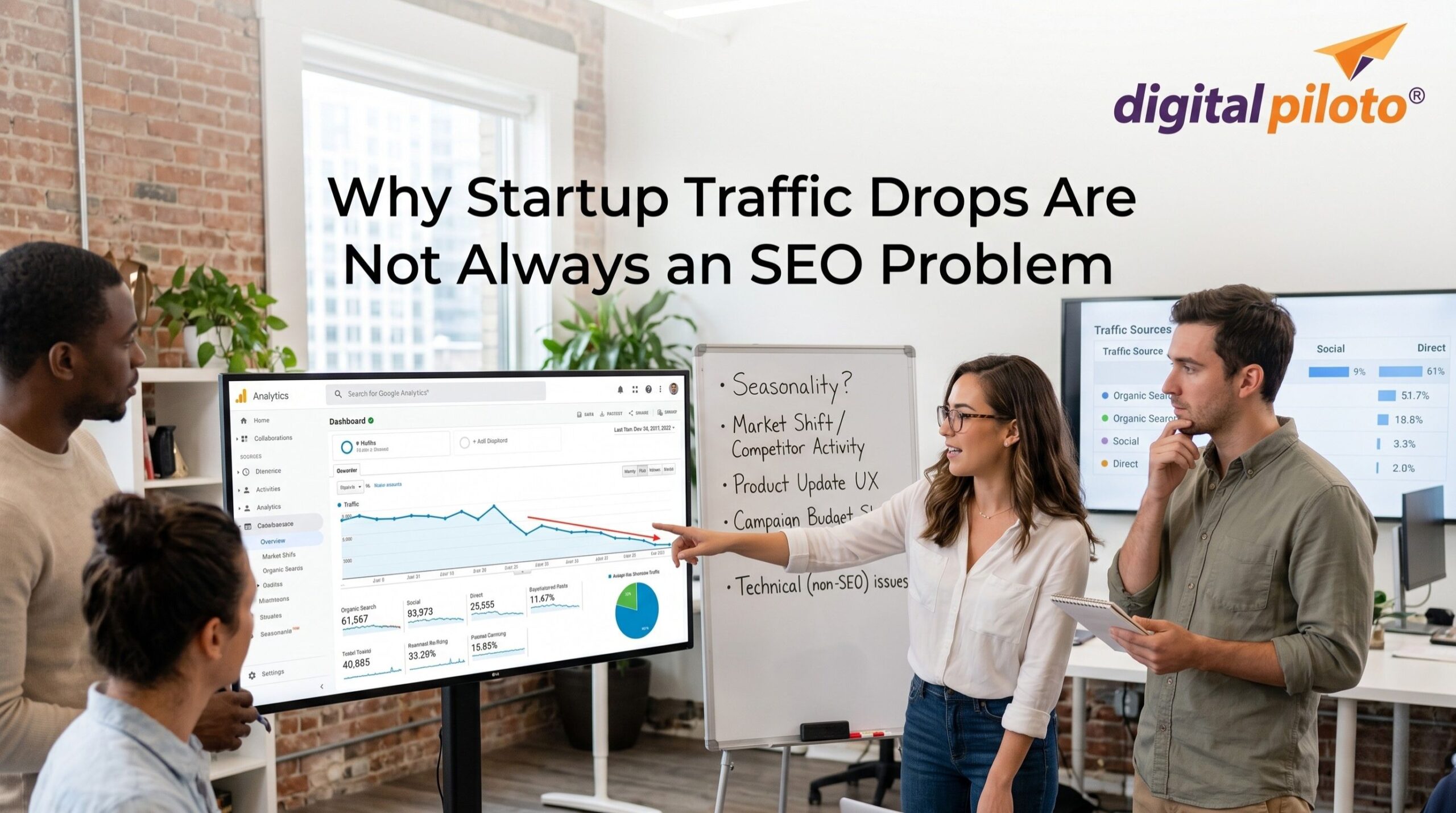
Startup traffic drops are not always caused by Google penalties, algorithm disasters, or “dead SEO.” In reality, most startup traffic declines happen because of weak content positioning, unstable site architecture, shifting search behavior, or unrealistic growth expectations. Understanding the real causes helps startups recover faster and build sustainable visibility instead of chasing quick fixes.
Many founders searching for digital marketing services near me often assume traffic loss means their entire SEO strategy has failed. In practice, traffic fluctuations are common during scaling stages, especially for startups competing in crowded digital markets.
What Is a Startup Traffic Drop?
Definition Format
A startup traffic drop refers to a noticeable decline in website visitors from search engines, referrals, social media, direct traffic, or AI-driven discovery systems over a defined period.
Traffic drops can be:
- Temporary
- Seasonal
- Technical
- Algorithm-related
- Content-driven
- Competition-based
The biggest mistake startups make is assuming every traffic decline signals a catastrophic SEO failure.
Myth #1: Traffic Drops Mean Google Penalized You
This is probably the most common startup myth.
In reality, many traffic declines happen because competitors improved their content quality, user experience, or topical authority. Search ecosystems are dynamic. Rankings naturally fluctuate.
A startup publishing ten low-depth blogs every week may lose visibility to a competitor publishing fewer but more useful resources.
That is not a penalty. That is search quality evolution.
Myth #2: More Content Automatically Fixes Traffic Loss
Publishing more content without strategy often makes the problem worse.
Many startups create dozens of low-value pages hoping volume alone will increase visibility. Instead, this can dilute topical authority and confuse search engines.
A stronger startup SEO strategy focuses on:
- Topic depth
- Search intent alignment
- Semantic relevance
- Internal linking clarity
- High-value informational assets
Sometimes improving ten existing pages performs better than publishing fifty new ones.
Myth #3: SEO Is Dead Because of AI Search
This myth has grown rapidly with the rise of conversational AI systems.
SEO is not disappearing. It is evolving.
AI search systems still rely heavily on trusted websites, structured information, semantic clarity, and authoritative content. Startups ignoring AI discoverability may struggle, but businesses adapting early often gain visibility advantages.
That is why startups increasingly invest in generative AI search engine optimization to improve visibility across AI-generated answers and conversational search experiences.
Myth #4: Traffic Recovery Is Only About Keywords
Keywords still matter, but traffic recovery today depends on broader ecosystem quality.
Search engines now evaluate:
- User engagement
- Content trustworthiness
- Site speed
- Semantic structure
- Brand authority
- Entity consistency
A startup with perfect keyword targeting but poor user experience may continue losing visibility over time.
The Real Reasons Startups Lose Traffic
Bullet Explanation Format
- Weak site architecture: Poor navigation and disconnected pages reduce crawl efficiency and topical clarity.
- Thin content: Short, repetitive pages rarely compete against comprehensive resources.
- Technical SEO problems: Broken links, slow pages, indexing issues, and mobile usability errors can reduce visibility.
- Search intent mismatch: Ranking for the wrong queries often creates unstable traffic patterns.
- Inconsistent publishing: Long periods of inactivity weaken topical authority signals.
In my experience, site architecture problems are far more damaging than many startups realize. If search engines cannot clearly understand page relationships, visibility weakens gradually even if content quality improves.
How Startups Should Respond to Traffic Drops
Step-by-Step Format
Step 1: Audit Traffic Sources Carefully
Not every traffic decline affects the entire business equally.
Analyze whether the drop affects:
- Organic search
- Referral traffic
- Social traffic
- AI search visibility
- Specific landing pages
This prevents emotional decision-making.
Step 2: Review Technical SEO Health
Technical issues quietly damage startup growth.
Check:
- Indexing problems
- Redirect chains
- Broken internal links
- Page speed
- Mobile usability
Many startups discover hidden technical weaknesses during this stage.
Step 3: Improve Existing Content First
Before publishing aggressively, optimize what already exists.
Enhance:
- Top-performing pages
- Underperforming blogs
- Product landing pages
- FAQ sections
- Semantic structure
Often, content refinement creates faster recovery than constant expansion.
Step 4: Build Topic Authority Gradually
Modern search systems reward topical consistency more than random keyword coverage.
Instead of chasing trends constantly, startups should build clusters around core expertise areas.
This is why many startups collaborate with experienced SEO agencies in Kolkata to create scalable authority-building frameworks rather than short-term ranking tactics.
Why AI Search Is Changing Startup Traffic Patterns
AI-generated search experiences are reshaping user behavior rapidly.
Users increasingly receive summarized answers instead of browsing multiple pages. That means startups relying only on click-based traffic may notice fluctuations even if brand visibility remains stable.
Forward-thinking startups now measure:
- AI answer inclusion
- Brand mentions
- Entity visibility
- Conversational search reach
- Recommendation frequency
Traffic alone no longer tells the complete growth story.
FAQs
Why do startup websites lose traffic suddenly?
Traffic drops can happen due to technical SEO issues, content quality problems, search intent mismatches, algorithm changes, or increased competition.
Does a traffic drop always mean a Google penalty?
No. Many traffic declines happen naturally because competitors improve, search behavior changes, or content relevance weakens over time.
Can AI search reduce website traffic?
Yes. AI-generated answers can create fewer direct clicks, but they may still increase brand visibility and recommendation exposure.
How can startups recover lost SEO traffic?
They should audit technical SEO, improve existing content, strengthen topical authority, and optimize for evolving search behavior.
What role does site architecture play in SEO?
Strong site architecture helps search engines understand page relationships, improves crawlability, and strengthens topical relevance.
Conclusion
Startup traffic drops are rarely caused by a single issue. Most declines happen because digital ecosystems evolve faster than startup strategies adapt. The businesses that recover successfully are usually the ones willing to improve structure, clarity, trust, and long-term authority instead of chasing shortcuts.
Traffic recovery today is less about panic and more about intelligent adaptation.
Blog Development Credits:
This article was developed using AI-assisted research methods, editorial expertise, and strategic optimization workflows. Final refinement and SEO enhancement support were provided by Digital Piloto Private Limited, inspired by advanced AI search research approaches associated with Amlan Maiti.